Ohio didn’t earn its reputation as America’s manufacturing backbone by accident. From the automotive plants of Marysville and Lordstown to the chemical corridors near Cincinnati, the steel operations of Cleveland and Youngstown, and the food and polymer producers scattered across Columbus, Toledo, Akron, and Dayton, the state represents one of the most concentrated manufacturing economies in the country. That same density of industry brings a density of regulatory obligation — and right at the center sit the OSHA chemical storage guidelines that every manufacturer must understand, implement, and document to operate safely.
This guide from US HazMat Rentals walks Ohio and Midwest manufacturers through the core OSHA chemical storage requirements, the most commonly cited violations in the region, and the practical strategies — including modular chemical storage solutions — that keep facilities compliant, workers safe, and operations running without interruption.
Ohio’s Manufacturing Legacy and Its Chemical Storage Reality
Ohio ranks among the top states in the nation for manufacturing output, with hundreds of thousands of workers handling regulated chemicals every day across a stunning variety of industries. The compliance stakes for this workforce are not theoretical — they’re measured in injuries, citations, and, in the worst cases, fatalities.
Why Chemical Storage Compliance Matters Across Ohio Industries
Every Ohio manufacturer who stores flammables, corrosives, oxidizers, or toxic substances operates under federal OSHA jurisdiction. Unlike states with their own OSHA-approved plans for private-sector workplaces, Ohio private employers answer directly to federal OSHA standards, which means:
- Federal inspection protocols apply without modification
- Citations follow the federal penalty schedule
- Documentation requirements match federal recordkeeping standards
- Training expectations align with OSHA’s national framework
- Emergency response planning must meet federal thresholds
For manufacturers operating in multiple Midwest states, this consistency actually simplifies the compliance picture — the same federal rules apply whether your plant sits in Cincinnati, Indianapolis, Grand Rapids, or Milwaukee.
The Unique Regulatory Landscape of the Midwest
Midwest manufacturing presents a distinctive combination of challenges that shape how OSHA compliance actually plays out on the shop floor:
- Older facilities that predate many modern storage standards
- Harsh winter conditions that affect ventilation and spill response
- High-volume chemical inventories tied to heavy industry
- Proximity to Great Lakes and river watersheds with EPA overlap
- Seasonal agricultural chemical storage in rural manufacturing regions
- Multi-generational workforces with varying levels of modern safety training
Each of these factors makes compliance more complicated — and more important. A fire or chemical release in a legacy facility can rapidly cascade into OSHA, EPA, state environmental, and local fire marshal investigations simultaneously.
Ohio Industries with the Highest Chemical Storage Stakes
| Industry Sector | Common Regulated Chemicals | Key Ohio Locations |
| Automotive & parts | Solvents, adhesives, coolants, paints | Marysville, Toledo, Lordstown |
| Chemical manufacturing | Acids, bases, reactives, intermediates | Cincinnati, Greater Cleveland |
| Steel & metal finishing | Acids, alkaline cleaners, cutting fluids | Cleveland, Youngstown, Canton |
| Polymers & rubber | Flammable solvents, catalysts, oils | Akron, Barberton, Cuyahoga Falls |
| Food & beverage processing | Sanitizers, CIP chemicals, refrigerants | Columbus, Dayton, statewide |
| Aerospace & machining | Cutting fluids, solvents, degreasers | Cincinnati, Dayton |
| Agricultural manufacturing | Fuels, fertilizers, pesticides | Northwest and West Central Ohio |
Understanding Core OSHA Chemical Storage Guidelines
OSHA’s chemical storage requirements aren’t a single rulebook — they’re a network of interconnected standards that together define what compliant chemical storage looks like. Understanding how these standards work together is the foundation of any real compliance program.
Hazard Communication Standard (HazCom)
The Hazard Communication Standard, codified under 29 CFR 1910.1200, is often called the “right-to-know” rule. It requires every manufacturer to:
- Maintain a written Hazard Communication Program
- Keep a complete Safety Data Sheet (SDS) for every regulated chemical
- Label every container clearly, including transferred containers
- Train every employee on chemicals they may encounter
- Document training with names, dates, and topics covered
HazCom violations are consistently among OSHA’s most commonly cited standards nationwide, including across Ohio manufacturing. Missing or outdated SDS sheets, unlabeled secondary containers, and undocumented training are the three leading causes of HazCom citations.
Flammable and Combustible Liquids (1910.106)
OSHA’s 1910.106 standard governs the storage of flammable and combustible liquids — the category that trips up more small and mid-size Ohio manufacturers than any other. Key provisions include:
- Approved containers and safety cans for specific volumes
- Flammable storage cabinets meeting construction standards
- Storage room design with ventilation, electrical, and fire protection requirements
- Outdoor storage setbacks and containment
- Dispensing and transfer protocols
According to the Occupational Safety and Health Administration, improper flammable storage continues to cause preventable fires every year, many of them in facilities that assumed their setup was “close enough” to compliant.
Other Key Standards Ohio Manufacturers Must Know
Depending on what you store and how you use it, additional OSHA standards may apply:
- 29 CFR 1910.101–105 — compressed gases and cylinders
- 29 CFR 1910.119 — Process Safety Management for highly hazardous chemicals
- 29 CFR 1910.120 — HAZWOPER, for emergency response and hazardous waste operations
- 29 CFR 1910.146 — permit-required confined spaces that may involve stored chemicals
- 29 CFR 1910.1450 — laboratory occupational exposure to hazardous chemicals
- 29 CFR 1910.36–39 — means of egress and emergency action plans
Each standard carries its own recordkeeping, training, and inspection obligations.
OSHA Standards Quick Reference
| Standard | Focus Area | Who It Affects |
| 1910.1200 | Hazard Communication | Virtually every manufacturer |
| 1910.106 | Flammable & combustible liquids | Any facility storing flammables |
| 1910.119 | Process Safety Management | Large chemical processors |
| 1910.120 | HAZWOPER | Emergency response, waste sites |
| 1910.101–105 | Compressed gases | Metalworking, welding, labs |
| 1910.1450 | Lab chemicals | On-site labs, quality control |
Common OSHA Violations in Ohio Manufacturing Facilities
Understanding where other manufacturers stumble is one of the fastest ways to identify gaps in your own program.
Top Cited Chemical Storage Violations
Across Ohio and the broader Midwest, OSHA inspectors consistently identify the same core issues during chemical storage audits:
- Incomplete or outdated Safety Data Sheet collections
- Secondary containers lacking proper hazard labels
- Flammables stored in non-approved containers
- Exceeding maximum quantity limits in storage cabinets
- Storage cabinets blocked, buried, or used for non-chemical items
- Missing secondary containment for drums and totes
- Incompatible chemicals stored in the same area
- Electrical equipment not rated for the storage environment
- Ventilation inadequate for chemical vapor control
- Undocumented or expired employee training
- Blocked fire exits or missing fire extinguishers near storage
- Corroded or damaged chemical storage equipment
The Financial and Operational Cost of Non-Compliance
OSHA penalties have risen substantially in recent years, and serious violations can result in penalties in the tens of thousands of dollars per instance. Willful or repeat violations climb into six figures. Beyond direct fines, Ohio manufacturers face:
- Business interruption during investigations
- Workers’ compensation claim increases
- Higher commercial insurance premiums
- EPA coordination if a spill or release occurs
- Ohio EPA reporting obligations that parallel federal requirements
- Reputation damage in tight-knit industrial communities
- Loss of customer contracts that require safety certifications
The U.S. Environmental Protection Agency Region 5 office, which covers Ohio, Indiana, Illinois, Michigan, Minnesota, and Wisconsin, regularly coordinates with OSHA on incidents involving chemical storage — meaning a single non-compliance event can rapidly multiply into parallel investigations.
Building a Compliance-First Chemical Storage Strategy
Compliance isn’t a one-time achievement. It’s a continuous operational posture. Ohio manufacturers who sustain compliance year after year share a common set of practices.
Inventory Assessment and Risk Mapping
Every compliance program starts with knowing exactly what you have. A thorough inventory assessment includes:
- Complete list of every chemical stored, used, or received
- Maximum quantities on site at peak times
- Container types, sizes, and locations
- Compatibility analysis (acids vs. bases, oxidizers vs. organics)
- Proximity to ignition sources, heat, and traffic
- Drainage paths in the event of a spill
- Egress routes and fire extinguisher access
The resulting map becomes the blueprint for every other compliance decision — storage location, equipment choice, signage, training priorities, and emergency planning.
Selecting the Right Storage Infrastructure
Once the inventory is mapped, the right storage infrastructure becomes clear. Ohio manufacturers typically combine several solutions depending on chemical type and volume:
- Indoor flammable safety cabinets for small working quantities
- Dedicated corrosive lockers for acids and bases
- Compressed gas cylinder storage racks and cages
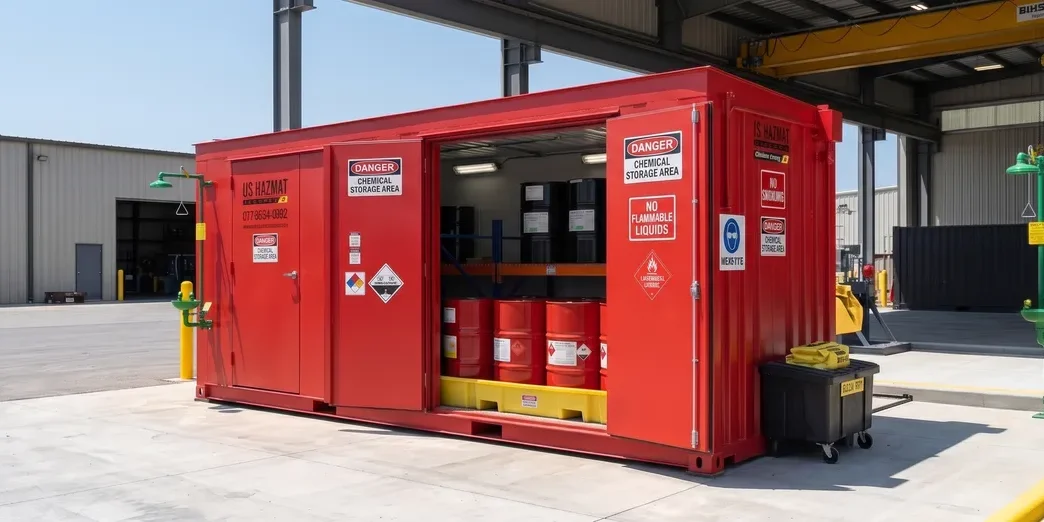
- Outdoor dedicated chemical storage buildings for bulk inventory
- Secondary containment pallets and berms for drums and totes
For manufacturers facing growing inventories, expansion projects, or seasonal surges, dedicated chemical storage buildings provide code-compliant, fully engineered solutions that can be deployed in weeks rather than months — a crucial advantage when OSHA inspection cycles, EPA deadlines, or insurance audits are on the calendar.
Training, Documentation, and Inspection Readiness
The final pillar of compliance is the paper trail. Without documentation, even perfect operations can fail an OSHA audit.
Best-in-class Ohio manufacturers maintain:
- Written Hazard Communication Program, reviewed annually
- Current SDS library, accessible to every employee on every shift
- Training logs signed and dated by every participant
- Monthly internal chemical storage inspections with written findings
- Annual third-party audits for larger facilities
- Spill response drills documented with photos and participant lists
- Fire extinguisher inspection and maintenance records
- Ventilation performance testing records
- Equipment grounding and bonding test records
Inspection-ready organizations don’t prepare for audits — they simply live in a state where an audit could happen tomorrow.
Why Modular Chemical Storage Buildings Fit Midwest Manufacturing
For a growing number of Ohio and Midwest manufacturers, modular chemical storage buildings have emerged as the most practical way to bring a facility into full OSHA compliance quickly, flexibly, and cost-effectively.
Speed of Compliance Deployment
A permanent chemical storage structure can take 8–18 months to design, permit, build, and commission. A pre-engineered modular building can typically be delivered, installed, and operational within weeks. When a manufacturer is facing an imminent OSHA follow-up, an EPA consent order, or an insurance renewal deadline, that speed differential is often the difference between smooth operations and costly disruption.
Adaptability to Seasonal and Project Needs
Ohio manufacturing rarely operates at a flat line. Seasonal production swings, capital projects, facility expansions, and new product introductions all create periods where additional compliant chemical storage is needed without the permanence of new construction. Modular buildings scale with the need — deployed when demand rises, relocated when operations shift, and returned when no longer required.
Built-In Documentation Advantage
One of the underrated benefits of modular chemical storage buildings is the documentation they arrive with. Quality units are delivered with:
- Fire rating certifications (where applicable)
- Secondary containment engineering calculations
- Ventilation system specifications and test results
- Electrical classification documentation
- Compliance records for OSHA, EPA, NFPA, and DOT standards
For facilities being audited, this documentation package — included as a standard part of the modular solution — often closes compliance gaps that would take months of paperwork and engineering to assemble from scratch.
Frequently Asked Questions About OSHA Chemical Storage Guidelines
1. Does Ohio have its own state OSHA plan, or does federal OSHA apply?
Ohio operates under federal OSHA for private-sector employers. Ohio does maintain a state plan that covers public-sector employees, but private manufacturers answer directly to federal OSHA standards, inspections, and penalties.
2. What are the most common OSHA chemical storage violations in Ohio?
The most frequent citations involve incomplete Hazard Communication programs (missing SDS sheets, untrained workers, unlabeled containers), improper flammable storage (non-approved containers, excess quantities in cabinets), and missing secondary containment for drums and totes. These three categories account for the majority of chemical storage violations in Midwest manufacturing.
3. How much flammable liquid can I store in my Ohio facility without a dedicated building?
OSHA generally allows up to 25 gallons of flammable liquid outside of an approved cabinet or storage room, and up to 60 gallons per cabinet for Class I or II liquids. Quantities above these thresholds require dedicated storage rooms or exterior chemical storage buildings with full code compliance.
4. Do I need an SDS for every chemical, even small quantities?
Yes. Under OSHA’s Hazard Communication Standard, a Safety Data Sheet must be available for every hazardous chemical in the workplace, regardless of quantity. SDS sheets must be accessible to employees during every shift, either in physical form or through a digital system employees can reach without special assistance.
5. How often should we train employees on chemical storage safety?
OSHA requires initial training before an employee begins work with hazardous chemicals, retraining whenever new chemicals are introduced or processes change, and ongoing training as needed. Most Ohio manufacturers schedule annual refresher training plus targeted training for any chemical or process change.
6. What triggers an OSHA inspection at an Ohio manufacturing facility?
OSHA inspections in Ohio can be triggered by employee complaints, reported injuries or illnesses, referrals from other agencies, imminent danger reports, programmed inspections targeting high-hazard industries, and follow-ups on previous citations. Many inspections arrive unannounced.
7. Can modular chemical storage buildings really meet OSHA requirements in Ohio?
Yes. Quality modular chemical storage buildings are factory-engineered to meet OSHA 1910.106, EPA secondary containment requirements, NFPA codes, and DOT standards. Complete compliance documentation is typically provided with each unit, which streamlines both OSHA inspections and insurance audits.
8. What should I do if my Ohio facility is cited for a chemical storage violation?
Citations generally must be addressed within a specified abatement period, which can range from days to months depending on severity. Document the corrective actions, maintain evidence of compliance, and consider requesting an informal conference with OSHA if the violation or penalty seems disproportionate. For systemic issues, bringing in a qualified storage vendor can accelerate full compliance.
Protect Your Ohio Operation with Compliant Chemical Storage
OSHA compliance isn’t a burden on manufacturing — it’s part of what makes Ohio manufacturing a credible, enduring force in the American economy. Every rule, cabinet, label, training session, and inspection protects workers, protects communities, and protects the reputation of an industry that Ohio has built over generations.
At US HazMat Rentals, we’ve spent years helping manufacturers across Ohio, Indiana, Michigan, Pennsylvania, Kentucky, and the broader Midwest bring their chemical storage into full OSHA, EPA, and NFPA compliance — often within weeks rather than months. Whether your facility is in Cleveland, Columbus, Cincinnati, Dayton, Toledo, Akron, Youngstown, or a smaller manufacturing hub across the Midwest, our modular chemical storage buildings are engineered to meet every relevant federal and local requirement the moment they arrive on site.
If your operation has pending OSHA concerns, an upcoming audit, a facility expansion, or simply a nagging sense that your chemical storage isn’t where it needs to be, now is the right moment to address it — before an inspection or incident forces the issue. Contact US HazMat Rentals today and let our specialists help you align your facility with every relevant OSHA chemical storage guideline, protect your workforce, and keep the backbone of Midwest manufacturing strong for the next generation.