In the high-stakes world of industrial operations, a single leak from a 55-gallon drum isn’t just a maintenance headache—it’s a potential environmental disaster and a regulatory nightmare. Understanding osha secondary containment requirements is the bedrock of a proactive safety strategy. Whether you are managing a small workshop in North Carolina, or a massive chemical distribution center in New Jersey, the principle of “bunded storage” remains the same: you must have a backup plan for when primary containers fail.
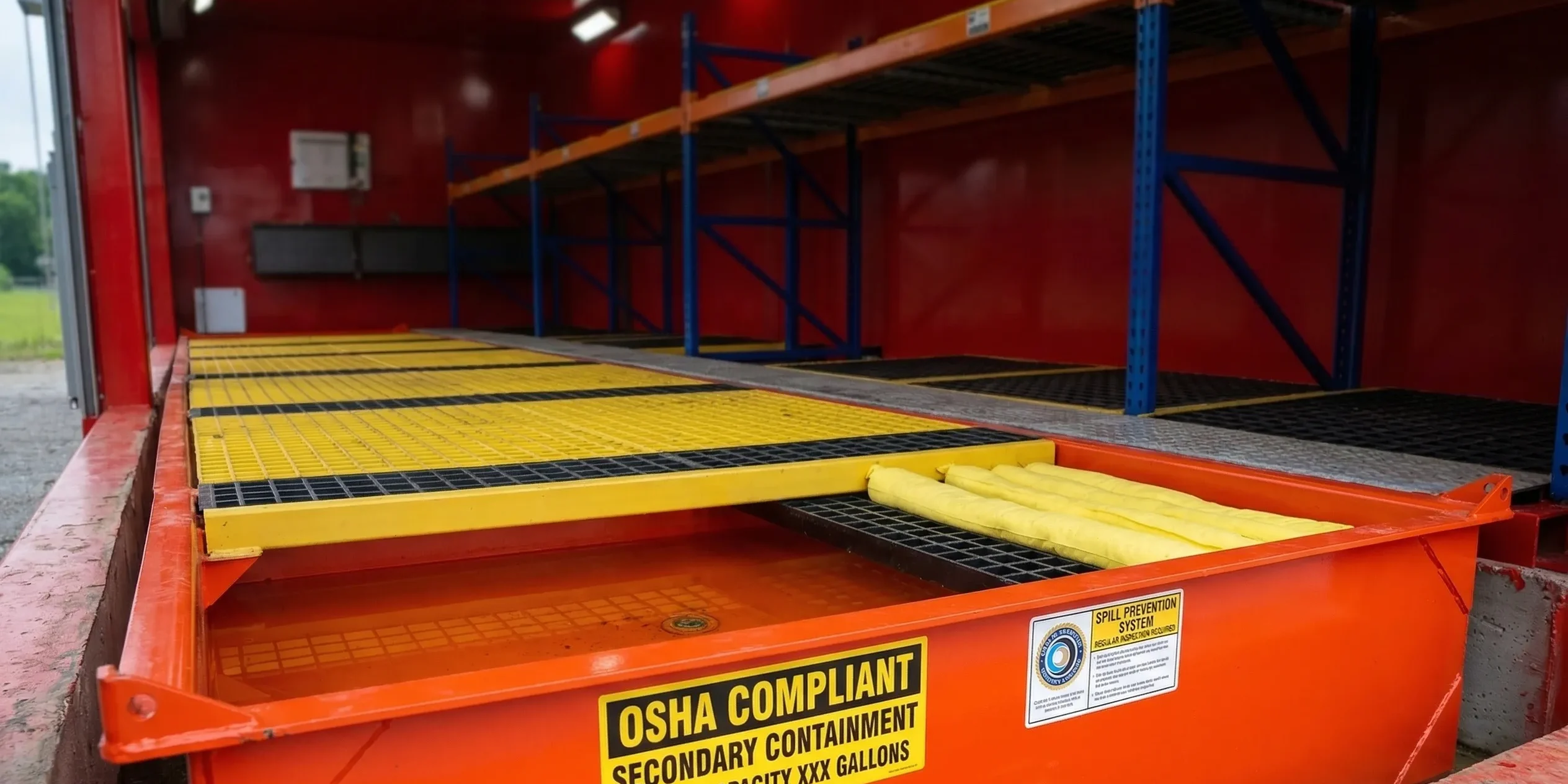
Secondary containment is essentially a “fail-safe” system. It is the outer shell, the spill pallet, or the spill berm designed to catch hazardous substances before they reach the floor, the drain, or the soil. By implementing high-quality hazardous materials storage area protocols, you demonstrate a commitment to environmental stewardship—a principle that not only satisfies inspectors but also builds immense trust with your local community and stakeholders.
The Regulatory Landscape: OSHA vs. EPA
While users often search for “OSHA rules,” it is vital to recognize that secondary containment is governed by a “Dual-Agency” framework in the United States.
- OSHA (29 CFR 1910.106 & 1910.120): OSHA’s primary focus is worker safety. They require containment to prevent fire hazards and “slip and fall” accidents caused by leaks.
- EPA (40 CFR 264.175): The EPA focuses on environmental protection. Their Resource Conservation and Recovery Act (RCRA) standards are often more specific regarding the actual volume and construction of containment systems.
When you align your facility with both, you create a “Fortress of Compliance” that protects your bottom line from heavy fines and your reputation from the fallout of an environmental spill.
Breaking Down OSHA Secondary Containment Requirements
OSHA’s regulations are designed to ensure that hazardous liquids do not create a dangerous environment for employees. Under 29 CFR 1910.106, OSHA mandates that “leakage and spills shall be confined to the storage area.”
The “Common Sense” Safety Rule
OSHA expects that if a drum leaks, the liquid will not migrate into walkways or near ignition sources. This is where bunded storage becomes essential. A “bund” is simply a secondary perimeter (like a wall or a sloped pallet) that keeps the spill localized.
Requirements for 55-Gallon Drums
The 55-gallon drum is the workhorse of the chemical industry, but it is also the most common source of spills. To meet osha secondary containment requirements, facilities must ensure:
- Stability: Drums must be stored on level surfaces to prevent tipping.
- Accessibility: Containers must be organized so that leaks can be identified immediately.
- Prompt Cleanup: Any liquid caught in the secondary containment must be removed promptly to maintain the system’s capacity.
EPA 40 CFR 264.175: The “Rule of 10%” and “100%”
While OSHA is broad, the EPA is mathematically precise. For a containment system to be considered “compliant” for hazardous waste, it must meet specific volume benchmarks. According to EPA.gov, the containment system must be able to hold the larger of two specific volumes.
Calculating Your Required Containment Capacity
To stay compliant, your bunded storage must adhere to the following logic:
- The 100% Rule: The system must be able to contain 100% of the volume of the largest single container in the storage area.
- The 10% Rule: The system must be able to contain at least 10% of the total volume of all containers combined in that specific area.
- The “Greater Of” Logic: If you have four 55-gallon drums, 100% of the largest is 55 gallons, while 10% of the total (220 gallons) is only 22 gallons. In this case, your containment must be at least 55 gallons.
- Large Scale Storage: If you have twenty 55-gallon drums, 100% of the largest is still 55 gallons, but 10% of the total (1,100 gallons) is 110 gallons. In this scenario, you need a minimum of 110 gallons of containment.
This “Rule of Thumb” is critical when selecting spill pallets or renting specialized storage lockers. If your containment is undersized, you are technically out of compliance the moment you add one extra drum to the area.
Bunded Storage: Methods and Materials
“Bunded storage” refers to the physical barrier used to contain spills. Depending on your facility’s layout and the chemicals involved, you may choose different methods.
1. Permanent Concrete Bunds
For large-scale permanent installations, concrete dikes are common. However, concrete must be coated with a chemical-resistant sealant, as many acids and solvents can eat through raw concrete over time.
2. Modular Spill Pallets
These are the most popular choice for 55-gallon drums. Made of high-density polyethylene (HDPE), they are impervious to most chemicals and easy to move with a forklift.
3. Portable Spill Berms
When you need flexibility, spill berms are the ideal solution. These are essentially “collapsible bunds” made of heavy-duty PVC or geomembrane materials. They are perfect for temporary storage during facility maintenance or vehicle refueling stations.
The Strategic Use of Spill Berms and Flexible Containment
One of the biggest challenges in osha secondary containment requirements is handling “Transient Hazards”—materials that are moved frequently. Hard-walled containment isn’t always practical for a truck-mounted tank or a temporary pumping station.
Why Spill Berms are Essential
Spill berms allow for “Drive-In/Drive-Out” capability. Specialized berms with foam or “L-bracket” walls can be flattened to allow a vehicle to park over them, then popped back up to provide full containment. This is a classic example of “Liking” in safety culture—workers are more likely to use safety equipment if it doesn’t significantly hinder their workflow.
Maintaining Containment Integrity
A containment system is only as good as its last inspection. Per the Environmental Protection Agency, containment areas must be free of cracks and gaps. If you are using flexible berms, ensure they are checked for punctures or “UV degradation” if used outdoors.
Technical Standards for Containment Liners
When dealing with highly aggressive chemicals, the material of your spill berm or liner matters. Using the wrong liner is a “Hidden Risk” that can lead to catastrophic failure.
- Polyurethane: Excellent for fuel and oil containment.
- XR-5 / Reinforced Materials: Designed for long-term outdoor exposure and extreme chemical resistance.
- PVC: A cost-effective solution for short-term projects involving non-corrosive liquids.
Always consult the Safety Data Sheet (SDS) for your specific chemicals before selecting a containment solution.
FAQs: Navigating OSHA and EPA Containment Rules
1. Does OSHA require secondary containment for all chemicals?
OSHA specifically requires it for flammable and combustible liquids (1910.106) and for hazardous waste operations (HAZWOPER). However, under the “General Duty Clause,” OSHA can cite employers for any liquid spill that creates a recognized hazard.
2. Can I use a regular wooden pallet for 55-gallon drums?
A wooden pallet provides stability but zero containment. If you store drums on wood, you must place that pallet inside a larger bunded area or a spill berm.
3. What is the difference between a spill pallet and a spill berm?
A spill pallet is a rigid platform usually used for 1-4 drums. A spill berm is a larger, often flexible containment area used for large equipment, tanks, or entire vehicle fleets.
4. Do outdoor containment areas need covers?
The EPA requires that containment areas are managed to prevent “run-on” from rainwater. If an outdoor area is uncovered, it must have enough extra capacity to hold the secondary containment volume plus the rainfall from a 25-year, 24-hour storm.
5. How do I drain a spill berm after a rainstorm?
If the water is uncontaminated, it can be drained. However, many facilities use “filter valves” that allow water to pass but lock shut if oil or chemicals are detected.
Securing Your Operations with US Hazmat Rentals
Managing osha secondary containment requirements doesn’t have to be a burden on your operational speed. By integrating smart bunded storage solutions and flexible spill berms, you transform your facility into a model of industrial safety. Whether you are managing compliance in Chicago, IL, Phoenix, AZ, or Atlanta, GA, the standard for safety is universal.
At US Hazmat Rentals, we specialize in providing “Authority-Backed” containment solutions that bridge the gap between “doing enough” and “exceeding expectations.” Protect your team, your facility, and the environment with one decisive move.
Need to secure your 55-gallon drums immediately? Contact US Hazmat Rentals today