How to store batteries the right way is not a question about shelf height or temperature labels. It is a question about code compliance, site chemistry, and hazard separation, and it has to be answered before the first unit arrives on-site. Compliance problems with battery storage often arise not from ignorance of the rules but from failure to recognize that batteries are potentially hazardous. A typical case is the rack-mounted battery in the server room that powers the UPS.
These types of energy storage also consist of multiple electrochemical cells that can generate flammable gases, produce heat faster than can be dissipated by cooling systems and burn with a fire type that is not easily extinguished by typical Class B fire suppression systems used to fight fires involving normal combustible liquids and gases.
The cost effective chemistry has decreased in cost but increased in energy density. The resulting hazard must now be stored in facilities and spaces not previously designed to contain battery storage. Code compliance for the storage of these batteries in these various facilities and spaces is defined in a relatively new body of code that gap between old construction and new regulation is exactly where compliance problems develop.
Every week we receive calls from EHS managers who are two weeks away from a delivery date and suddenly realize that they don’t have a storage plan in place. They may be looking at how to store batteries in close proximity to their flammable liquids storage or seeking alternative locations to store their BESS enclosure in close proximity to their existing chemical storage, how to satisfy an AHJ that is seeing lithium battery permit applications for the first time. Those are the conversations we have at US Hazmat Rentals every week.
Why NFPA 855 Sets the Framework
NFPA 855, Standard for the Installation of Stationary Energy Storage Systems, is the generally adopted code for compliance of battery energy storage systems in most U.S. jurisdictions. The code specifies maximum allowable energy per control area, minimum separations from adjacent occupied spaces and other chemical storage, construction classification for dedicated battery rooms, suppression system specifications, and the ventilation and monitoring requirements that must be in service before a system goes live.
It is very important to note that NFPA 855 is not the local fire code. It is a standard that local AHJs can adopt and then amend and add to as necessary based on factors such as the type of occupancy where the batteries will be stored, local experience with stored energy fires, and other factors related to the specific risk associated with the installation under review. Work from the ceiling, not the floor facilities relying solely on NFPA 855 for battery storage information are missing the local AHJ information added on top. Information required of how to store batteries at a specific site in a jurisdiction.
The battery systems are organized by chemistry and by aggregate capacity. For systems greater than specified levels, fire protection for the battery rooms are specified. For systems greater than specified levels for fire protection for the battery rooms, dedicated enclosures with fire-resistive construction are required with detection for smoke,
Key features for automatic suppression and monitoring of potential combustible off-gas are required. A system that on paper looked to be of a modest nature quickly reveals additional requirements when designing for backup capacity above and beyond the existing system, and very quickly turns into a question of how to store batteries above the threshold.
Ventilation, Gas Detection, and the Monitoring Stack
Ventilation for battery storage is a code requirement and not an upgrade. NFPA 855 requires that battery storage in enclosed spaces be provided with sufficient ventilation to prevent accumulation of combustible gases. The required ventilation rate will vary as a function of battery chemistry, energy capacity, and enclosure volume, and it must be calculated precisely against the off-gas production rates the standard specifies.
A flammable gas sensor is the most practical sensor to monitor. A catalytic bead sensor or an electrochemical hydrogen sensor measures the concentration of flammable gases in terms of percentage of the lower explosive limit (LEL). It sends out staged alarms at 10% LEL and 25% LEL. Hydrogen is the first off-gas produced during early stages of a thermal runaway. It appears before CO, methane, or ethylene, and before any smoke or temperature rise that would trigger a standard detector.
A facility looking to safely store batteries and have an early warning system for a fire would require a flammable gas sensor. This sensor would need to be calibrated for the correct target gas, at the correct height and have an alarm output connected to the facility’s fire alarm system. Teams with no prior experience of running a battery storage who ask how to store batteries safely should treat the gas detection specification as a peer-level deliverable to the suppression design, not a commissioning afterthought.
A flammable gas sensor alone does not complete the monitoring picture. Hydrogen fluoride detection is required in some jurisdictions and strongly advisable in all lithium-ion installations, because HF appears at more advanced stages of cell decomposition and its concentration is a reliable indicator of cascade risk.
Temperature sensors installed at cell, module and rack level can be set up to trigger alarms should they reach a certain temperature threshold, based on the manufacturer’s thermal management parameters. Early detection of a potential fire can be achieved by means of smoke detection with the correct sensitivity for early stages of battery rounds out the stack. How to store batteries safely without a full monitoring stack in service are operating with detection gaps that AHJ inspectors cite consistently and insurance underwriters flag during renewal reviews.
The Flammable Versus Combustible Separation Problem
Siting a battery storage enclosure on a site that already holds chemical storage is not a real estate exercise. It is a chemical incompatibility analysis that produces a set of minimum separation distances, and those distances are not negotiable with the AHJ. NFPA 855’s co-location requirements apply the flammable versus combustible distinction directly: Class I flammable liquids, with flash points below 100°F, produce ignitable vapor at ambient temperature and require greater separation from battery enclosures than Class II combustible liquids, whose flash points at 100°F and above mean vapor production is not immediate at room temperature.
When a facility stores flammable liquids and combustible liquids, for example, the separation from the location of the battery enclosure must be determined for both categories, with the more restrictive answer being the controlling factor. A facility can design a suitable battery storage room enclosure, but until that space has been mapped against the surrounding chemical inventory and understands how to store batteries within a compliant enclosure.
Adding an oxidizer to the mix increases the risk by a third dimension. Hydrogen peroxide, potassium permanganate, etc. (Class 5.1 products) stored near a battery enclosure can pose an incompatibility risk. The decomposition of an oxidizer increases the ambient oxygen concentration. This reduces ignition energy for the flammable gases a battery fault might produce and accelerates fire behavior in any combustible material nearby.
How to store batteries on a site that carries oxidizer inventory requires resolving the separation matrix for flammable liquids, combustible liquids, and oxidizers simultaneously before the enclosure location is committed to. Facilities that approach how to store batteries as a standalone enclosure question, without mapping the full surrounding chemical inventory against NFPA 855’s separation requirements, consistently find the siting problem waiting for them at AHJ plan review rather than during the design phase when corrections are cheap.
Electrical Classification Inside and Around the Enclosure
While a battery storage enclosure does not inherently carry a hazardous electrical classification under the NEC, the off-gas from the storage equipment during a fault can warrant a detailed classification review of the electrical equipment in the enclosure. Such review would be conducted in NEC Article 500 and NFPA 855 together define when a classified electrical environment is required and what equipment ratings apply within it.
Above NFPA 855’s defined energy thresholds, the electrical equipment inside a battery storage enclosure, including charge controllers, BMS hardware, disconnect switches, ventilation motors, and lighting fixtures, must be rated for the potential gas environment. This specification is rarely included in a battery manufacturer’s standard installation package.
It requires the electrical engineer of record to coordinate with the battery system integrator and the AHJ before construction begins. Facilities asking how to store batteries compliantly and treating electrical classification as a detail for the contractor to sort out later will find that the AHJ plan review flags it as a condition of approval, not a minor comment.
The permit sequence matters here. NFPA 855 compliance increasingly requires that the building permit, fire permit, and electrical permit be submitted and reviewed as a coordinated package. A facility that sequences them independently, starting with the electrical permit and adding the fire permit later, often finds that the fire permit review requires changes to already-permitted electrical work. How to store batteries in a compliant facility means resolving the building permit, fire permit, and electrical permit as a coordinated package.
Submitting them separately is the most common permit-phase mistake in battery storage projects, and it is avoidable if how to store batteries is framed as a multi-discipline compliance project from the first planning meeting.
Outdoor Containerized Storage: The Cleanest Compliance Path
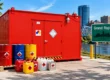
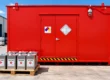
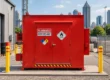
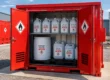
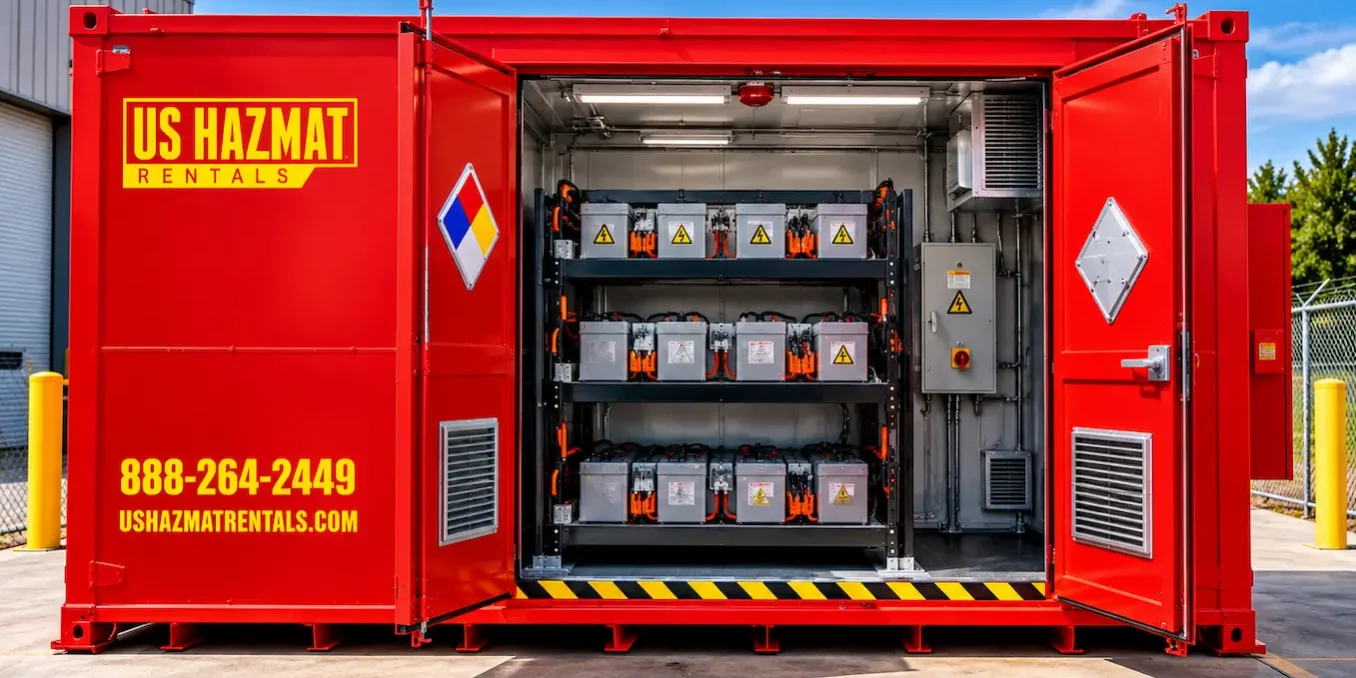
For a site that already carries significant flammable liquid storage indoors, a containerized battery energy storage system on an outdoor yard pad is often the configuration that resolves the most problems at once. A BESS container sited at the NFPA 855-required separation distances from the occupied building and from other chemical storage points satisfies NFPA 855’s co-location restrictions without requiring the facility to redesign its indoor storage program.
For facilities working out how to store batteries in a yard that already holds chemical storage at scale, the containerized approach is frequently the path that requires the fewest structural changes to the existing site.
The outdoor container is not a shortcut past the requirements. Fire suppression, typically a clean agent or water mist system rated for the battery chemistry and energy capacity, is required inside the container above defined thresholds. Ventilation must maintain the off-gas dilution rate the standard specifies. A flammable gas sensor with alarm output connected to the facility’s fire alarm system is standard equipment for any compliant outdoor installation. The difference from the indoor configuration is not fewer requirements; it is that the separation distance requirement is met by geography rather than by construction.
For sites where a yard pad is not an option, indoor dedicated battery rooms with fire-resistive construction, rated suppression, and continuous monitoring are the path. Both approaches answer how to store batteries compliantly. The outdoor pad solves the separation problem with distance; the indoor room solves it with rated construction. Facilities asking how to store batteries across a mixed-use industrial site will find the right answer depends on the specific chemical inventory, the available yard footprint, and the local AHJ’s position on NFPA 855 compliance.
US Hazmat Rentals works with facility teams evaluating both configurations through our flammable storage protection services, where the interaction between battery storage requirements and existing chemical inventories is part of every site assessment.
AHJ Coordination Before the Permit Submission
Companies who submit battery storage permit applications without prior discussion with local AHJ(s), no pre-application meeting and without knowledge of local amendments are almost always surprised by the comments that are returned. Most jurisdictions with active NFPA enforcement have developed local checklist items, occupancy-specific requirements, or amendment positions that do not appear in the published standard. A pre-application conversation turns the question of how to store batteries at a specific site into a scoped compliance checklist rather than an open-ended permit review.
The pre-application conversation changes what gets submitted. Engaging the fire marshal’s office before finalizing the enclosure specification lets the facility team understand exactly what the local AHJ expects to see in the compliance package: suppression system documentation, ventilation calculations, gas detection specification, separation distance analysis, and emergency response plan integration.
How to store batteries correctly at the regulatory level is ultimately a question the AHJ answers based on the specific site, the specific chemistry, and the specific neighboring inventory. The code provides the structure; the AHJ provides the final determination. Getting that determination as early in the project as possible is the variable that most consistently controls project schedule. Facilities that frame the conversation as how to store batteries to satisfy NFPA 855 and the local amendment layer arrive at permit approval faster than those that present a system and ask the AHJ to evaluate it.
The Storage Plan Has to Exist Before Delivery
A battery system on-site without a storage plan in place is already in a compliance condition. How to store batteries correctly under NFPA 855 is not a question that waits for commissioning. The storage requirements attach the moment the system is on the property. NFPA 855 does not carve out an exception for systems awaiting installation. Once the energy storage equipment is on the property, the storage requirements apply. A palletized rack in a receiving bay is subject to the same rules as a commissioned system in a dedicated room.
Building the storage plan means completing the chemical inventory and separation analysis, specifying and procuring the ventilation and monitoring equipment, submitting and receiving approval on the permit package, and confirming the installation sequence with the AHJ before the delivery date. Facilities that work through how to store batteries using that sequence move through the permit process in one round. Those that start the plan after the system arrives spend that time on remediation instead.
Book a call with our engineering team. US Hazmat Rentals helps facility teams work through how to store batteries on sites where flammable and combustible liquid storage programs are already in place, identifying the separation gaps, monitoring deficiencies, and permit sequencing issues before a battery system arrives and creates them as enforcement findings. Reach out through our flammable storage protection page and let’s look at the site together.
FAQ
How to store batteries long-term without losing capacity?
Store lithium-ion and lithium iron phosphate batteries at 40–60% state of charge in a climate-controlled space between 59°F and 77°F (15°C to 25°C). Run voltage and cell balance checks every 30 to 90 days. Avoid leaving the system at full charge or full discharge; both accelerate degradation more aggressively than active cycling does. The facilities with the best long-term battery outcomes are those that documented the answer to how to store batteries at the manufacturer’s specification and assigned someone to run the periodic check cycles rather than leaving it as a general storage area responsibility.
How to store lithium batteries safely in a facility that also holds flammable chemicals?
NFPA 855 governs the separation distances between battery enclosures and flammable or combustible liquid storage. Class I flammable liquids require greater separation than Class II combustibles; oxidizers require separate analysis. A compliant installation means running the full separation matrix for every chemical category on-site before the battery enclosure location is fixed, and engaging the AHJ early to confirm local requirements beyond the NFPA 855 baseline.
What is the practical difference between flammable versus combustible in a battery storage plan?
Flammable liquids, those with flash points below 100°F, produce ignitable vapor at room temperature. Combustible liquids, with flash points at or above 100°F, produce vapor only when heated above their flash point. Both create incompatibility problems with battery storage, but Class I flammable liquids represent the more immediate scenario: a battery fault event in a space that holds acetone or lacquer thinner has an ignition-ready vapor present before any heat is generated. The flammable versus combustible distinction controls which separation distance threshold applies under NFPA 855.
Is outdoor containerized storage the best answer for a congested industrial site?
For many sites, yes. A yard-mounted BESS container at the NFPA 855-required separation distances solves the co-location problem without requiring changes to the indoor chemical storage layout. The container still requires rated fire suppression, continuous ventilation, and gas detection with facility alarm integration. But the separation distance requirement is met by geography instead of by rated construction, which simplifies the building permit and reduces the fire-resistive construction cost.
What permits are typically needed to know how to store batteries at code?
A building permit, fire permit, and electrical permit are the standard package, and in most jurisdictions enforcing NFPA 855, all three are reviewed together rather than sequentially. Some localities add a hazardous materials storage permit based on chemistry and energy capacity. AHJ pre-application coordination is the fastest way to map the local permit sequence before committing to a project schedule that depends on an approval timeline you have not yet confirmed.