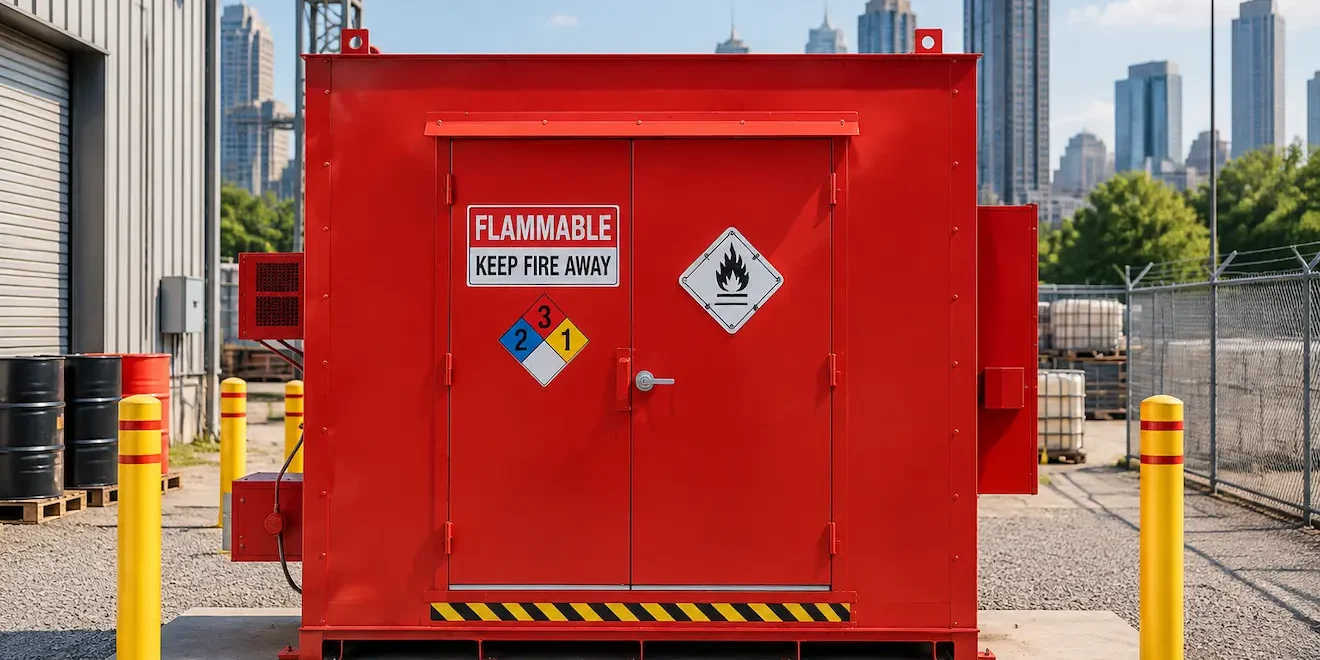
Atlanta-area facilities dealing with paint thinners, solvents, hydraulic fluids, or any Class I through Class III flammable liquid have a compliance decision that cannot be deferred: what does proper containment actually look like for their site? Flammable storage cabinets Atlanta operations rely on are not simply metal boxes for keeping chemicals out of sight.
They are OSHA and NFPA 30-specified enclosures designed to limit vapor accumulation, slow fire spread, and demonstrate defensible compliance to any inspector who walks through. Getting that decision right, before an unannounced visit or a near-miss incident, is what separates a facility with a real safety program from one with good intentions and poor execution.
The compliance landscape in Georgia adds its own layer. Atlanta and the surrounding metro area fall under Georgia’s adoption of federal OSHA standards, which means 29 CFR 1910.106 applies in full to flammable liquid storage. County-level fire marshals and the local AHJ in Fulton, DeKalb, Gwinnett, and Cobb counties have historically applied these requirements with rigor, particularly for facilities in industrial corridors near the airport or along I-85 and I-285. Knowing what flammable storage cabinets Atlanta code requires, and where rental options fit within that framework, is the starting point for any EHS team building out a storage plan.
At US Hazmat Rentals, we help facility managers and safety officers across the Atlanta metro work through exactly these questions before a cabinet shows up on site. The conversation almost always starts with one of three scenarios: a facility that has exceeded its room-limit threshold, a job site that needs temporary compliant storage, or a company preparing for an inspection that is closer than they would like.
What OSHA and NFPA 30 Actually Require
OSHA 29 CFR 1910.106 sets the governing framework for flammable liquid storage in general industry. The regulation establishes quantity limits that determine when a dedicated storage cabinet or storage room becomes mandatory rather than optional. Inside any single storage area or control area, you can hold up to 25 gallons of Class IA, IB, and IC flammable liquids in containers outside of an approved cabinet before you trigger the cabinet requirement.
Once you cross that threshold, OSHA requires those liquids be stored in an approved flammable liquid storage cabinet. For flammable storage cabinets Atlanta operations need to meet that threshold, the compliance path is the same whether the facility is in Midtown or College Park: the listed cabinet must satisfy both OSHA 1910.106 and NFPA 30.
NFPA 30 provides the technical specifications for what those cabinets must be. Approved cabinets are constructed of steel with at least 18-gauge sheet metal on the door and 16-gauge for the body. They must have a self-closing door, a three-point latch, a raised sill to retain spills, and a 2-inch vent space with a fusible-link closure to limit oxygen supply in a fire event. The interior capacity limit under NFPA 30 is 60 gallons for Class I and II flammable liquids combined, and no more than 120 gallons when Class II and III materials are included. These are not suggestions.
Facilities in Atlanta operating under mixed-occupancy conditions need to track quantity limits per control area rather than per building. A control area is typically one floor or a zone separated by fire-rated construction. Exceeding the per-control-area limit without the right cabinet type or without moving to a dedicated storage room is a citable OSHA violation regardless of how compliant the rest of the facility looks.
The flammable storage cabinets Atlanta OSHA citations most often reference are not missing entirely; they are present but unrated, over-capacity, or misplaced within the occupancy.
The Four-Way Decision: Cabinet Type, Location, Quantity, Duration
Choosing the right flammable storage cabinets Atlanta configuration comes down to four variables that define the decision tree before any quote is useful. First, what materials are being stored, specifically their NFPA 30 classification (Class IA through IIIB), their flash point, and whether any of them qualify as incompatible when co-stored. Second, what quantity is involved across the storage footprint. Third, where the storage will be located, inside the building, in an attached structure, or freestanding outdoors. Fourth, how long the storage need exists: permanent infrastructure, a 60-to-90-day project, a turnaround shutdown, or a contract period tied to a production cycle.
Duration matters more than most Atlanta facility teams initially expect. For permanent or long-term flammable storage needs, purchasing a listed cabinet and anchoring it to the facility may produce better total cost of ownership than renting. But for a job site at one of the many Atlanta-area construction, infrastructure, or industrial expansion projects underway at any given time, renting eliminates the capital spend, avoids depreciation tracking, and puts the logistics burden on the rental provider rather than the project team.
The flammable storage cabinets Atlanta job sites typically need are in service for 30 to 120 days per project phase, which makes rental the clear economic choice over a capital purchase that will sit idle between phases.
The location variable drives the unit selection more than almost anything else. A cabinet placed inside an occupied workspace or production floor must meet interior placement rules under NFPA 30, including restrictions on proximity to ignition sources and the requirement for adequate ventilation of the storage area.
A freestanding outdoor unit on a job site or plant yard opens additional options. The flammable storage cabinets Atlanta plant managers request for outdoor yard placement often differ significantly in gauge, size, and secondary containment spec from the interior units used inside production buildings, even when they hold the same material.
Fire Rating, Steel Gauge, and What “Listed” Actually Means
EHS managers evaluating flammable storage cabinets Atlanta vendors offer will encounter the term “listed” in every spec sheet. Under NFPA 30 and OSHA 1910.106, an approved or listed cabinet is one that has been tested and certified by a recognized testing laboratory, typically FM Global or Underwriters Laboratories (UL), to withstand a 10-minute fire exposure without allowing the internal temperature to exceed 325°F.
That fire test is the technical basis for the cabinet’s compliance claim; a cabinet that lacks FM or UL listing is not an approved cabinet under the standard regardless of its construction materials or appearance.
The 18-gauge door and 16-gauge body specification from NFPA 30 reflects the minimum construction standard. Heavier gauge steel is not a compliance violation, and in higher-traffic environments, thicker construction meaningfully extends service life. Self-closing mechanisms, three-point latches, and fusible-link vent closures are all tested components in a listed cabinet; aftermarket modifications that disable these features can void the listing.
The flammable storage cabinets Atlanta fire marshals most frequently cite in inspection reports are not structurally deficient; they are units where a self-closing mechanism was disabled for convenience or a vent was permanently opened to reduce odor in the storage area.
For facilities handling higher-hazard Class IA materials like diethyl ether or pentane, or for operations that exceed standard cabinet capacity, the fire-rating conversation shifts from individual cabinet specifications to the fire-resistive construction requirements for the storage structure itself. Two-hour and four-hour rated structures are available in the rental market. For operations where total flammable liquid inventory exceeds what any cabinet configuration can address, those larger units are the next step after flammable storage cabinets Atlanta per-control-area limits are reached.
Atlanta-Specific Compliance Context
Georgia operates under the Georgia Occupational Safety and Health Act, which adopts federal OSHA standards by reference. For most flammable storage decisions, that means the same 29 CFR 1910.106 thresholds apply. What varies by jurisdiction within the Atlanta metro is fire code enforcement and inspector familiarity with the specific configurations flammable storage cabinets Atlanta facilities commonly use.
Atlanta proper falls under the Atlanta Fire Rescue Department, while unincorporated Gwinnett County, Cobb County, and Cherokee County each have their own fire marshal offices with slightly different inspection cadences and enforcement priorities.
Facilities along the industrial corridors near Hartsfield-Jackson Atlanta International Airport, in the Aerotropolis zone, or in the Forest Park and College Park industrial areas should expect active fire code enforcement activity given the density of chemical handling operations in those zones. Flammable storage cabinets Atlanta facilities in those areas maintain are often subject to spot inspections tied to certificate-of-occupancy renewals, permit applications for facility expansions, or follow-up from neighboring incident reports.
One practical consequence for Atlanta facilities is that AHJ plan review timelines can add weeks to a facility expansion or renovation project if flammable storage is part of the scope. Having compliant cabinet storage in place during the plan review period demonstrates good-faith compliance and often smooths the permitting conversation.
The flammable storage cabinets Atlanta facilities install on a rental basis during that review window have helped EHS managers avoid the citation exposure that comes with operating above the 25-gallon outside-cabinet limit while waiting for a permanent solution to be approved.
Quantity Thresholds and When a Cabinet Is Not Enough
The 25-gallon outside-cabinet limit and the 60-gallon per-cabinet limit from OSHA and NFPA 30 are the two numbers most EHS managers have memorized. What they sometimes miss is the per-control-area aggregate limit, which caps total flammable liquid storage in a single control area, regardless of how many cabinets are present. Under NFPA 30, a non-sprinklered occupancy typically allows up to 120 gallons of Class I and II liquids across all cabinets in one control area. A fully sprinklered building doubles that allowance to 240 gallons per control area.
When Atlanta operations exceed those aggregate thresholds, a dedicated storage room or a freestanding outdoor storage building is required. Flammable storage rooms must meet fire-resistive construction requirements (typically one-hour minimum), mechanical ventilation at a minimum of one cubic foot per minute per square foot of floor area, non-sparking ventilation motors, and electrical systems classified for the area’s hazard level.
Outdoor buildings with the appropriate fire rating and secondary containment can satisfy the same compliance need with less facility construction impact. The shift from flammable storage cabinets Atlanta operations use within their per-control-area limit to a dedicated storage building is often triggered by a plant capacity expansion or a new product line that increases flammable liquid volume faster than the existing cabinet configuration can absorb.
For Atlanta job sites, remote yard storage, or facilities that need to add capacity quickly without triggering a construction permit, a rental outdoor storage building is often the fastest compliant path. The flammable storage cabinets Atlanta EHS managers select for indoor use and the outdoor rated buildings they deploy for yard storage address the same aggregate limit from different directions; the right choice depends on total inventory and available footprint.
Flammable Storage Cabinets Atlanta: Ventilation, Grounding, and Placement Rules
Compliance does not end at the cabinet door. NFPA 30 and OSHA 1910.106 specify how cabinets must be placed and what the surrounding environment must look like. Cabinets must not be located in areas where hot work is performed without physical separation. They must be positioned so that spills or vapor cannot migrate toward ignition sources, drains, or HVAC intakes. This placement discipline is part of what makes flammable storage cabinets Atlanta inspectors evaluate during compliance reviews, not just the cabinet label.
Bonding and grounding requirements apply when transferring flammable liquids from containers. The cabinet is typically grounded through its metal construction and anchor points, but transfer operations at or near the cabinet may require dedicated grounding cables and bonding clips to prevent static discharge ignition. Facility teams in Atlanta running solvent-heavy production lines or paint finishing operations sometimes overlook this detail until an incident or an insurance review surfaces it.
Ventilation of the storage area around the cabinet matters as well. A cabinet with closed vents placed in a poorly ventilated room does not satisfy the intent of the standard, because the room itself becomes the vapor accumulation zone. Adequate general ventilation, minimum six air changes per hour in most interpretations, is a companion requirement to proper cabinet placement. The flammable storage cabinets Atlanta facilities use in enclosed areas are regularly flagged during AHJ inspections precisely because ventilation is not part of the cabinet purchase conversation.
Rental vs. Purchase: Making the Business Case
The rental versus purchase question for flammable storage cabinets Atlanta operations face is driven by three variables: timeline, mobility, and total cost of ownership. A 45-gallon or 90-gallon listed cabinet purchased outright for a permanent Atlanta facility represents a capital asset with a long service life and no recurring rental cost. For a facility with a stable, long-term storage need at a fixed location, purchase often wins on total cost. But that calculation shifts quickly when the need is temporary, location-dependent, or tied to a project end date.
The rental case gets stronger in three scenarios. First, when the storage need is tied to a project with a defined end date: a construction phase, a plant turnaround, a seasonal production run. Second, when the location will change, because Atlanta metro construction and infrastructure projects frequently relocate as phases complete, and renting eliminates the logistics cost of moving, reconditioning, and re-inspecting a purchased cabinet. Third, when the facility is in a growth phase and needs to prove the concept before investing in permanent storage infrastructure.
Rental also shifts maintenance and inspection responsibility to the provider. A compliant rental unit arrives in verified condition, with listing documentation available on request, and returns when the rental term ends without the facility tracking disposal or resale. For Atlanta EHS teams managing multiple compliance priorities simultaneously, that administrative simplification has real value. The flammable storage cabinets Atlanta rental providers deliver to active job sites and operating facilities come pre-inspected and ready to deploy without the sourcing delay a purchased unit often carries.
Common Specification Gaps That Delay Atlanta Projects
Project teams requesting flammable storage cabinets Atlanta providers have in stock sometimes arrive at the procurement conversation without the information that determines which unit they actually need. The most common gap is the material classification: ordering a cabinet without knowing whether the materials stored are Class I, II, or III flammable liquids means the unit may arrive with a capacity spec that does not align with NFPA 30’s per-class limits.
A facility that stores Class IA and Class IIIB materials in the same cabinet is mixing a flash point below 73°F with one above 140°F; both materials may be within the cabinet’s weight capacity but the incompatibility risk and the regulatory requirements for co-storage have not been addressed.
The second common gap is the missing listing documentation. Flammable storage cabinets Atlanta facilities order from unfamiliar vendors sometimes arrive without FM or UL certification paperwork. During an inspection, the AHJ will ask to see the listing label on the unit itself and may request the test documentation. A cabinet without a visible listing label is not automatically non-compliant, but the burden of proof shifts to the facility, and that conversation during an active inspection is not where you want to spend time.
Planning Your Flammable Storage Program in Atlanta
A complete flammable storage program for an Atlanta facility is not just a cabinet on the floor with a lock on the door. The flammable storage cabinets Atlanta operations deploy are the hardware component of a program that also requires a written flammable liquid inventory, a hazard classification for each material, a control-area quantity calculation, a documented placement and spacing plan, a grounding and bonding procedure for transfer operations, an inspection log for cabinet condition and self-closing mechanism function, and a training record for personnel who handle materials from the cabinet.
Facilities that have those program elements in place when an Atlanta Fire Rescue inspector or OSHA compliance officer walks through are in a fundamentally different position than those that have the cabinet but none of the surrounding documentation. The cabinet demonstrates the hardware; the program documentation demonstrates the intent and the ongoing management. Both matter for a citation-free inspection. Flammable storage cabinets Atlanta inspectors pass without comment are almost always backed by a written program, not just a listed unit on a shop floor.
If your Atlanta operation is adding flammable storage capacity, preparing for an inspection, or building out a new job site that will handle flammable liquids, reach out US Hazmat Rentals team through our flammable liquid storage cabinet page to see what compliant flammable storage cabinets Atlanta sites have available with same-day response. Request specs, pricing, and delivery timelines today.
FAQ
What are the OSHA requirements for flammable storage cabinets?
Under OSHA 29 CFR 1910.106, flammable liquids exceeding 25 gallons in a single control area must be stored in an approved storage cabinet. The cabinet must be FM- or UL-listed, constructed of minimum 18-gauge steel on the door and 16-gauge on the body, equipped with a self-closing door, three-point latch, and fusible-link vent closure. Maximum capacity per cabinet is 60 gallons for Class I and II liquids.
How many flammable storage cabinets can I have in one room?
NFPA 30 limits the aggregate volume of flammable and combustible liquids per control area regardless of how many cabinets are present. In a non-sprinklered occupancy, the combined total across all cabinets in a single control area is typically 120 gallons of Class I and II liquids. A sprinklered building doubles that allowance to 240 gallons. Exceeding these aggregate limits requires a dedicated storage room or outdoor storage building.
What is a flammable storage cabinet required to be made of?
NFPA 30 specifies a minimum of 18-gauge steel for the door panels and 16-gauge for the cabinet body. The door must self-close, have a three-point latch, and include a 2-inch vent with a fusible-link closure to limit oxygen during a fire. Cabinets must be tested and listed by a recognized laboratory such as FM Global or UL to confirm they hold internal temperatures below 325°F during a 10-minute fire exposure.
Is it better to rent or buy a flammable storage cabinet in Atlanta?
For permanent, fixed-location storage needs, purchasing typically wins on total cost of ownership. For job sites, project-based needs, or facilities in growth phases where storage requirements may shift, rental eliminates capital spend, depreciation tracking, and end-of-life logistics. Atlanta metro construction and industrial projects with defined timelines are strong candidates for rental.
Do ventilation requirements apply to the room, not just the cabinet?
Yes. The cabinet’s internal vent is designed to limit oxygen inside the unit during a fire event. The surrounding storage area still requires adequate general ventilation, typically a minimum of six air changes per hour, to prevent ambient vapor accumulation. A well-specified cabinet in a poorly ventilated room is a common compliance gap that AHJ inspectors identify during facility reviews.
Can I store different classes of flammable liquids in the same cabinet?
NFPA 30 allows co-storage of Class I and Class II liquids within the 60-gallon per-cabinet limit. However, materials with significantly different flash points or incompatibility risks (such as Class IA oxidizer-forming solvents mixed with Class III combustibles) should be evaluated for segregation. Any material with incompatibility concerns noted on its SDS should not share a cabinet with its incompatible counterpart.