Contact Us

Detroit’s industrial base is all about petroleum distillates. You’ve got cleaning solvents for precision parts, cutting fluids in the machining cells, mineral spirits on the finishing floor etc. These are so ubiquitous in the manufacturing in Wayne County that the hazard classification of them is generally ignored until an OSHA inspection or a visit from the local fire marshal forces the issue and the way the material is stored is put under the microscope. The first document the inspector will ask for is proof that the material has been correctly classified and stored in accordance with the 1268 hazmat code which is the one that Detroit operations are required to follow.
The 1268 hazmat code Detroit facilities come across most frequently is UN 1268 which is the UN hazardous materials code for petroleum distillates and petroleum products not otherwise specified. Under 49 CFR 172.101 that material is a DOT Class 3 Flammable Liquid and that triggers the regulatory stack on how it’s labelled on containers, how it’s stored in buildings, how it’s managed at the point of generation when it’s spent and how it’s protected against spill migration under the EPA rules. Getting that stack right prior to an inspection is the difference between a clean walk-through and a correction notice with a 30 day timeline on it.
EHS managers and safety coordinators across the Detroit metro area rely on US Hazmat Rentals to set up their 1268 Detroit hazmat code storage solutions to meet both federal and Michigan requirements prior to the first unit even arriving on site.
What the 1268 Hazmat Code Detroit Classification Covers
1268 is a UN/NA ID number as per the DOT hazardous materials table at 49 CFR 172.101. It is a Petroleum distillates, n.o.s. or Petroleum products, n.o.s. number. The scope is very wide in practice indeed, covering mineral spirits, petroleum naphtha, Stoddard solvent, petroleum ether and the like. It will be used for any of those refined fractions where no more specific proper shipping name is available. In a typical Detroit automotive or industrial facility, this covers a significant share of the cleaning and lubrication products in daily use.
The 1268 hazmat code that the Detroit EHS managers encountered the most is predominantly Packing Group II and III. Packing Group II is for materials which have a flash point below 23°C (73°F) and an initial boiling point above 35°C. Packing Group III is for materials which have a flash point at or above 23°C and no higher than 60°C (140°F). The packing group dictates the quantity limits, packaging requirements and placarding requirements for each individual product. A product in Packing Group II has more restrictive storage limits than one in Packing Group III even though they are both shipped under the same UN 1268.
Identifying 1268 Hazmat Materials by Container Markings
You can identify hazardous materials by looking for the DOT Class 3 label on the container itself: a red diamond with a flame and the class number. For UN 1268 shipments the Class 3 label will be on the outer packaging and will be accompanied by the proper shipping name, the UN number and the packing group roman numeral. Any facility that is receiving these materials in bulk must also check that the SDS on file for the material identifies it as a Class 3 flammable liquid (UN 1268) and that the SDS is available to the personnel in the storage and handling area as required by OSHA 29 CFR 1910.1200.
Any storage areas which are storing material covered by this number must have the DOT Class 3 placard on all four sides of the transport vehicle and at the entrance to any room which is used solely for the storage of flammable liquids. Any facility which uses the NFPA 704 diamond on the storage room should have the correct health, flammability and instability ratings for the particular petroleum product stored in that room.
The NOAA CAMEO Chemicals database has the full UN 1268 hazard profile and is a good reference to check that a petroleum product in storage is correctly classified prior to an inspection review.
Federal Storage Requirements for 1268 Hazmat Code Detroit Facilities
Federal rules on the storage of petroleum distillates come from two different agencies with separate enforcement authority. OSHA 29 CFR 1910.106 covers building and outdoor storage of flammable and combustible liquids in the general industry. EPA 40 CFR 112 covers spill prevention for petroleum storage above the threshold quantity. It’s in the area of addressing 1268 hazmat code Detroit compliance under both of those that most facility plans fail. You can satisfy one and still not satisfy the other.
OSHA 29 CFR 1910.106: Inside storage limits and room requirements.
OSHA 29 CFR 1910.106 sets out the physical requirements for storage of flammable liquids in the manufacturing and industrial setting. Inside a building the quantities are limited according to whether or not the space is sprinklered and the fire resistance rating of the storage room. For a non-sprinklered inside storage room of a two hour fire resistance rating the maximum quantity of Class I and Class II liquids combined is 500 gallons. That quantity increases to 2,000 gallons if automatic sprinklers are provided. Storage cabinets may contain no more than 60 gallons of Class I and II liquids per cabinet and no more than three cabinets may be located in a single fire area unless the building is sprinklered throughout.
Beyond the quantity limits, 1910.106 requires that the electrical wiring and equipment in the storage room be in accordance with NFPA 70 for a Class I, Division 1 or Division 2 location as appropriate to the vapor zone. Explosion proof fixtures, vapor tight conduit seals and bonding and grounding of the dispensing equipment are all required. Ventilation at a rate of not less than one cubic foot per minute per square foot of floor area is required to prevent accumulation of vapour.
US Hazmat Rentals have buildings configured to the 1268 Hazmat Code Detroit requirements: fire rated, with explosion relief and ventilation to NFPA 30 and 1910.106. They can provide the full range of hazardous materials storage and will confirm the building configuration that is appropriate for your storage volume and packing group.
EPA SPCC: Secondary Containment for Petroleum Above Threshold Volumes
Any facility which stores petroleum products (including petroleum distillates classified as UN 1268) is subject to the EPA Spill Prevention, Control and Countermeasure (SPCC) rule under 40 CFR 112 once the aggregate above ground storage capacity of the facility exceeds 1,320 gallons. At that point the facility is required to have a written SPCC plan, to have secondary containment installed which is sized to hold the volume of the largest single tank plus the precipitation that could fall into the containment area during the most intense 24 hour storm on record and to have that plan reviewed and certified by a licensed professional engineer.
SPCC applies specifically to petroleum oil. Petroleum distillates carrying the UN 1268 designation fall within the rule’s scope. Wayne County facilities that operate multiple storage tanks for cleaning solvents, cutting fluids, or maintenance petroleum products commonly exceed the 1,320-gallon SPCC threshold without a formal compliance analysis in place. A facility with three 500-gallon tanks is above the threshold regardless of whether each individual tank is below the triggering quantity.
Michigan EGLE and Local Permits for 1268 Hazmat Code Detroit Sites
Federal regulations set the floor. Michigan adds a state-level layer that Detroit-area facilities must satisfy independently. The Michigan Department of Environment, Great Lakes, and Energy (EGLE) administers the state’s flammable liquid storage rules under Part 211 of Act 451, which mirrors federal requirements in most respects but requires separate registration for aboveground petroleum storage tanks that meet the Part 211 threshold. The Detroit Fire Department and Wayne County Fire Marshal both require permits for the storage of Class I flammable liquids above specified quantities in places of business, with permit applications reviewed against the locally adopted fire code.
For 1268 hazmat code Detroit operations in Wayne County, the practical compliance picture involves satisfying OSHA 1910.106 at the federal level, Part 211 at the state level, and a local fire marshal permit at the county level before a new storage installation is considered fully compliant. Each framework has its own inspection trigger, its own documentation requirement, and its own correction timeline. A facility that has addressed the OSHA requirements but has not filed the required Part 211 registration will receive a state-level notice independent of any federal inspection outcome.
US Hazmat Rentals provides flammable chemical storage solutions built to the specifications that 1268 hazmat code Detroit facility compliance requires, including fire-rated construction, NFPA 30-compatible ventilation, explosion relief, and integrated secondary containment.
Satellite Accumulation for Spent Petroleum Distillates
When petroleum distillates classified under UN 1268 are used as solvents, degreasers, or cleaning agents and are no longer fit for their intended purpose, the spent material becomes a RCRA-regulated hazardous waste. Spent petroleum-based cleaning solvents may carry the D001 ignitability characteristic under 40 CFR 261.21, and some formulations of spent non-halogenated solvents are F-listed wastes under 40 CFR 261.31.
The satellite accumulation provision under RCRA allows facilities to hold up to 55 gallons of hazardous waste at or near the point of generation without a storage permit. For a 1268 hazmat code Detroit cleaning or degreasing operation, this means a labeled container at each workstation where spent solvent accumulates can remain in satellite accumulation status as long as it is kept closed except when adding or removing waste, labeled with the words “Hazardous Waste” and the waste identity, and moved to the central accumulation area once it reaches 55 gallons. The satellite accumulation limit is per point of generation, not per facility, so a facility with multiple degreasing stations may maintain a separate 55-gallon satellite accumulation container at each one.
Hazmat Warehousing Solutions for 1268 Hazmat Code Detroit Operations
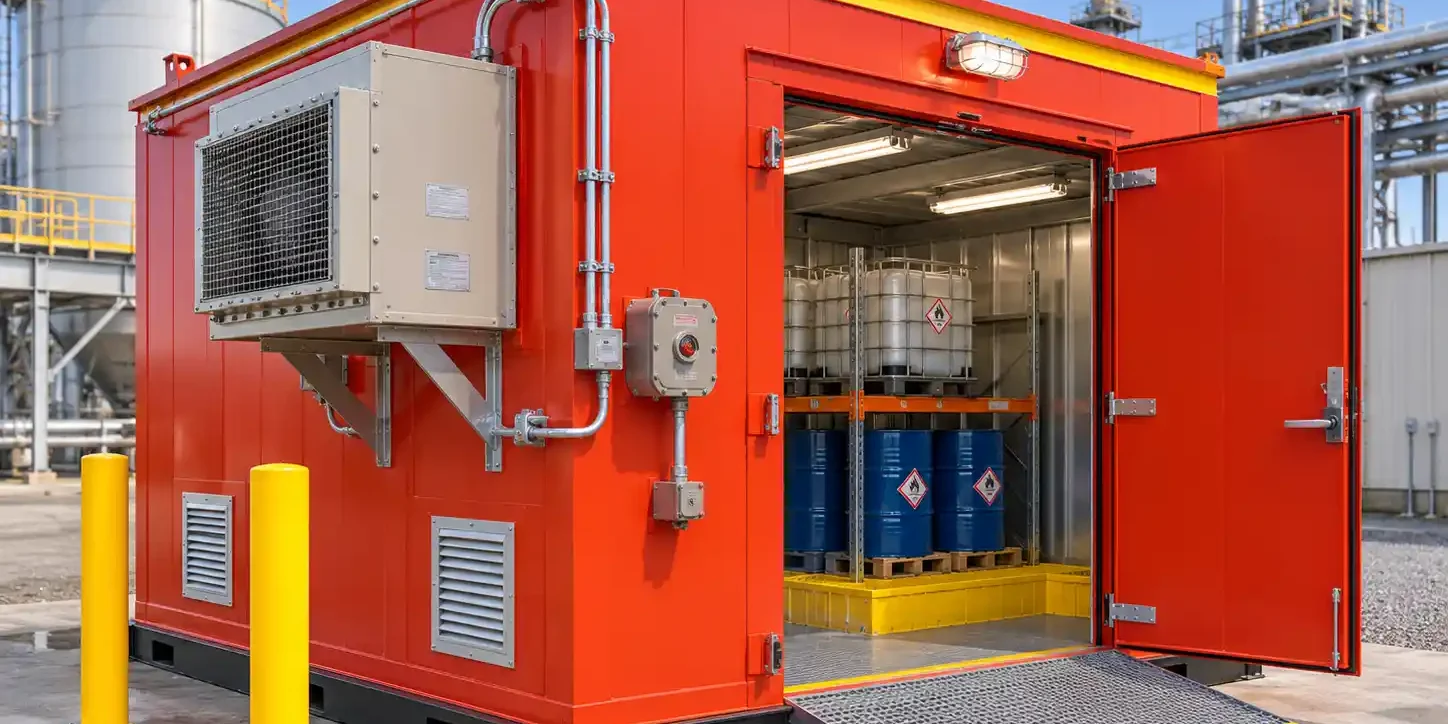
The correct approach to hazmat warehousing for Class 3 flammables is to start with the specification of the storage building. Both NFPA 30 and OSHA 1910.106 recognise a fire rated inside storage room as the appropriate containment structure for the larger volumes of petroleum distillates. A purpose built hazmat storage building with a 2 hour or 4 hour fire rating, explosion relief panels, NFPA 70 Article 501 compliant electricals and continuous ventilation is the type of building that provides the controlled environment required for 1268 hazmat code Detroit compliance.
Any facility which is storing a range of product types (petrol distillates along with corrosives, oxidisers or water reactive materials for example) must have the different hazard classes segregated within the storage building. NFPA 30 and OSHA 1910.106 both expressly prohibit incompatible materials from being stored in the same storage unit or in the same secondary containment basin. A purpose built hazmat storage building with segregated bays is the solution to this requirement in a single building. The secondary containment is incorporated into the building floor so that any release is contained within the building and will not migrate into the floor drains or the surrounding area.
Get Your 1268 Hazmat Code Detroit Compliance in Order Before Inspection Day
A full 1268 hazmat code Detroit compliance review will cover four areas: correct classification and container labelling at storage, a building specification which is in compliance with OSHA 1910.106 and NFPA 30 for the quantities and packing groups involved, a secondary containment plan sized to meet EPA SPCC requirements if the petroleum volumes are above the federal threshold and a RCRA satellite accumulation protocol for the spent petroleum waste generated at each workstation.
Facilities that only deal with the most obvious element (the building itself) and don’t get to the detail of container labelling, containment sizing or waste accumulation documentation will still be cited for the gaps even if the building is otherwise in compliance.
Get in touch with us to get a bespoke proposal for your site. US Hazmat Rentals works with EHS managers and facility teams across the Detroit area to configure storage and containment systems that satisfy the full 1268 hazmat code Detroit compliance stack from classification through containment.
FAQ
What does the 1268 hazmat code mean?
UN 1268 is the United Nations hazardous materials identification number for Petroleum distillates, n.o.s. and Petroleum products, n.o.s. under the DOT Hazardous Materials Table at 49 CFR 172.101. It classifies these materials as Class 3 Flammable Liquids and assigns them to Packing Groups I, II, or III depending on flash point and initial boiling point. The number appears on shipping documents, container labels, and placards for any petroleum distillate that does not have a more specific proper shipping name.
What OSHA standard applies to 1268 hazmat storage in Detroit?
OSHA 29 CFR 1910.106, the Flammable Liquids standard, governs the storage of petroleum distillates and other Class 3 flammable liquids in general industry workplaces. It sets quantity limits for inside storage rooms and cabinets, requires appropriate ventilation and electrical classification, and specifies construction requirements for flammable liquid storage rooms. Michigan enforces equivalent requirements through the Michigan OSHA program, so the same standard applies to Detroit facilities under state enforcement.
Does EPA SPCC apply to petroleum distillates?
Yes. The EPA Spill Prevention, Control, and Countermeasure (SPCC) rule at 40 CFR 112 applies to facilities that store petroleum oil, including petroleum distillates, in aggregate aboveground quantities greater than 1,320 gallons or underground quantities greater than 42,000 gallons. Facilities above that threshold must prepare a written SPCC plan certified by a professional engineer and install secondary containment for petroleum storage areas.
What is satellite accumulation and how does it apply to spent petroleum solvents?
Satellite accumulation is an EPA RCRA provision that allows facilities to hold up to 55 gallons of hazardous waste at or near each point of generation without a storage permit. When petroleum distillates are used as solvents or degreasers and become spent, they may be classified as D001 ignitable hazardous waste or F-listed waste under RCRA. Each degreasing or cleaning station in a facility qualifies as a separate point of generation and may maintain its own 55-gallon satellite accumulation container.
What permits does Detroit require for flammable liquid storage?
Detroit-area facilities storing Class I flammable liquids above the quantities specified in the locally adopted fire code must obtain a permit from the Detroit Fire Department and comply with Wayne County Fire Marshal requirements. Separately, Michigan EGLE administers aboveground petroleum storage tank registration under Part 211 of Act 451 for tanks that meet the Part 211 threshold. Federal OSHA 1910.106 compliance is required independently of local or state permits.