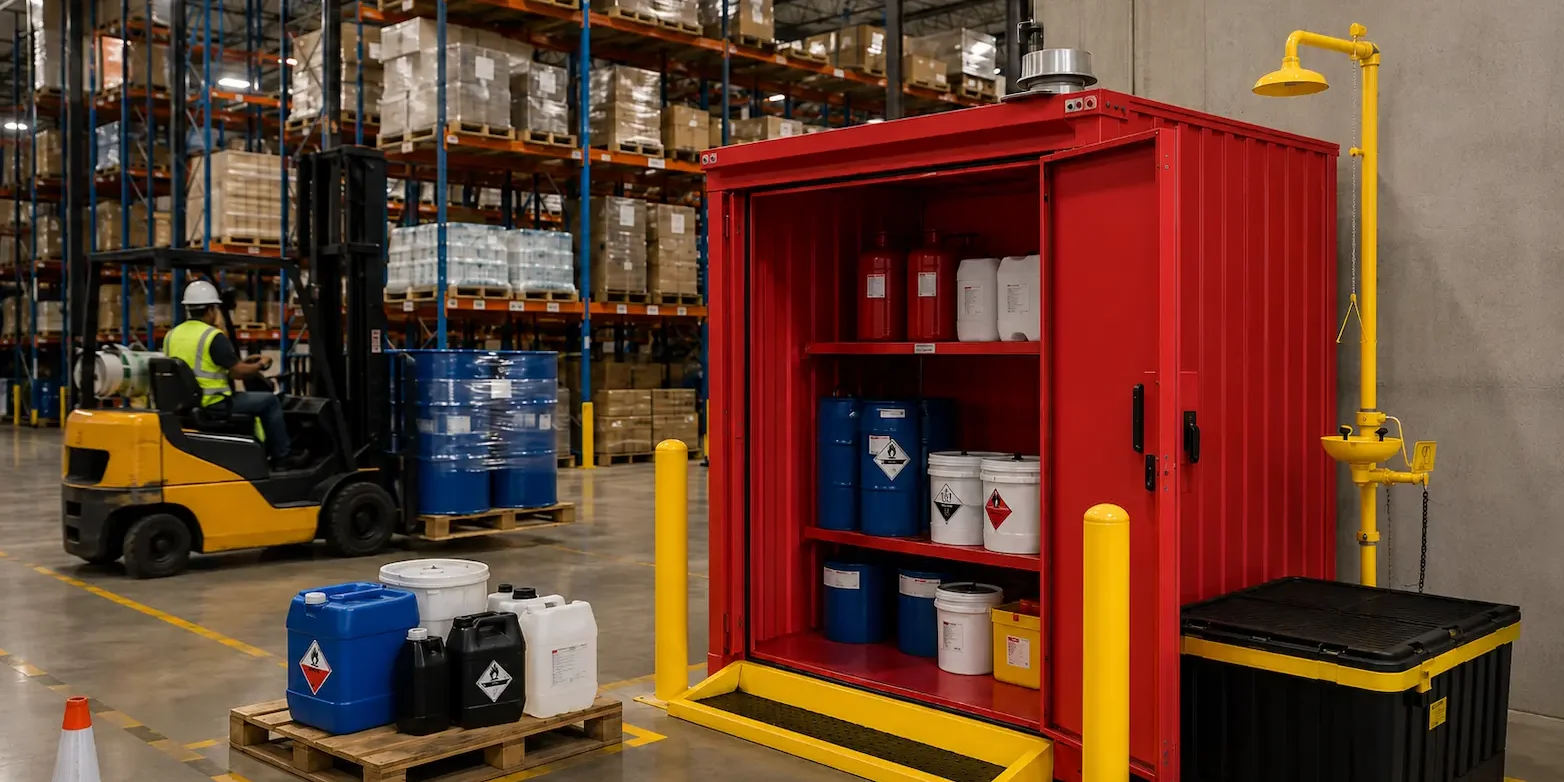
OSHA warehouse regulations in Atlanta logistics operations move quickly. Freight arrives, pallets shift, forklifts cross active aisles, temporary materials enter the building, and warehouse teams work under pressure to keep orders, inventory, staging, and loading schedules on track. When chemicals or regulated materials are part of that environment, OSHA warehouse regulations become more than a compliance topic. They become part of how the site protects people, products, equipment, and daily workflow.
The challenge is that warehouse safety is rarely one single issue. A facility may have flammable liquids, aerosols, cleaning chemicals, batteries, maintenance fluids, adhesives, coatings, or waste materials in the same general operation as racking, forklifts, loading docks, pedestrian movement, and temporary staging. If those materials are not stored with containment, access control, labeling, and separation in mind, small gaps can turn into inspection concerns or operational interruptions.
At US Hazmat Rentals, we support industrial and logistics teams that need temporary, flexible, and project-based hazardous materials storage. For Atlanta warehouses, distribution centers, and logistics facilities, the goal is not to complicate operations. The goal is to make chemical storage easier to locate, easier to control, and easier to defend when safety, compliance, or internal review questions come up.
OSHA warehouse regulations start with the reality of daily movement
OSHA warehouse regulations matter because warehouses are built around movement. Products move from receiving to storage, from storage to picking, from picking to packing, and from packing to outbound docks. Forklifts, pallet jacks, contractors, drivers, maintenance crews, supervisors, and warehouse workers may all share the same operational space.
That movement creates safety pressure. Chemicals stored in the wrong location may block access, sit too close to traffic, lose label visibility, or end up near incompatible materials. A container that seems harmless while sitting still can become a risk when a forklift route changes, a dock door backs up, or a temporary project adds more material than the warehouse originally planned to handle.
For Atlanta logistics teams, this is especially important because facilities often operate as regional movement points. A chemical storage plan should not be built around leftover floor space. It should be built around how the warehouse actually works.
Why Atlanta logistics safety needs a stronger storage plan
Atlanta logistics safety has to account for scale, speed, and constant change. The metro area’s distribution environment includes warehouses, third-party logistics operations, manufacturing support, last-mile facilities, cross-dock operations, and industrial properties tied to regional and national supply chains. That kind of environment leaves little room for unclear hazardous materials control.
A strong storage plan helps answer basic but important questions:
- What materials are on-site?
- Are they hazardous, flammable, corrosive, reactive, or environmentally sensitive?
- Where are they stored?
- Who has access to them?
- Are Safety Data Sheets available?
- Are labels readable and current?
- Is there spill containment?
- Are materials separated from drains, exits, traffic lanes, and incompatible substances?
- Is the storage area easy to inspect?
These questions are not only for regulatory review. They also help supervisors, safety managers, warehouse leads, and contractors work from the same understanding. A clearer storage plan reduces improvisation, and in logistics environments, less improvisation usually means better control.
Hazardous materials storage should not be treated like ordinary inventory
Hazardous materials storage is different from standard warehouse inventory because the risk does not stop at product value. A damaged carton may create a replacement cost. A damaged chemical container can create exposure, cleanup, downtime, fire risk, environmental concern, or documentation pressure.
That difference matters when warehouses use the same staging logic for everything. A pallet of packaging supplies and a container of solvent should not be managed with the same assumptions. Chemicals may require separation, ventilation review, containment, signage, SDS access, and trained workers who understand the hazards tied to the material.
Atlanta logistics facilities may need a dedicated storage approach for:
- Flammable liquids
- Cleaning and degreasing chemicals
- Maintenance fluids
- Aerosols
- Paints, coatings, and adhesives
- Corrosive materials
- Waste containers
- Contractor-supplied chemicals
- Temporary materials used during equipment installation or facility upgrades
When these materials are treated as a controlled category, the warehouse becomes easier to manage. When they blend into ordinary inventory, risk becomes harder to see.
Where OSHA expectations often show up in warehouse operations
OSHA warehouse regulations do not exist as one simple checklist for every facility. Different standards may become relevant depending on what the warehouse stores, how workers interact with the materials, and what hazards are present. For chemical storage, hazard communication, flammable liquid requirements, walking-working surfaces, powered industrial trucks, emergency access, housekeeping, and PPE planning may all enter the conversation.
A warehouse does not need to be a chemical plant to have chemical safety obligations. If workers can be exposed to hazardous chemicals, the facility needs labels, Safety Data Sheets, and training that helps employees understand what they are handling. If flammable liquids are stored or dispensed, storage method, quantity, location, and approved equipment can become critical.
| Warehouse Area | Why It Matters | What Safety Teams Should Review |
| Receiving | Chemicals may enter before storage is ready | Label checks, SDS access, receiving procedures |
| Staging | Temporary placement often becomes long-term storage | Time limits, containment, traffic exposure |
| Racking | Not every material belongs in standard rack storage | Compatibility, weight, leaks, access, visibility |
| Loading docks | High movement increases impact and spill risk | Forklift routes, edge safety, clear aisles |
| Maintenance areas | Chemicals may be used outside inventory controls | Secondary containers, labels, waste handling |
| Outdoor storage | Weather and stormwater can increase risk | Covers, containment, drainage, security |
| Waste areas | Used materials can be more confusing than new inventory | Segregation, labeling, pickup schedule |
This is where US Hazmat Rentals can support planning. Rental storage gives logistics teams a defined place for regulated materials instead of forcing chemical control into spaces originally designed for general freight.
Chemical labeling and SDS access are part of warehouse chemical safety
Warehouse chemical safety depends on workers being able to identify hazards quickly. If a container is unlabeled, damaged, blocked from view, or separated from its SDS information, the storage area becomes harder to manage. That problem grows when temporary workers, contractors, new employees, or multiple shifts share the same space.
Labels should help people understand the material, not slow them down. Safety Data Sheets should be accessible to workers who need them, not hidden in a system nobody checks during daily operations. Training should connect the written information to the actual materials in the warehouse.
A practical warehouse chemical safety program should review:
- Primary container labels
- Secondary container labels
- SDS availability
- Worker training
- Chemical inventory updates
- Material compatibility
- Spill response expectations
- Storage area signage
- Inspection frequency
This information gives the storage system context. A containment unit, cabinet, or rental building is more effective when the people using it understand what belongs there and why.
Flammable materials need more than convenient floor space
Flammable materials create a different level of concern inside logistics operations. They may be used for maintenance, cleaning, coatings, production support, repair work, or temporary projects. In a busy warehouse, the temptation is to keep them close to the work. That convenience can create risk if the storage location is not properly reviewed.
Flammable storage decisions should consider quantity, container type, ventilation, ignition sources, access, separation, and whether the material should be kept in a dedicated storage solution. The wrong location can place flammable liquids too close to exits, traffic routes, electrical equipment, or general inventory.
For Atlanta logistics teams, temporary needs are common. A facility upgrade, shutdown, seasonal surge, equipment repair, or contractor phase can introduce materials that are not part of normal inventory. Rental hazardous materials storage can help create a controlled area for those materials without permanently changing the entire warehouse layout.
How rental hazardous materials storage supports logistics flow
Rental hazardous materials storage works best when it supports the OSHA warehouse regulations instead of interfering with them. The storage location should be practical for workers but controlled enough to reduce exposure, spills, and confusion. If the unit is too far away, teams may create unofficial staging points. If it is too close to active traffic, impact and access risks may increase.
The right rental setup depends on the material, project duration, available space, and workflow around the storage area. A warehouse may need short-term chemical storage during a project, flammable storage support during maintenance work, or flexible containment for materials that arrive before permanent storage is available.
| Planning Question | Why It Matters for Atlanta Warehouses |
| What chemicals are being stored? | Material identity drives storage controls. |
| How long will storage be needed? | Temporary projects may not justify permanent infrastructure. |
| Where will workers access the materials? | Poor placement can create unofficial staging areas. |
| Are forklifts operating nearby? | Impact risk affects placement and protection. |
| Could liquid reach drains or traffic areas? | Spill containment needs to be planned before placement. |
| Are materials compatible? | Incompatible storage can increase reaction risk. |
| Who owns inspection responsibility? | Clear accountability prevents neglected storage areas. |
This is one reason US Hazmat Rentals focuses on practical, project-based storage. A rental solution can help Atlanta logistics teams respond to changing needs without losing control over hazardous materials management.
OSHA warehouse regulations are easier to manage when storage is visible
OSHA warehouse regulations become harder to manage when storage is scattered. A few containers near receiving, a few in maintenance, a few outside a dock door, and a few left from a contractor project can create a site that looks manageable day to day but becomes difficult to explain during a review.
Visibility matters. A defined storage area helps workers know where materials belong. It helps supervisors inspect consistently. It helps emergency responders understand where hazardous materials may be concentrated. It helps safety managers document the system instead of chasing containers across the facility.
Good visibility can include:
- Clear storage boundaries
- Readable labels
- Dedicated access routes
- Separation from general inventory
- Spill response materials nearby
- Assigned inspection responsibility
- Updated inventory records
- SDS access connected to the storage area
The point is not to make the warehouse slower. The point is to make storage decisions easier to understand at the speed the warehouse already operates.
What Atlanta teams should review before choosing a rental setup
Before choosing a rental setup, Atlanta logistics teams should review the material first and the container second. The same rental unit may not be appropriate for every chemical. A facility storing flammable liquids has different concerns than a facility managing corrosives, maintenance fluids, or temporary waste containers.
A practical review should include:
- Chemical inventory
- SDS review
- Quantity and container size
- Storage duration
- Indoor or outdoor placement
- Fire, spill, corrosion, or compatibility concerns
- Forklift and pedestrian traffic
- Access control
- Drainage and stormwater exposure
- Inspection and documentation responsibilities
- Site-specific safety requirements
This review does not replace professional compliance guidance. It helps teams enter the rental conversation with the right information. Better input usually leads to a better storage decision.
Safer storage starts before the next shipment arrives
The worst time to build a hazardous materials storage plan is after the shipment has already arrived. By then, teams may be trying to make quick decisions around dock availability, production pressure, driver schedules, and limited space. That is when containers get placed in areas that were never meant to hold regulated materials.
Planning earlier protects the operation. It gives the warehouse time to choose a safer location, define access, check compatibility, assign inspection responsibility, and make sure the storage approach supports OSHA-related expectations. It also gives teams a stronger answer when leadership asks why the setup was chosen.
For Atlanta logistics facilities, that preparation can make a real difference. Fast freight movement and warehouse safety do not need to compete. They need a storage plan that keeps pace with the operation.
Build Atlanta logistics safety around control, not guesswork
Atlanta logistics safety is not only about moving freight efficiently. It is also about knowing where risk lives inside the facility and building a storage system that makes that risk easier to manage. When chemicals, flammables, maintenance fluids, or hazardous materials enter the warehouse, OSHA warehouse regulations should be part of the planning conversation from the beginning.
A stronger storage plan gives materials a defined place, gives workers clearer information, and gives safety teams a more defensible system. It also helps prevent temporary needs from becoming permanent hazards.
US Hazmat Rentals supports industrial and logistics teams with flexible rental storage solutions for hazardous materials management. If your Atlanta facility is reviewing chemical storage, flammable material staging, or temporary project needs, start with the material, review the workflow, and build the storage plan around control.
Contact us to start planning hazardous materials storage for project-based and industrial operations.
FAQ
What are OSHA warehouse regulations?
OSHA warehouse regulations can include multiple standards depending on hazards present, including chemical communication, forklift safety, flammable liquids, housekeeping, access, and worker training.
Why do Atlanta logistics facilities need chemical storage planning?
Atlanta logistics facilities often move materials quickly through active warehouse environments. Chemical storage planning helps control spills, access, labeling, compatibility, and worker exposure.
Does every warehouse need hazardous materials storage?
Not every warehouse does. Facilities that store hazardous chemicals, flammable liquids, corrosives, maintenance fluids, or regulated waste should review dedicated storage needs.
What is hazard communication in warehouse chemical safety?
Hazard communication requires employers to provide labels, safety data sheets, and training so workers understand hazardous chemicals they may encounter.
Can rental storage support temporary warehouse projects?
Yes. Rental hazardous materials storage can support facility upgrades, maintenance work, contractor projects, seasonal volume changes, and temporary chemical staging.
Does US Hazmat Rentals replace OSHA compliance advice?
No. US Hazmat Rentals supports storage planning and rental solutions, but facilities should review applicable OSHA, NFPA, EPA, local, and professional guidance.