A tanker truck rolls over on a state highway, and the first engine on scene has ninety seconds to decide whether to approach. The placard bolted to the trailer carries four colored squares, and the one on the right, the yellow one, tells that crew whether they are looking at something that could still go off in their hands. Grasping NFPA yellow diamond meaning before that moment, not during it, is the entire point of getting facility signage right in the first place.
Most people glance past these diamonds the way they glance past a speed limit sign, present but unread until it suddenly matters. A warehouse manager who understands NFPA yellow diamond meaning can label a storage building correctly the first time. A responder pulling up to an unfamiliar site at night depends entirely on that label being accurate, current, and legible from the cab of a fire truck.
US Hazmat Rentals spend a fair amount of time walking facility managers through hazard placarding, and the yellow quadrant is consistently the one people misread or skip past fastest, mostly because reactivity feels more abstract than flammability or a straightforward health warning. Getting NFPA yellow diamond meaning right protects more than a compliance checklist, it protects whoever answers the call to your site on the worst night of the year.
What the NFPA Yellow Diamond Meaning Actually Communicates
NFPA 704, the standard behind the fire diamond, divides the placard into four color-coded quadrants, each reporting a different category of hazard to anyone reading it during an emergency. Blue sits on the left and reports health hazards, red sits on top for flammability, yellow sits on the right for instability and reactivity, and white sits at the bottom carrying symbols rather than numbers for special hazards like water reactivity or oxidizers.
| Quadrant | Position | Hazard Category |
| Blue | Left | Health hazard |
| Red | Top | Flammability |
| Yellow | Right | Instability and reactivity |
| White | Bottom | Special hazards (symbols, not numbers) |
NFPA yellow diamond meaning specifically concerns how a material behaves under stress, not whether it burns or poisons. A chemical can carry a low flammability rating and still carry a high reactivity rating if it decomposes violently under heat, shock, or contact with water, which is exactly why responders treat the yellow quadrant as its own separate question rather than an extension of the red one.
Reading the Reactivity Scale From Zero to Four
Each colored quadrant except white uses a numerical scale from zero to four, with zero indicating minimal hazard and four indicating the most severe. The scale inside the yellow quadrant maps directly onto how much energy a material can release and how little provocation it needs to do so.
| Rating | What It Indicates | Example Material |
| 0 | Normally stable, not reactive with water | Liquid nitrogen |
| 1 | Stable, but can become unstable at elevated temperature or pressure | Propene |
| 2 | May react violently or with water under normal conditions | White phosphorus, sodium |
| 3 | Capable of detonation with a strong initiating source, or explosive with water | Ammonium nitrate |
| 4 | Readily capable of detonation at normal temperature and pressure | Materials requiring extreme handling precautions |
A rating of two versus a rating of three changes the entire tactical approach a fire crew takes on arrival, since one calls for standard caution and the other calls for a defensive perimeter and specialized response. NFPA yellow diamond meaning at the higher end of that scale is not a subtle distinction, it is the difference between an interior attack and a full evacuation radius.
Why Responders Lean on This Signal in the First Sixty Seconds
Emergency crews rarely have time to pull a safety data sheet before making an initial approach decision, which is exactly the gap NFPA yellow diamond meaning was designed to close. A quick glance at the yellow quadrant tells an incident commander whether water is a safe extinguishing option or a mistake that could trigger a violent reaction.
That speed only works if the label reflects what is actually stored behind it. A facility that lets its placard fall out of date, while inventory shifts toward a more reactive product line, quietly erases the advantage NFPA yellow diamond meaning is supposed to provide.
Responders trust the diamond because it is meant to be current, not because it is decorative signage bolted up once during initial construction.
Training compounds the value of accurate placarding. Firefighters drilled on reading these diamonds can process a rating in a glance, but that training only pays off when the number on the wall matches the chemistry actually stored inside. A mismatch between placard and inventory turns a fast, informed decision into a dangerous guess.
Connecting the Yellow Diamond to NFPA 30 Storage Classification
NFPA 30 governs how flammable and combustible liquids get classified, stored, and separated, and that classification work feeds directly into what a facility’s hazard diamond should display. A Class IA flammable liquid with genuine reactivity concerns needs both an accurate red rating and an honest yellow one, since NFPA 30 storage limits assume the placard outside the building tells the truth about what sits inside it.
Storage cabinets and buildings under NFPA 30 already require flammability signage, the word FLAMMABLE displayed at a minimum letter height, alongside KEEP FIRE AWAY markings. Layering accurate NFPA yellow diamond meaning onto that same structure gives a fuller hazard picture than flammability signage alone, particularly for facilities storing peroxides, certain oxidizers, or materials that react with moisture.
Facilities juggling multiple chemical classes under one roof face the hardest version of this task, since a single storage building might need to reflect the highest reactivity rating present rather than an average across everything stored inside. Getting that math right during initial classification saves a costly re-labeling project later.
Where the Diamond Belongs on a Storage Structure
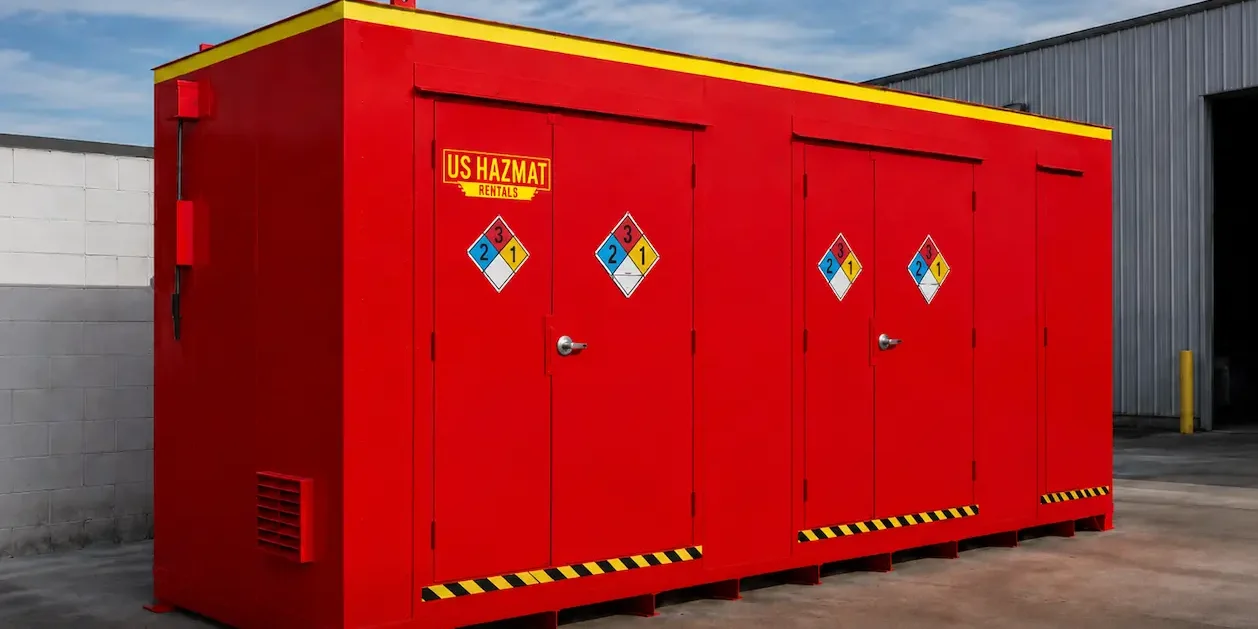
NFPA 704 placement guidance calls for diamonds at every principal point of entry a responder might use, exterior walls facing an access road, and any storage area entrance a crew would approach during an incident. A diamond hidden behind equipment or mounted where headlights cannot reach it at night fails at conveying NFPA yellow diamond meaning regardless of how accurate the numbers happen to be.
Legibility matters as much as placement. A placard sized for a quiet daytime walkthrough often becomes unreadable from a moving vehicle at night, which is why sizing should account for realistic viewing distance and lighting conditions rather than a comfortable up-close read. NFPA yellow diamond meaning does nothing for a crew that cannot make out the number from where they actually have to stop.
Multiple storage points on one property complicate placement further. A site with several separate chemical buildings needs a diamond at each one reflecting that specific structure’s contents, rather than a single sign at the main entrance implying uniform hazard levels across a property that may store very different materials in each building.
Common Mistakes That Undercut the Yellow Diamond’s Value
Outdated placards rank as the most common failure point, since inventory changes far more often than signage gets reviewed. A building that swapped a stable solvent for a more reactive substitute six months ago, without updating the yellow rating, is quietly lying to whoever reads that placard during an emergency.
Guessing at a rating instead of pulling it from the material’s actual safety data sheet creates a second common failure. NFPA yellow diamond meaning depends on accurate source data, not a facility manager’s best estimate of how dangerous something seems. The number belongs to chemistry, not to instinct.
Inconsistent numbers across a property round out the usual mistakes, one building using outdated ratings while a newer structure reflects current data. A responder arriving at a multi-building site expects consistent NFPA yellow diamond meaning applied everywhere, and inconsistency erodes trust in every diamond on the property, not just the one that is wrong.
Keeping the Diamond Current as Inventory Changes
Chemical inventory rarely stays static for long, new suppliers, new formulations, and seasonal product shifts all change what actually sits inside a storage structure. A placarding review tied to inventory changes, rather than a fixed annual calendar, catches these shifts before an outdated yellow rating becomes a real problem during a response.
Assigning one person clear ownership over placard accuracy prevents the update from falling through organizational cracks. NFPA yellow diamond meaning stays reliable only when someone treats reviewing it as part of receiving new stock, not as a separate task that competes for attention against daily operations.
Documentation supporting each rating matters as much as the number itself. Keeping the safety data sheet that justified a particular reactivity rating on file, alongside a record of when the placard was last verified, gives a facility something concrete to show an inspector or an insurer questioning whether the signage reflects reality.
How a Fire-Rated Storage Building Simplifies Getting This Right
Housing reactive and flammable materials inside a purpose-built structure removes several of the placarding headaches that come with makeshift storage. A dedicated building gives a facility one clear location to placard accurately, rather than trying to reflect mixed inventory scattered across shelving, cabinets, and improvised corners of a warehouse.
Our fire-rated chemical storage buildings are engineered around exactly this kind of classification clarity, giving a facility a single, well-defined storage point where NFPA yellow diamond meaning can be verified, posted, and kept current without hunting across multiple storage locations. Consolidating reactive inventory into one structure also simplifies which safety data sheets need reviewing whenever the placard comes up for an update.
Facilities managing a temporary spike in reactive or flammable inventory, during a shutdown, a seasonal project, or a facility expansion, often benefit from a rental unit sized to that specific need rather than forcing new chemistry into a building never rated for it. Matching the structure to the hazard class from the start keeps the placard honest instead of asking signage to compensate for a storage mismatch.
Building a Placarding Routine Your Site Can Actually Sustain
A routine beats a one-time compliance push every time, since chemical inventory keeps moving long after the initial placard goes up. Pairing a placarding check with existing inspection habits, the same walkthrough that already covers fire extinguishers or spill containment, keeps the yellow diamond from becoming an afterthought nobody revisits.
Training staff to read the diamond themselves, not just install it, adds another layer of protection. Employees who understand NFPA yellow diamond meaning can flag an outdated rating faster than an annual audit ever will, since they are the ones handling new shipments and noticing when the chemistry on hand no longer matches what the sign outside claims.
None of this demands a complicated system. A short checklist tied to receiving new inventory, a named owner for placard accuracy, and a habit of pulling the safety data sheet before assuming a rating stays valid closes most of the real-world gap between installing a diamond and keeping it trustworthy.
Getting NFPA yellow diamond meaning right is less about passing an inspection and more about giving the next responder through your gate an honest answer before they have to guess. Accurate reactivity ratings, placed where a crew can actually see them, turn a sign bolted to a wall into a genuine piece of emergency infrastructure. If your facility needs help matching chemical classification to compliant, well-placarded storage, reach out to US Hazmat Rentals to talk through your inventory, your storage structure, and what your signage should actually say.
What does the yellow diamond on an NFPA placard mean?
It reports instability and reactivity, rated zero through four, showing how likely a material is to react violently under heat, shock, or water contact.
Is NFPA 704 the same as NFPA 30?
No. NFPA 704 governs hazard identification placards, while NFPA 30 governs flammable and combustible liquid storage and classification requirements.
Who is responsible for keeping a facility’s diamond accurate?
Typically the facility or EHS manager, though ownership should be assigned explicitly rather than left ambiguous across a site.
Where should the diamond be placed on a storage building?
At every principal entry point a responder might use, sized and positioned to remain legible from a realistic viewing distance at night.
Can one building have multiple yellow ratings?
A single structure typically displays its highest applicable reactivity rating, reflecting the most hazardous material stored inside it.
How often should placards be reviewed?
Whenever inventory changes meaningfully, rather than on a fixed calendar alone, since chemistry on hand can shift faster than an annual review cycle.