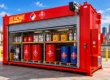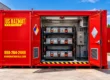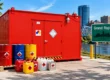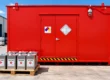
A 4 hour fire rated wall is not just a stronger version of an ordinary wall. It is a tested assembly built to resist flame passage, limit heat transfer, and hold its performance for a defined period under severe fire conditions. For facilities storing flammable or combustible materials, that number matters because it can affect separation distance, permitting conversations, emergency planning, and the level of protection expected by engineers, insurers, and local fire officials.
The real question is not whether four hours sounds safer than two. The question is whether the site, inventory, fire load, layout, and local code conditions actually call for that higher rating. A 4 hour fire rated wall only earns its place when the risk profile supports it, especially on crowded industrial sites, temporary storage areas, or projects where distance from other buildings is limited.
US Hazmat Rentals helps facilities think through that decision from a practical rental and compliance perspective. Before choosing a fire-rated storage solution, the wall rating should be matched to the materials being stored, the available space, the required documentation, and the authority having jurisdiction that will ultimately review the setup.
Unpacking What a 4 Hour Fire Rated Wall Really Means
A 4 hour fire rated wall is a wall assembly proven and documented to block flame penetration, hold its structural shape, and keep heat transfer to the cool side within limits for four full hours inside a standardized furnace. That figure traces back to ASTM E119 testing, the identical protocol UL leans on whenever it issues a formal fire resistance classification for a given wall design.
Three separate failure points get judged during that test, not merely whether the wall eventually gives way. The assembly must block flame or superheated gas from passing through, keep the unexposed side’s temperature climb under a set ceiling, and if it carries structural load, keep carrying that load the entire time. Slipping on any one of these conditions stops the clock and locks the rating below the full four hours.
Non-load-bearing assemblies clear a somewhat easier bar than load-bearing ones, since they only owe you flame resistance and heat limitation rather than structural support on top of everything else. Most flammable liquid storage buildings rely on a non-load-bearing 4 hour fire rated wall built around exactly that narrower job, keeping the panel focused purely on containment instead of doubling as a load-bearing column.
What Actually Happens Inside the Test Furnace
ASTM E119 subjects a sample wall to a standardized time-temperature curve, a rising heat profile meant to mimic how a genuine structure fire builds momentum rather than a flat, unchanging blast of heat. The furnace spikes fast in the opening minutes and keeps climbing steadily all the way toward the four hour mark.
| Time Elapsed | Approximate Furnace Temperature |
| 5 minutes | 1,000°F |
| 30 minutes | 1,550°F |
| 1 hour | 1,700°F |
| 2 hours | 1,850°F |
| 4 hours | 2,000°F |
A genuine 4 hour fire rated wall keeps performing while that curve keeps rising, not just surviving one dramatic temperature peak somewhere in the middle. Thermocouples mounted on the cool side track exactly how much heat sneaks through the assembly, and the wall fails the instant a reading crosses the allowable temperature rise above ambient, no matter how many minutes remain on the clock.
Independent testing labs run these trials, turning a passing result into documentation an engineer or an AHJ can actually cross-check rather than accept on a supplier’s word. Requesting that underlying test report, not a headline claim of “four hour rated,” is a fair and honestly necessary step before anyone commits to a wall design for a real storage project.
The Materials Doing the Heavy Lifting
Steel thickness by itself never produces a 4 hour fire rated wall. The assembly relies on layered construction, usually steel face sheets wrapped around a mineral-based or ceramic fiber insulation core built specifically to slow heat migration far beyond what bare steel could ever manage alone.
Joint craftsmanship pulls just as much weight as the panel material itself. Seams between panels tend to be the weakest link in almost every fire-rated assembly, since a gap that lets flame or scorching gas slip past undermines the entire system regardless of how well the panels perform on their own. Fully welded or continuously sealed seams, rather than bolted connections with visible gaps, typically separate an authentic 4 hour fire rated wall from an assembly that stalls out closer to two hours under the same furnace conditions.
Door hardware and every penetration through the wall matter just as much as the panel itself, since a rated wall paired with an unrated door defeats the entire point the moment flame reaches that opening. Ductwork, conduit runs, and access points each need fire-rated treatment matched to the surrounding wall, or the assembly’s overall performance quietly drops to whatever its weakest opening can withstand.
Weighing 2 Hour Against 4 Hour Protection
A 2 hour fire rated wall handles a large share of flammable liquid storage projects comfortably, particularly on smaller-volume sites where generous separation distance and modest quantity limits already keep total fire load in check. Stepping up to a 4 hour fire rated wall becomes the smarter call once storage volume, proximity to neighboring structures, or a stricter local fire code pushes exposure risk noticeably higher.
| Consideration | 2 Hour Fire Rated Wall | 4 Hour Fire Rated Wall |
| Best Suited For | Smaller-volume storage with room to spare on separation distance | Larger inventories, cramped sites, tougher local code |
| Insulation Core | Standard mineral-based fill | Denser or thicker core rated for extended exposure |
| Seam Requirements | Sealed seams, conventional hardware | Fully welded or continuously sealed joints throughout |
| Cost and Timeline | Lower upfront cost, quicker sourcing | Higher investment, longer engineering and testing runway |
Neither choice wins automatically, and picking between them without reviewing your actual site conditions is exactly where facilities end up overspending or underprotecting. A 4 hour fire rated wall earns its place when the numbers behind your specific inventory and layout genuinely call for it, not because a bigger number feels safer on a proposal.
Where NFPA 30 Steps Into the Wall Rating Conversation
NFPA 30 shapes how flammable and combustible liquids get classified and stored, and that classification feeds straight into what wall rating a given structure actually needs. A site holding large volumes of Class IA liquids, the most volatile tier under NFPA 30, typically faces a tighter construction and separation standard than one holding smaller volumes of a higher flash point product.
Sheer quantity matters just as much as classification alone. Crossing certain gallon thresholds inside one structure can push a project out of 2 hour territory and straight into a 4 hour requirement, since both NFPA 30 and local fire code scale construction expectations to the real fire load a facility chooses to keep on hand. Underestimating peak inventory during early planning is a common way projects find themselves needing a wall upgrade halfway through construction.
Local fire marshals frequently hold final authority over which rating actually applies on a given site, since NFPA 30 sets a floor that jurisdictions are free to raise based on local conditions. Looping in your AHJ before locking down a wall specification, rather than afterward, sidesteps an expensive mismatch between what got built and what actually earns approval.
How Separation Distance and Wall Rating Trade Off
Fire-rated wall performance and separation distance work as a pair in most code calculations, not as isolated variables. A stronger 4 hour fire rated wall can sometimes shrink the required gap between a storage structure and a neighboring building, since the wall itself absorbs more of the containment burden that distance would otherwise have to cover alone.
That trade matters most on cramped industrial lots where land, not budget, is the real bottleneck. A facility wedged between existing buildings may discover that upgrading wall rating, rather than lobbying for a variance on separation distance, offers the more realistic path toward compliant storage on ground that was never going to offer generous breathing room. Retrofitting an existing structure to a higher rating can also prove cheaper over several years than repeatedly fighting a permitting battle over tight setbacks.
None of these tradeoffs should be worked out without a structural or fire protection engineer familiar with your specific jurisdiction, since separation distance tables shift with code edition and local amendment. A 4 hour fire rated wall is a genuinely useful lever in that math, though it remains just one variable among several an engineer has to balance correctly.
Myths That Undercut How People Read Fire Ratings
The most stubborn myth treats a fire rating as a promise against any damage whatsoever, rather than a documented window of time. A 4 hour fire rated wall is engineered to contain and stall a fire, not to walk away from one untouched, and expecting zero visible damage afterward misreads what the test was ever measuring in the first place.
A second common mistake assumes a rating carries over automatically to any wall built from similar-looking materials. Two assemblies can appear nearly identical from across a parking lot while behaving very differently once inside a real furnace, since insulation density, seam sealing, and fastener placement all shape actual performance in ways no visual inspection could ever catch. Only a tested, documented assembly earns a genuine rating.
Assuming a rated wall keeps its rating forever, no matter what happens to it afterward, rounds out the usual missteps. Cutting a fresh penetration, swapping in unrated hardware, or reworking the assembly after installation can quietly void the original test basis, leaving a facility with a wall that still looks rated but no longer performs to that documented standard.
Specifying the Right Wall for Your Site
Choosing the correct wall starts with an honest count of what you actually store today, plus any realistic growth on the horizon, rather than sizing purely around current inventory. Facilities that undersize their fire protection to match today’s numbers often find themselves paying for a costly upgrade within a year or two of expanding.
Our 4-hour fire rated storage buildings are built around documented ASTM E119 performance, giving facilities a rental path that satisfies higher-volume or tighter-clearance storage needs without locking in permanent construction before a site’s long-term layout has settled. Renting also closes the gap between spotting a compliance need and actually having a tested structure sitting on your property.
Bringing your local fire marshal and your own engineer into the conversation early, working from the wall’s actual test documentation rather than a glossy sales sheet, keeps the whole selection process grounded in what your specific site and inventory truly require. A 4 hour fire rated wall justifies its price tag only when the underlying risk profile genuinely calls for it.
Staying Ready for the Day an Inspector Shows Up
Paperwork decides whether a fire-rated wall proves its worth during an actual inspection. Keeping the ASTM E119 test report, the UL design listing, and any manufacturer certification on hand gives a facility something solid to hand over, rather than a verbal promise that the wall meets code.
Routine upkeep protects the rating just as much as the original construction ever did. A quick yearly check for unauthorized penetrations, dented panels, or hardware swapped during unrelated facility work catches the kind of quiet drift that can undermine a 4 hour fire rated wall long before anyone notices in the middle of a real emergency.
None of this calls for an elaborate system. One named person responsible for wall integrity, a habit of routing every new penetration request through that person first, and paperwork stored somewhere it can actually be found closes most of the practical gap between owning a rated structure and knowing it still performs the way it was tested to perform.
Choosing and maintaining a 4 hour fire rated wall ultimately comes down to making sure the number on the spec sheet still matches reality on the day a real fire puts it to the test. If your facility is weighing wall ratings against your current storage volume and site constraints, reach out to US Hazmat Rentals and talk through what your inventory and layout genuinely require.
FAQ
What does a 4 hour fire rated wall actually protect against?
It blocks flame passage, limits heat transfer, and holds its structural integrity for four hours under standardized ASTM E119 furnace conditions.
Is a 4 hour rating always the better choice over a 2 hour rating?
Not automatically. The right rating depends on stored volume, separation distance, and local fire code, not simply a preference for a bigger number.
Can a fire-rated wall lose its rating after it’s installed?
Yes. Unrated penetrations, swapped hardware, or unapproved changes can quietly void the original tested assembly’s performance basis.
Who actually decides which wall rating a facility needs?
NFPA 30 sets the baseline, but the local fire marshal or AHJ typically holds final say for a specific site.
Does a higher wall rating shrink the required separation distance?
Sometimes. Many code calculations trade wall performance against separation distance, though an engineer should confirm this for your site.
How does testing for a 4 hour fire rated wall actually work?
Through ASTM E119, exposing the assembly to a standardized rising time-temperature curve inside an independent lab’s furnace.