A row of totes sits behind a warehouse through July, baking under direct sun for six weeks straight, and nobody notices the plastic has gone slightly brittle until a forklift tine catches one wrong and the wall gives way. Outdoor chemical tote storage rarely fails all at once. It fails one degree of heat, one freeze cycle, one missed inspection at a time, until the container that looked fine in April cannot survive being handled in August.
Most facilities treat an IBC tote sitting outside as a temporary inconvenience rather than a genuine storage decision, something to deal with once the yard gets crowded rather than something planned around from day one. That casual approach works fine for water or inert liquids. It works far less well for anything with a flash point, a reactivity concern, or packaging never engineered to survive a summer on asphalt, and chemical tote storage handled this casually tends to reveal its weak points at the worst possible time.
At US Hazmat Rentals, we spent a lot of time with facility managers who assumed their tote yard was a low-priority corner of the property, right up until a container failed and turned into an environmental cleanup instead of a quiet Tuesday. Getting chemical tote storage right outdoors is less about buying a cover and more about understanding what sun, cold, and standing water actually do to a plastic container full of something regulated.
What Outdoor Chemical Tote Storage Actually Involves
A standard IBC tote holds roughly 275 to 330 gallons inside a high-density polyethylene bladder wrapped in a steel cage, designed for transport and short-term staging rather than years of continuous outdoor exposure. Chemical tote storage becomes a different engineering question the moment that container stops moving through a supply chain and starts sitting in one spot through multiple seasons.
The material itself was never meant to be a permanent outdoor enclosure. HDPE plastic handles UV exposure and temperature swings reasonably well for a limited window, but that tolerance was built around transit and short-term holding, not indefinite yard storage. Treating a tote as a permanent outdoor fixture asks more of the plastic than its original design ever accounted for.
Volume compounds the stakes quickly. A single failed drum spills a manageable quantity. A single failed tote releases hundreds of gallons at once, which turns chemical tote storage from a housekeeping concern into a spill response and containment question the moment something actually goes wrong outside.
The Slow Damage Sunlight and Heat Cause
Ultraviolet exposure breaks down HDPE plastic at a molecular level over time, gradually reducing the wall’s flexibility and impact resistance even when the tote shows no obvious surface damage. A tote that looks structurally sound from across a parking lot can be significantly weaker than a new one after a year or two of full sun exposure.
| Exposure Factor | What Happens to the Tote | Practical Risk |
| UV radiation | Breaks down polymer chains in HDPE plastic | Increased brittleness, cracking under impact |
| Sustained heat | Raises internal pressure of volatile contents | Higher chance of venting failure or rupture |
| Repeated thermal cycling | Expands and contracts plastic and cage fittings | Loosened fittings, stress fractures at seams |
Heat adds a second problem beyond material fatigue. Volatile chemicals inside a tote left in direct sun can build internal pressure as temperatures climb through an afternoon, stressing seams and fittings that were never rated for that kind of repeated cycling. Chemical tote storage exposed to full sun essentially runs a slow-motion pressure test on every container in the yard, day after day, without anyone monitoring the result.
Color and opacity play a role few facilities consider. A translucent tote lets more UV radiation reach the contents directly, accelerating degradation of both the container and, in some cases, the chemical itself if the product is light-sensitive. Choosing opaque or UV-stabilized containers where possible reduces one variable in an already demanding outdoor environment.
Freeze Cycles and the Cold Weather Side of the Problem
Cold brings a different but equally serious set of risks to chemical tote storage. Water-based or aqueous products can freeze and expand inside a rigid container, stressing the tote wall and cage fittings in ways the plastic was not designed to absorb repeatedly across a winter.
Freeze-thaw cycling, rather than a single hard freeze, tends to cause the most damage over time. A tote that freezes and thaws repeatedly through a season experiences the same expansion and contraction stress many times over, weakening seams and fittings incrementally until a container that survived the first cold snap fails during the fifth one.
Some chemicals also change viscosity or separate at low temperatures, creating handling problems even if the container itself survives structurally intact. Facilities storing temperature-sensitive products outdoors need to plan around both the container’s physical limits and the chemistry’s own behavior at low temperatures, not just one or the other, since a tote that survives the winter physically can still hold a product that separated or thickened past usability.
Containment and Stormwater Considerations Outdoors
Outdoor chemical tote storage sits directly in the path of rain, snowmelt, and runoff in a way indoor storage never has to consider. Secondary containment built for outdoor exposure needs to account for accumulated precipitation inside the containment area, not just the volume of a potential tote failure alone.
EPA stormwater and spill prevention expectations become directly relevant once chemical tote storage sits outside, since contaminated runoff reaching a storm drain or adjacent soil creates a materially different liability than a contained indoor spill. Containment systems designed for outdoor placement typically need drainage management built in, allowing clean rainwater to be released while trapping anything contaminated.
Facilities storing multiple chemical families outdoors face an added containment challenge, since incompatible materials sharing one containment area during a rain event can create a reaction risk that indoor, separated storage would have avoided entirely. Segregating outdoor tote storage by chemical compatibility matters just as much outside as it does inside a building.
Open-Air, Covered, and Fully Enclosed Options Compared
Facilities weighing how to protect chemical tote storage outdoors generally choose between three approaches, each with a different balance of cost and protection.
| Storage Type | UV and Weather Protection | Typical Best Fit |
| Open-air with containment pad | Minimal, relies on tote’s own resistance | Short-term staging, stable non-reactive products |
| Covered canopy or shade structure | Blocks direct UV and precipitation, not temperature swings | Moderate-duration storage, cost-conscious sites |
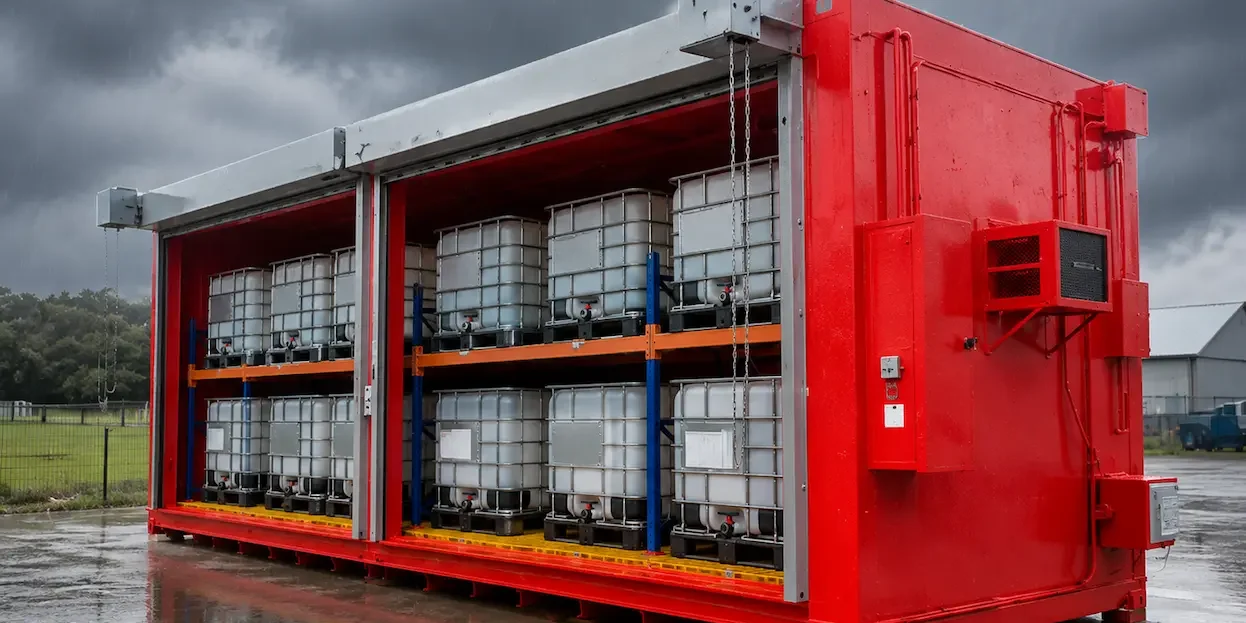
| Fully enclosed storage locker | Full weather protection, options for climate control | Long-term or sensitive chemical inventory |
Open-air storage with only a containment pad underneath offers the lowest upfront cost but leaves the tote fully exposed to sun, rain, and temperature swings, which shortens the container’s realistic service life considerably. A covered canopy improves the picture without the cost of full enclosure, blocking direct sun and precipitation while still leaving ambient temperature swings largely unaddressed.
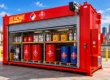
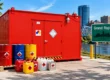
A fully enclosed storage locker gives chemical tote storage the most complete protection, shielding containers from UV, precipitation, and to some degree temperature extremes, while also simplifying secondary containment and compliance documentation into one defined structure rather than an open yard.
Placement, Spacing, and Access in an Outdoor Tote Yard
Spacing between totes affects both fire risk and practical accessibility, since containers packed too tightly complicate forklift access during a delivery and slow down emergency response if something does go wrong. Chemical tote storage laid out with clear aisles and defined bays tends to age better simply because problems get spotted and addressed before they compound.
Surface conditions underneath outdoor storage matter more than facilities often realize. A gravel or unimproved surface can shift under load over time, tilting totes and stressing fittings unevenly, while a properly graded concrete pad with containment sloped toward a collection point keeps both the containers and any spilled material where they are supposed to be.
Access for both routine handling and emergency response should shape the layout from the start rather than getting solved after the yard is already full. A tote yard designed around how it will actually be used, not just how much can be squeezed into the available footprint, tends to hold up better as inventory grows and new deliveries need somewhere planned to go.
Common Mistakes That Shorten a Tote’s Service Life
Assuming any IBC tote can sit outside indefinitely without consequence ranks as the most common and costly mistake facilities make. Chemical tote storage treated as a permanent outdoor fixture, rather than a container with a realistic service window, tends to fail earlier and with less warning than facilities expect.
Skipping regular visual inspection compounds the risk. A tote developing surface cracking, cloudy discoloration, or a slow bulge from internal pressure gives warning signs well before it fails outright, but only if someone is actually looking for them on a routine basis rather than after a problem has already occurred.
Mixing incompatible chemical families in one containment area, or stacking totes in ways their cage structure was never designed to support, round out the most frequent errors. Both mistakes trade a small convenience today for a meaningfully larger risk the next time weather, handling, or simple time catches up with an aging container.
Choosing a Weatherproof Solution for Your Facility
Matching the storage approach to your actual chemical inventory, rather than defaulting to whatever open space happens to be available, is the starting point for solving this properly. A facility storing stable, non-reactive materials for a short window has very different needs than one storing temperature-sensitive or reactive chemicals for months at a time.
Our IBC tote container storage options are built around exactly this kind of exposure problem, giving facilities a fully enclosed alternative to open-air yards, with secondary containment, optional climate control, and forklift-accessible bays sized for real tote volumes. Moving chemical tote storage into a purpose-built structure removes UV exposure and precipitation from the equation entirely, rather than trying to manage around them indefinitely.
Facilities dealing with a temporary volume spike, a seasonal project, or an expansion that has outpaced existing storage often find a rental unit solves the immediate exposure problem without committing to permanent construction before the long-term need is fully clear. Matching structure to actual inventory keeps the solution proportional to the real risk rather than either under- or over-building.
Building an Inspection Habit That Actually Holds Up
A routine inspection schedule catches the slow damage that a one-time installation review never will, since UV degradation and freeze-thaw stress accumulate gradually rather than announcing themselves all at once. Tying tote inspection to an existing walkthrough, the same one covering spill kits or fire extinguishers, keeps chemical tote storage from becoming a blind spot between other priorities.
Documenting tote age and rotation matters as much as visual inspection. Chemical tote storage benefits from a simple log tracking when each container went into outdoor service, since a tote installed three years ago carries very different risk than one placed last month, even if both look similar from a distance today.
None of this requires a complicated system to sustain. A named person responsible for the tote yard, a seasonal check tied to temperature extremes rather than a fixed calendar alone, and a habit of rotating or retiring older containers before they fail closes most of the practical gap between an outdoor yard that looks fine and one that actually is.
Protecting chemical tote storage outdoors comes down to respecting what sun, cold, and standing water do to a container never designed to sit in one place indefinitely. If your facility is weighing how to protect outdoor tote inventory through another season, reach out to US Hazmat Rentals to talk through what your specific chemicals and site conditions actually require.
FAQ
How long can an IBC tote safely sit outside?
It depends on UV exposure, temperature swings, and the chemical stored, but continuous outdoor exposure shortens a tote’s realistic service life considerably.
Does chemical tote storage need secondary containment outdoors?
Typically yes, since outdoor placement adds stormwater and runoff exposure that indoor storage does not have to account for.
Can freezing temperatures damage a chemical tote?
Yes. Freeze-thaw cycling stresses tote walls and fittings, particularly for aqueous or water-based products stored through winter.
Is a covered canopy enough protection for outdoor totes?
It helps against sun and rain but does little for temperature swings, making it a partial rather than complete solution.
How often should outdoor totes be inspected?
On a routine schedule tied to existing safety walkthroughs, with additional checks after extreme heat or freeze events.
What is the safest long-term option for outdoor chemical tote storage?
A fully enclosed, weatherproof storage structure with secondary containment typically offers the most complete long-term protection.