The compliance question that precedes every gallon of any of it is the same one most teams answer too late: what classification does this material carry, and what does that classification require? Understanding which materials that are combustible Grand Rapids facilities handle, and how NFPA 30 and OSHA sort them by hazard tier, is where every compliant storage program begins.
Grand Rapids has always been a working city. The plants along the US-131 corridor, the finishing shops in the furniture district, the stamping operations feeding the automotive supply chain. They all share one characteristic that rarely appears in the marketing copy: flammable and combustible chemicals are part of the daily inventory. Diesel in the yard, lacquer thinner in the spray booth, hydraulic fluid in the press line, acetone on the parts-cleaning bench.
The industrial range across West Michigan is broad. Furniture manufacturing, automotive supply, food processing, commercial construction, aerospace components. Each sector runs different chemicals, but all of them operate under the same federal and state framework. The cabinet on the shop floor, the building at the back of the yard, the ventilation spec for the spray room: every one of those decisions traces back to the flash point classification of the material being stored.
For teams building or auditing a storage program, knowing where the materials that are combustible Grand Rapids plants keep in daily use sit on the NFPA 30 ladder is the prerequisite to everything else.
At US Hazmat Rentals, the calls we get from West Michigan EHS managers and plant supervisors almost always start with the same two things: a chemical that just got added to the purchasing list, and uncertainty about what storage configuration that chemical requires. The materials that are combustible Grand Rapids operations deal with regularly are well-documented in the regulatory framework.
Materials That Are Combustible Grand Rapids: What NFPA 30 and OSHA Actually Define as Combustible
The line between flammable and combustible is a flash point, not a judgment call. NFPA 30 defines a flammable liquid as any liquid whose flash point falls below 100°F. A combustible liquid has a flash point at or above that threshold. Both categories are subdivided by how close the flash point sits to ambient temperature and where the boiling point lands.
Class I flammable liquids break into three subgroups. Class IA covers flash points below 73°F with boiling points under 100°F. Class IB has flash points below 73°F but boiling points at or above 100°F. Class IC falls between 73°F and 100°F. Moving up the scale: Class II combustible liquids sit between 100°F and 140°F. Class IIIA covers 140°F to 200°F. Class IIIB is everything above 200°F.
These classifications are not bureaucratic sorting exercises. They determine how much of a given liquid can sit outside an approved cabinet before a storage violation exists, what type of cabinet or building must contain it, how the surrounding electrical environment must be classified, and what ventilation rate the enclosed storage area requires.
The materials that are combustible Grand Rapids teams most commonly stock include diesel, lubricating oils, hydraulic fluids, cutting fluids, and certain degreasers. These spread across several of those tiers, and each tier carries its own storage obligations. Knowing where every chemical in the inventory lands on that scale is the work that makes the rest of the storage program for materials that are combustible Grand Rapids facilities operate defensible under OSHA and NFPA review.
Common Combustible Materials in Grand Rapids Industries
The West Michigan industrial profile generates a cross-section of combustible and flammable liquids that reflects the region’s manufacturing depth. Automotive supply and metal stamping operations run hydraulic oils and metal-working fluids that commonly fall into the Class IIIA or IIIB range, with flash points above 140°F and relatively forgiving cabinet requirements. Those same shops also run solvent degreasers and cleaning agents in the Class IB or IC range, where the storage thresholds are significantly tighter and the fire risk is immediate.
Furniture manufacturing, which put Grand Rapids on the map long before the city’s current economic diversification, involves lacquers, varnishes, stains, and thinners that sit consistently in the Class I range.
A production-scale spray finishing operation generates some of the highest per-area flammable liquid concentrations found in any industrial setting. Managing materials that are combustible Grand Rapids wood products facilities use means tracking aggregate volumes across spray booths, day tanks, and production-area storage simultaneously, against NFPA 30’s per-control-area caps.
Commercial construction across the metro brings its own inventory to the site: acetone, mineral spirits, adhesives, and fuel for equipment. Job sites rarely have permanent storage infrastructure in place when chemical deliveries begin. Materials that are combustible Grand Rapids construction projects use during an active phase need the same compliant storage that a permanent facility requires.
The temporary nature of a build schedule does not adjust OSHA’s quantity thresholds. A rental cabinet or outdoor storage building delivered to a Grand Rapids job site addresses that gap without requiring a capital commitment from a project team managing materials that are combustible Grand Rapids builds generate for only 60 to 90 days at a stretch.
How to Store Hydrogen Peroxide Alongside Combustibles
Hydrogen peroxide creates a specific planning problem for facilities that already manage a combustible liquid inventory. Knowing how to store hydrogen peroxide correctly requires stepping outside the NFPA 30 framework entirely, because hydrogen peroxide is not a flammable or combustible liquid and does not belong in that regulatory category at all.
DOT classifies hydrogen peroxide as a Class 5.1 oxidizer. NFPA 400, not NFPA 30, governs its storage. The hazard it presents in proximity to combustibles is not self-ignition. As hydrogen peroxide decomposes, it releases oxygen gas. In a room or building where flammable and combustible liquids are also present, that elevated oxygen concentration reduces ignition energy and intensifies any fire that does start.
Placing hydrogen peroxide in the same cabinet or storage area as the materials that are combustible Grand Rapids facilities keep under NFPA 30 control creates exactly the incompatible co-storage condition that NFPA 400 is written to prevent.
How to store hydrogen peroxide correctly means a dedicated oxidizer storage area, fully separate from any flammable or combustible liquid inventory. Secondary containment must be noncombustible and chemically compatible with the concentration in use. HDPE suits concentrations up to about 30%; PTFE and SS316L handle higher concentrations.
Ventilation must address oxygen accumulation, not just vapor control. Any storage site that holds both oxidizer and combustible inventories needs two distinct programs: one governed by NFPA 30 and one by NFPA 400. The materials that are combustible Grand Rapids operations manage under the first standard cannot share a space with hydrogen peroxide under the second.
OSHA Storage Limits and Cabinet Requirements
OSHA 29 CFR 1910.106 sets the thresholds that determine when compliant cabinet storage stops being optional. Outside an approved flammable storage cabinet, 25 gallons of Class I and II flammable and combustible liquids combined is the per-area limit. Inside an FM Global or UL-listed cabinet, that limit rises to 60 gallons of Class I and II liquids combined.
Above the individual cabinet level, per-control-area aggregate limits apply regardless of how many cabinets are in service. In a non-sprinklered occupancy, NFPA 30 caps Class I and II liquids at 120 gallons per control area. In a fully sprinklered building, that cap doubles to 240 gallons. A control area is defined by fire-rated construction, typically a single floor or a rated partition zone, not by the building as a whole. Grand Rapids plants running production on multiple floors or across large open floor plates need per-zone quantity calculations, not per-building totals.
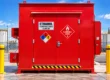
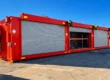
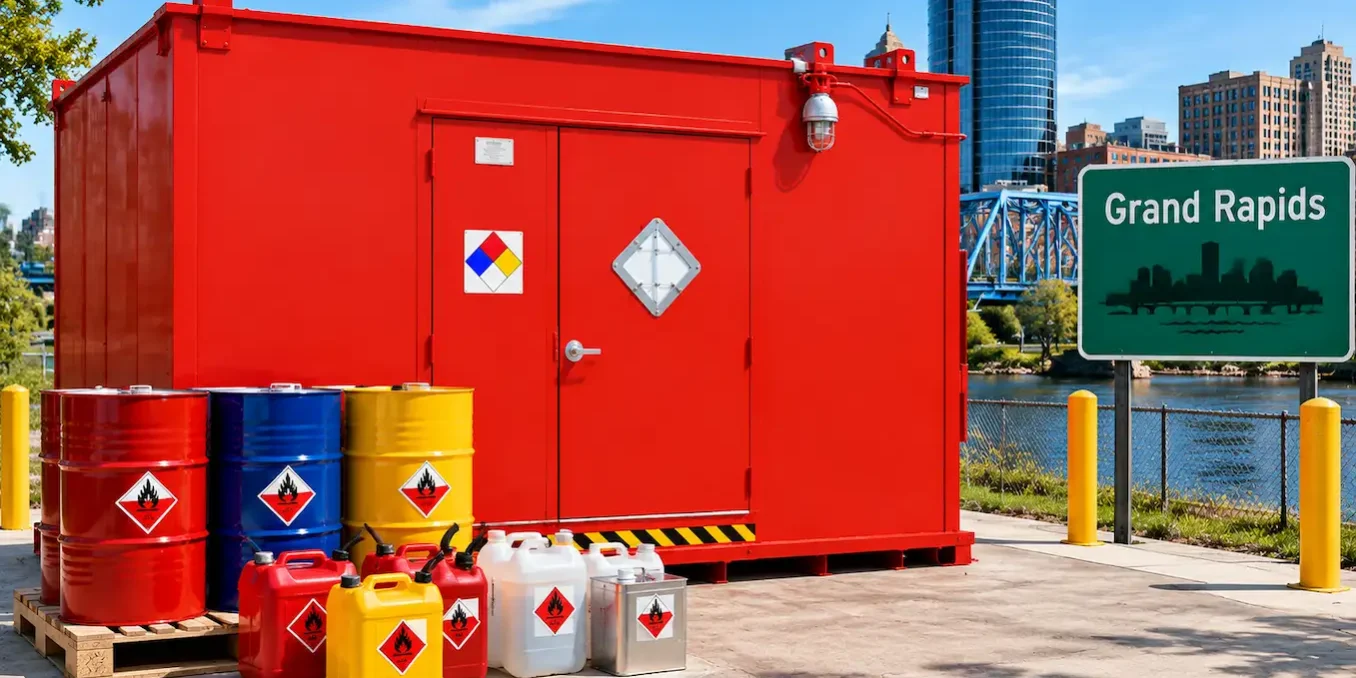
When materials that are combustible Grand Rapids facilities stock exceed those per-control-area caps, additional cabinets do not resolve the compliance problem. A dedicated flammable liquid storage room with fire-resistive construction, or a freestanding outdoor storage building sited at the required separation distances, becomes the next step.
At that point the compliance path is a construction or procurement decision, not a cabinet swap. The per-control-area calculation is the single number that determines how far the storage program for materials that are combustible Grand Rapids plants maintain needs to scale.
Michigan Fire Code and Grand Rapids AHJ Requirements
Michigan runs its own building and fire code program, which adopts and references NFPA 30 and NFPA 400 by state rule. In Grand Rapids, fire code enforcement falls under the Fire Prevention Bureau of the Grand Rapids Fire Department. The Bureau handles inspections tied to certificate-of-occupancy applications, facility expansions, and chemical storage modifications. Kent County operations outside the city limits fall under county or township fire marshal jurisdiction.
Permit applications are typically required before a new flammable liquid storage room or large outdoor storage building goes in. AHJ plan review in Grand Rapids can surface local amendments or occupancy-specific requirements that go beyond what the NFPA base codes mandate. For the materials that are combustible Grand Rapids plants store at scale, the permit conversation with the Fire Prevention Bureau before installation is consistently faster and cheaper than a retrofit conversation after an inspection finding.
Facilities that completed their AHJ coordination before a storage unit arrived on-site have had significantly fewer surprises than those that learned about a local code condition from an inspector standing in front of the unit they just installed to store materials that are combustible Grand Rapids code now says must be managed differently.
The industrial zones that line the US-131 corridor, the M-6 interchange areas, and the Wyoming and Kentwood industrial districts south of the city carry a high concentration of manufacturing and distribution operations with mixed chemical inventories. Inspection activity in those zones reflects the regulatory stakes: facilities managing materials that are combustible Grand Rapids industry keeps on-site at volume should treat AHJ coordination as a standard project step, not an optional one.
Combustible Materials: Secondary Containment and Spill Planning
Secondary containment is a code requirement before it is a good idea. NFPA 30 requires containment capable of holding the volume of the largest single container in storage, or 10% of the total stored volume, whichever is greater. For outdoor storage buildings, that containment must capture a full spill event without overflow reaching yard drains, stormwater conveyances, or any surface that connects to a waterway.
For materials that are combustible Grand Rapids facilities keep in outdoor or yard storage, Michigan’s stormwater permit conditions add a layer beyond the NFPA requirement. A petroleum or solvent release that reaches a yard drain or surface drainage channel in Kent County or the City of Grand Rapids can trigger a Michigan EGLE notification and a cleanup obligation that far exceeds the cost of a compliant containment sump installed from the start.
Material compatibility matters within the containment design. Carbon steel and galvanized sumps cover most combustible petroleum products without issue. That spec holds for most of the materials that are combustible Grand Rapids petroleum distribution and stamping operations keep on-site, but the review changes when other chemical categories enter the picture.
When hydrogen peroxide appears in the same storage footprint and the question of how to store hydrogen peroxide alongside combustibles comes up, the containment review extends to all surfaces that could contact either material.
Flammable Liquid Fire Extinguisher Selection
A combustible or flammable liquid fire is a Class B event under NFPA classification, and the suppression equipment must match that designation. A flammable liquid fire extinguisher for Class B service is typically a dry chemical unit with a Class B rating, a CO₂ unit, or an AFFF unit. NFPA 10, the Standard for Portable Fire Extinguishers, governs placement density, minimum ratings, mounting requirements, and inspection intervals.
The right choice among those options depends on the production environment around the storage area. Dry chemical units are effective across a wide Class B range but leave residue that disrupts sensitive equipment and requires cleanup before production can resume. CO₂ units suppress without residue but lose effectiveness in open or windy outdoor conditions.
AFFF foam is strong for large-volume liquid fires but carries PFAS reformulation requirements that have changed the product landscape in recent years, and facilities still running older AFFF stock should verify their units meet current environmental compliance standards.
In storage areas where both flammable and combustible materials and electrical equipment share a space, the extinguisher must carry a BC rating that addresses both hazard classes. Facilities that updated their storage inventory without reviewing the fire suppression equipment in the same cycle may be running extinguishers rated for the old inventory rather than the current one. When materials that are combustible Grand Rapids production lines rely on change, the extinguisher rating review belongs in the same project scope.
A West Michigan plant that upgraded its cleaning solvents and deferred the suppression review is carrying a compliance gap until that review closes. The extinguisher placement density under NFPA 10 also scales with the hazard level of the materials that are combustible Grand Rapids facilities keep in the storage zone, so a quantity increase that did not trigger a placement audit may have left coverage gaps as well.
Ventilation and Electrical Classification for Combustible Storage
Mechanical ventilation in enclosed flammable and combustible liquid storage areas is a code requirement under NFPA 30, not an engineering option. The standard requires that vapor concentrations be maintained below 25% of the lower explosive limit through continuous or demand-activated ventilation. Achieving that target requires a ventilation rate calculation based on the materials stored, the room volume, and the ambient temperature range the space experiences through the seasons.
The electrical classification of the area around the storage point follows directly from the ventilation analysis. NEC Article 500 defines the requirements for Class I locations, where flammable vapor may be present in concentrations sufficient to create an explosive atmosphere. Standard commercial electrical equipment, including light switches, outlets, and standard-duty motors, is an ignition source within a classified zone.
The boundary of the classified area is defined by proximity to the source and height above the floor, accounting for the fact that Class I vapors are typically heavier than air and accumulate at floor level.
Enclosed storage areas for materials that are combustible Grand Rapids manufacturing operations keep on-site, particularly wood finishing rooms, spray booth anteroom areas, and solvent storage closets, need both the ventilation system and the electrical classification reviewed any time inventory volume changes meaningfully.
A ventilation design that held vapor concentrations at 20% of LEL with 50 gallons of Class I liquids may not maintain that margin when inventory scales to 100 gallons in the same space. For materials that are combustible Grand Rapids finishing and solvent operations store indoors, the ventilation reassessment belongs on the same timeline as any inventory increase.
Rental Storage Solutions for Grand Rapids Facilities
Purchasing a compliant flammable storage cabinet or building is the right answer for permanent, stable, long-term storage at a fixed site. It is the wrong answer for a 60-day construction phase, a seasonal production ramp, or a contract period that ends when the job ships. In those cases, a rental unit from a provider with listed, pre-inspected equipment on hand eliminates capital expenditure, removes the depreciation and resale problem, and puts the compliance verification on the provider rather than the facility team.
Materials that are combustible Grand Rapids job sites and production facilities handle during defined-duration phases represent the clearest use case for rental storage. A listed FM or UL outdoor building or cabinet arrives compliant, serves the project, and returns when the work is done. No asset to track, no listing documentation to chase, no unit to move or sell when the phase closes.
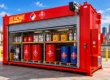
For facilities that have outgrown their current cabinet configuration and need a bridge solution while a permanent installation is permitted and built, a rental outdoor building covers the compliance gap without requiring a construction timeline decision before the storage need is urgent. The US Hazmat Rentals flammable storage protection page covers cabinet and building specifications for the materials that are combustible Grand Rapids operations manage at both the cabinet and building scale, with West Michigan delivery.
Building a Compliant Storage Program in Grand Rapids
The cabinet on the floor is the hardware. The compliance program is everything around it: a written chemical inventory with NFPA 30 classifications current as of the last procurement cycle, per-control-area quantity calculations that reflect actual inventory rather than design-day estimates, a cabinet placement plan that documents clearance from ignition sources and HVAC intakes, grounding and bonding procedures for transfer operations involving Class I liquids, an inspection log that captures self-closing mechanism function and cabinet condition at regular intervals, and training records for every person who accesses materials from the storage area.
Materials that are combustible Grand Rapids facilities bring into the inventory mid-cycle, through new product lines or supplier changes, need to trigger a storage program review before those materials arrive on the loading dock. The 25-gallon outside-cabinet threshold does not wait for an annual audit. It applies from the first container. Facilities that tie their chemical inventory review to procurement approval rather than inspection scheduling consistently close the gap between a new material entering the site and the storage program catching up to it.
Schedule a free site consultation today. The US Hazmat Rentals team works alongside Grand Rapids and West Michigan EHS managers to match the right storage solution to the materials that are combustible Grand Rapids operations manage at every volume level. Reach out through our flammable storage protection page for same-day response.
FAQ
What materials are classified as combustible under NFPA 30?
Combustible liquids under NFPA 30 have flash points at or above 100°F. Class II liquids fall between 100°F and 140°F; diesel is the most common example in industrial settings. Class IIIA covers 140°F to 200°F; Class IIIB covers anything above that. Flammable liquids, which have flash points below 100°F, carry more stringent storage requirements. The most common materials that are combustible Grand Rapids manufacturing operations keep on-hand, including diesel, lubricating oils, and hydraulic fluids, are Class II or Class III, while many of the solvents and thinners those same operations use fall into the stricter Class I flammable category, so identifying the correct tier for materials that are combustible Grand Rapids sites store matters before any quantity threshold decision is made.
What are OSHA’s storage limits for combustible liquids in Grand Rapids?
OSHA 29 CFR 1910.106 applies uniformly, including Grand Rapids. Outside an approved cabinet, no more than 25 gallons of Class I and II liquids in a single storage area. Inside a listed cabinet, up to 60 gallons. Per-control-area aggregate limits are 120 gallons in non-sprinklered occupancies and 240 gallons in sprinklered buildings, covering all Class I and II liquids across all cabinets in that zone. Calculating those totals accurately for materials that are combustible Grand Rapids facilities store is a per-zone exercise, not a per-building one.
How to store hydrogen peroxide with combustible liquids?
It should not be stored with them. Hydrogen peroxide is a DOT Class 5.1 oxidizer governed by NFPA 400, not NFPA 30. Placing it alongside flammable or combustible liquids creates an incompatibility hazard: H₂O₂ decomposition releases oxygen that amplifies the fire behavior of any combustible material nearby. Dedicated oxidizer storage, physically separated from all combustible liquid inventory, is required.
What type of fire extinguisher is required for combustible liquid storage?
A flammable liquid fire extinguisher rated for Class B hazards is the baseline requirement. Dry chemical and CO₂ units are the most common options. NFPA 10 governs placement, rating, and inspection intervals. In areas where electrical equipment is also present, a BC-rated unit addresses both hazard classes simultaneously.
Does Grand Rapids have additional fire code requirements beyond NFPA 30?
Michigan’s Fire Code adopts NFPA 30 and NFPA 400 by reference. In Grand Rapids, the Fire Prevention Bureau enforces those standards and may impose permit requirements, local quantity thresholds, or occupancy-specific conditions that go beyond the base NFPA codes. Coordinating with the Bureau before installing or modifying flammable storage is the faster path.
When does a storage cabinet stop being enough for combustible materials?
When aggregate quantities exceed the per-control-area limits (120 gallons for non-sprinklered occupancies, 240 gallons for sprinklered buildings under NFPA 30), additional cabinets do not resolve the compliance problem. A dedicated flammable liquid storage room or a rated outdoor storage building with compliant construction, ventilation, and secondary containment becomes the required next step for materials that are combustible Grand Rapids facilities keep above those aggregate thresholds.