
Managing combustible materials New York operations store is not a self-contained compliance exercise. The fire code framework that applies to facilities across the five boroughs and the greater metro is more layered than the federal standards alone, and the enforcement posture of the FDNY is more active than most EHS teams encounter in other markets.
Facilities that handle solvent-based paints, diesel fuel, printing inks, industrial solvents, lithium battery systems, or cleaning products need a clear picture of which materials fall under the combustible category, what storage requirements apply to each class, and how New York’s local code amendments change the federal baseline.
The NFPA 30 distinction between flammable and combustible is the starting classification: flammable liquids have flash points below 100 degrees Fahrenheit, combustible liquids have flash points at or above 100 degrees Fahrenheit.
The combustible materials New York facilities manage most frequently include diesel fuel (Class II, flash point around 125°F), kerosene (Class II, flash point 100-162°F), mineral spirits (Class IIIA, flash point 105-145°F), and motor oil (Class IIIA or IIIB depending on formulation). Each class carries different quantity limits, construction requirements, and ventilation criteria under NFPA 30, all adopted by reference in the New York City Fire Code.
At US Hazmat Rentals, we work with EHS managers, construction managers, and facility teams across New York City, Long Island, and Westchester who are setting up compliant storage for combustible materials New York facilities handle alongside flammable liquids, lithium battery systems, and mixed inventories.
How NFPA 30 Classifies Combustible Materials in New York
NFPA 30 divides combustible liquids into three classes based on flash point. Class II covers 100 to 140 degrees Fahrenheit. Class IIIA covers 140 to 200 degrees Fahrenheit. Class IIIB covers 200 degrees Fahrenheit and above.
The distinction matters because each class triggers different storage requirements: Class II combustible materials stored above 25 gallons in a room require either an approved safety cabinet or a dedicated storage building. Class IIIB materials generally do not require fire-rated storage under standard conditions.
New York City adopted the International Fire Code with substantial local amendments through the NYC Fire Code. The NFPA 30 classification framework is incorporated by reference, but the NYC Fire Code adds permit requirements, quantity thresholds, and construction standards specific to dense urban occupancy.
Facilities storing combustible materials New York code requires a permit for must obtain that permit from FDNY before the materials arrive on-site. The permit review considers the building type, the floor of occupancy, proximity to occupied spaces, and the aggregate quantity of all hazardous materials in the facility.
The practical consequence for New York operations is that a storage cabinet satisfying OSHA General Industry standards may not satisfy FDNY’s requirements for the same quantity in an occupied New York City building. Checking both frameworks before specifying storage equipment is the only way to avoid permit issues after delivery.
For combustible materials New York City operations place in high-rise buildings or mixed-use occupancies, the local code adds layers the federal framework does not address.
Flammable Examples Common in New York Operations
The full spectrum of flammable examples that appear in New York industrial and commercial operations spans both the flammable and combustible categories common to the combustible materials New York site managers are responsible for. On the flammable side: gasoline (Class IB, flash point -45°F), ethanol (Class IB, flash point 55°F), acetone (Class IB, flash point -4°F), and lacquer thinner (typically Class IB or IC). On the combustible side: diesel fuel (Class II), kerosene (Class II), mineral spirits (Class IIIA), and motor oil (Class IIIA or IIIB).
Solvent-based paints and coatings are among the most common flammable materials in New York construction. Most alkyd and oil-based paints have flash points placing them in the Class IB or IC category, making them flammable rather than combustible under NFPA 30.
A painting contractor storing 40 gallons of oil-based paint and 20 gallons of thinner is storing 60 gallons of Class I flammable liquid at the cabinet limit before any combustible materials New York code separately governs are counted. Confusing paint products with combustible liquids is a classification error that produces an incorrect enclosure specification.
Printing inks in New York’s publishing and commercial printing operations present similar classification complexity. Solvent-based inks typically fall in the Class IC or Class II range. Water-based and UV-curable inks are generally non-flammable. Mixed operations need a storage plan that addresses the solvent-based inventory specifically, because water-based products do not contribute to NFPA 30 quantity thresholds while solvent-based products do.
NYC Fire Code and FDNY Enforcement: What Makes New York Different
FDNY enforces the NYC Fire Code through permit reviews, Certificate of Fitness requirements for individuals who supervise certain hazardous material storage, and inspection programs more active than most facilities outside the metro encounter. Facilities storing combustible materials New York code requires a COF for must have a designated qualified individual before operations begin.
Permit requirements in New York City apply at lower quantity thresholds than the federal framework in some categories. Operations in high-rise buildings, mixed-use buildings, or buildings with adjacent residential occupancy face more restrictive thresholds than standalone industrial facilities.
The combustible materials New York City operations store in a ground-floor warehouse are evaluated differently than the same quantity stored on the fourth floor of a mixed-occupancy building in lower Manhattan or Long Island City.
The enforcement posture matters practically because FDNY conducts both scheduled and unscheduled inspections. A facility that receives a delivery of combustible materials without a required permit, or that stores materials in a non-compliant enclosure, faces a Stop Work Order or a Notice of Violation with correction timelines that can disrupt operations significantly.
Paint Storage and Paint Lock Requirements in New York
Paint storage is one of the most frequently cited compliance gaps in New York construction and building maintenance operations. Solvent-based paints are Class I flammable liquids under NFPA 30, not combustible materials, and they require the same storage infrastructure as acetone or lacquer thinner at equivalent quantities.
A painting contractor storing 50 gallons of oil-based paint in a basement room without a compliant enclosure is storing Class I flammable liquids above the room limit in a non-approved location.
A paint lock, in the context of compliant storage, refers to a fire-rated storage locker or cabinet specifically designed for paint and coating products. These enclosures meet the construction requirements of NFPA 30 and the NYC Fire Code: fire-rated wall and door construction, self-closing doors, ventilation, secondary containment, and appropriate labeling.
For building maintenance operations across the five boroughs, a compliant paint locker is the correct infrastructure, not a general-purpose cabinet or storage closet.
For larger quantities or operations storing paints alongside solvents, the locker capacity must be matched against the combined Class I flammable liquid inventory. Our flammable storage protection resource covers the quantity limits, cabinet requirements, and storage building specifications for paint and solvent storage in New York operations, including the FDNY permit thresholds that apply to each configuration.
How to Safely Store Lithium Batteries in New York Operations
Lithium battery storage presents requirements distinct from combustible materials New York operations manage, but both categories frequently appear at the same sites: construction operations with battery-powered tool fleets, warehouses with battery-operated forklifts, and manufacturing facilities with backup power systems.
Understanding how to safely store lithium batteries matters in New York specifically because urban density means thermal runaway events in battery storage have higher potential for collateral impact on adjacent occupancies than in low-density settings.
NFPA 855 governs lithium battery storage above certain kWh thresholds. The NYC Fire Code incorporates energy storage system requirements through NYC FC Section 1206 with local amendments. Facilities storing lithium batteries above NFPA 855 capacity thresholds must notify FDNY, obtain a permit, and document battery chemistry, energy capacity, suppression system, and enclosure fire rating.
The key storage principles for how to safely store lithium batteries remain consistent: climate control to maintain recommended temperature ranges, physical separation from combustible materials and flammable liquids, fire-rated enclosures above applicable thresholds, and suppression systems designed for lithium-ion chemistry.
Segregation, Incompatibility, and Multi-Hazard Planning
Many New York sites store combustible materials New York code addresses alongside flammable liquids, oxidizers, corrosives, and lithium battery systems in the same footprint. The segregation requirements under the IFC, NFPA 30, NFPA 400, and NFPA 855 collectively determine which materials can share an enclosure and what separation distances must be maintained.
In dense urban environments, those distances sometimes cannot be achieved through layout alone, which is why compliant storage enclosures that provide the required physical barrier through their own construction become the practical solution. Each hazard class needs its own purpose-built enclosure rather than a shared, general-purpose room organized by convenience.
Getting the Storage Configuration Right Before the First Delivery
Combustible materials New York operations manage correctly have one thing in common: the storage infrastructure was specified before the materials arrived, not after an inspection revealed a gap. The classification work, the quantity calculation, the enclosure specification, and the FDNY permit process all need to be completed before delivery.
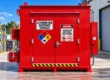
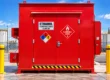
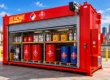
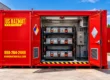
US Hazmat Rentals has compliant fire-rated storage buildings available for combustible materials New York sites of all types, with two-hour and four-hour fire-rated configurations, ventilation, secondary containment, and electrical classification matched to the material profile of each deployment. For the broader spectrum of combustible materials New York and tri-state operations manage, that documentation needs to be ready before the unit is placed, not after FDNY asks for it.
Book a call with our engineering team before you buy or rent to confirm the right configuration for your specific inventory, your occupancy type, and your FDNY permit requirements. Schedule your consultation with us.
FAQ
What are combustible materials under NFPA 30?
Combustible materials under NFPA 30 are liquids with flash points at or above 100 degrees Fahrenheit, classified as Class II (100-140°F), Class IIIA (140-200°F), and Class IIIB (200°F and above). Each class carries different quantity limits and storage requirements. Combustible materials New York facilities store are governed by NFPA 30 as adopted in the NYC Fire Code.
What flammable examples are most common in New York operations?
Gasoline, ethanol, and acetone are Class I flammable liquids common in New York construction and manufacturing. Diesel fuel and kerosene are Class II combustible liquids. Solvent-based paints are typically Class IB or IC flammable. Water-based paints are not flammable. Each product’s flash point determines its NFPA 30 class and the applicable storage requirements.
Does New York City require a permit for combustible material storage?
Yes. FDNY requires permits for flammable and combustible liquid storage above certain quantity thresholds, with requirements that vary based on building type, occupancy classification, and floor of storage. Combustible materials New York City facilities store above applicable thresholds must be permitted before arriving on-site. Certificate of Fitness requirements may also apply.
What is a paint lock and when is it required in New York?
A paint lock is a fire-rated storage locker designed for oil-based paints and coatings classified as flammable liquids under NFPA 30. In New York, painting contractors and building maintenance operations storing oil-based paints above the 25-gallon room limit or the 60-gallon cabinet limit must use compliant fire-rated enclosures under the NYC Fire Code.
How do you safely store lithium batteries in New York?
Requirements for how to safely store lithium batteries in New York include climate control, physical separation from combustible materials New York operations store alongside battery systems, fire-rated enclosures above NFPA 855 thresholds, suppression systems designed for lithium-ion chemistry, and FDNY notification and permit for energy storage systems above applicable capacity thresholds.
Can combustible materials be stored with flammable liquids in the same enclosure?
Combustible and flammable liquids can share a fire-rated enclosure in some configurations, but the aggregate quantity counts against the applicable NFPA 30 limits and the enclosure must be rated for the most demanding class in the inventory. Oxidizers, corrosives, and lithium battery systems require physical separation from combustible materials New York or elsewhere under the applicable segregation requirements.