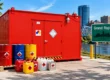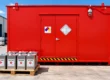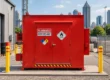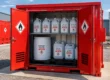
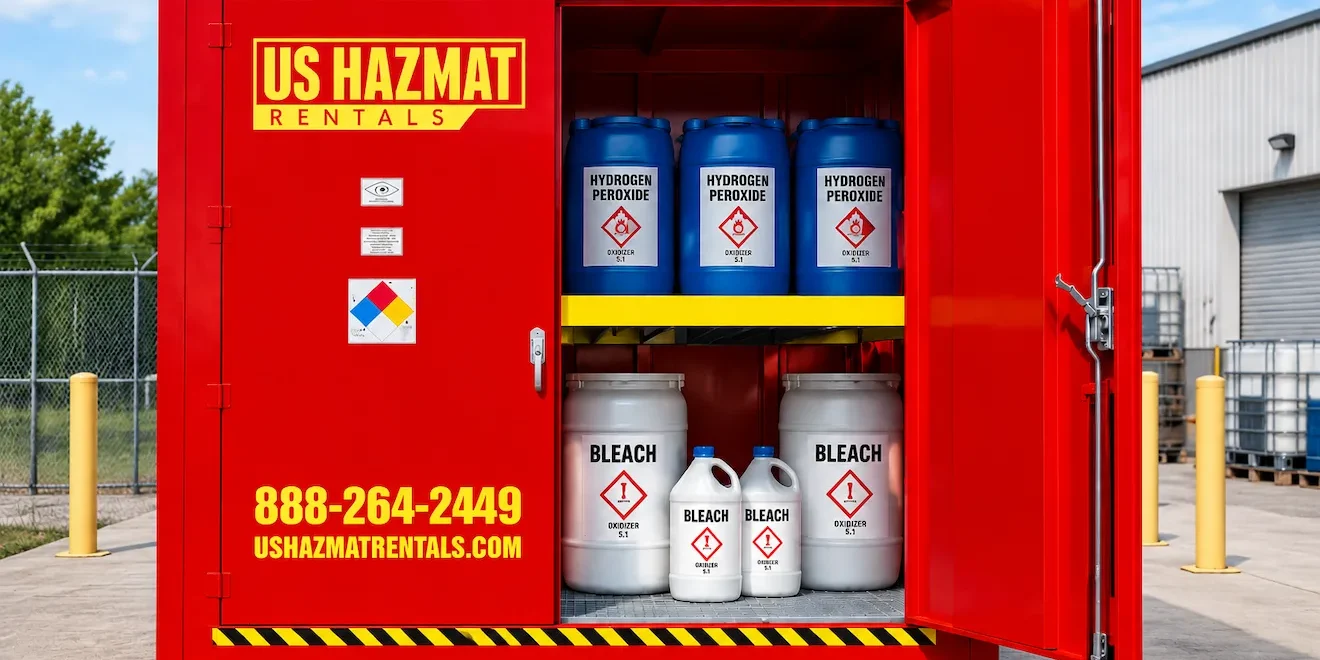
Before evaluating whether hydrogen peroxide and bleach belong in your facility’s chemical inventory, it helps to be clear about what both products actually are from a regulatory standpoint. Neither is a flammable liquid. Both are oxidizers. Hydrogen peroxide is classified as a Class 2 oxidizer under NFPA 400 at industrial concentrations, and sodium hypochlorite (bleach) carries a Class 1 or Class 2 oxidizer designation depending on concentration.
That classification is not just a labeling distinction. It determines the storage framework, the segregation requirements relative to other chemicals on site, and what can go wrong if storage planning treats them as ordinary cleaning products.
The reason hydrogen peroxide and bleach appear regularly in compliance questions about chemical storage is that both products are common in operations that also use flammable and combustible solvents. Water treatment facilities, pharmaceutical operations, food processing plants, healthcare facilities, and janitorial supply operations all handle oxidizing chemicals alongside cleaning solvents, alcohols, and degreasers.
When those chemicals end up in proximity without a reviewed storage plan, the risk is not theoretical. Hydrogen peroxide in contact with acetone can produce explosive peroxide compounds.
At US Hazmat Rentals, we work with EHS managers and facility teams setting up chemical storage for inventories that include hydrogen peroxide and bleach alongside solvents, flammable liquids, and other regulated materials. Getting the storage configuration right means understanding what each product requires, what it cannot be stored near, and how the facility’s overall inventory determines the enclosure configuration. This piece covers each of those questions directly.
What Hydrogen Peroxide Actually Is and Why It Matters for Storage
Hydrogen peroxide is an oxidizing liquid that decomposes slowly to water and oxygen under normal conditions and rapidly when contaminated, heated, or exposed to metals that catalyze the reaction. At concentrations above 8 percent by weight, it is classified as a Class 1 or Class 2 oxidizer under NFPA 400, with higher concentrations carrying more restrictive storage requirements.
Industrial grades range from 30 to 35 percent for laboratory and manufacturing use up to 50 percent for water treatment and food processing. Concentrated hydrogen peroxide above 91 percent is a Class 4 oxidizer, the most restrictive category in NFPA 400.
The storage requirement that follows from the oxidizer classification is physical segregation from all organic materials, reducing agents, and metals that accelerate decomposition. Most common industrial solvents, including acetone, methanol, ethanol, and isopropyl alcohol, are organic compounds.
Contact between hydrogen peroxide and bleach near any of these materials is not just a storage inconvenience; it is a reactive event with potential for fire, explosion, or toxic gas release. NFPA 400 requires that oxidizers be stored in dedicated enclosures separated from flammable and combustible liquids, with separation distances and construction requirements that vary by oxidizer class and quantity.
Container material also matters for hydrogen peroxide in ways it does not for most solvents. HDPE containers are appropriate for concentrations up to about 30 percent. Above that, specialty fluoropolymer containers or 316-grade stainless steel are used. Standard steel, aluminum, copper, and lead all catalyze H₂O₂ decomposition and are not appropriate container materials for any concentration.
What Bleach Is and Why It Belongs in a Different Storage Category
Sodium hypochlorite (bleach) is also an oxidizer rather than a flammable liquid. Household bleach at 3 to 8 percent is a mild oxidizer, but industrial bleach at 10 to 15 percent carries a more significant reactivity profile. The key incompatibilities are acids, ammonia-based products, and organic solvents. Contact between hydrogen peroxide and bleach with acids produces chlorine gas. Contact with ammonia produces chloramine.
Contact with acetone and other organic compounds produces chlorinated organic compounds, some of which are acutely toxic.
NFPA 400 governs hydrogen peroxide and bleach as oxidizers, requiring storage in enclosures constructed to limit fire spread, with ventilation that exhausts chlorine and oxygen off-gas rather than recirculating it, and with secondary containment to capture spills before they contact incompatible materials.
The ventilation requirement for bleach storage is driven primarily by chlorine vapor toxicity: OSHA’s permissible ceiling exposure limit for chlorine gas is 1 ppm, and enclosed bleach storage areas can exceed that threshold during a slow leak without adequate air exchange. The storage building for hydrogen peroxide and bleach does not need to be fire-rated in the same way a flammable liquid storage building does, but it does need oxidizer-compatible construction with the ventilation and secondary containment that oxidizer service demands.
Why Acetone Cannot Share Storage Space With Either Oxidizer
The incompatibility between acetone and the oxidizers in this piece is the most operationally consequential storage planning issue for facilities handling hydrogen peroxide and bleach alongside flammable solvents. Acetone is an organic compound and a reducing agent in the context of oxidizer chemistry.
Hydrogen peroxide in contact with acetone can produce acetone peroxide, a primary explosive that can form spontaneously in the liquid phase. That reaction does not require an ignition source. It can proceed in a storage area where both products are present through a spill, a leaking fitting, or an improperly sealed container.
Bleach in contact with acetone produces chloroacetone, a toxic lachrymatory agent. The reaction can occur at room temperature and does not require liquid mixing. Vapor-phase contact between chlorine gas from a bleach source and acetone vapors in a shared storage space can initiate the reaction at concentrations well below what can be detected without instrumentation.
This is why NFPA 400 and OSHA’s hazardous materials storage requirements mandate physical separation between oxidizers and organic flammable or combustible liquids, not just labeling or distance within the same room.
Acetone Container Requirements at Mixed-Inventory Sites
The acetone container question at facilities storing hydrogen peroxide and bleach alongside flammable solvents involves two related but distinct requirements. The first is the container specification itself: can you put acetone in a plastic container in an industrial setting? Under NFPA 30, no. Regulated quantities require UL-listed or FM-approved metal safety cans for dispensing and DOT-compliant metal drums for storage. General-purpose plastic containers are not appropriate for industrial acetone regardless of whether oxidizers are on site.
The second requirement is location. An approved metal safety can containing acetone placed in an oxidizer storage room is still a segregation violation. The container type and the storage location are separate compliance requirements. The acetone container must be in the flammable liquid storage enclosure, and that enclosure must be physically separated from the hydrogen peroxide and bleach storage enclosure. Both requirements have to be satisfied simultaneously.
For the full NFPA 30 framework that governs acetone and other flammable chemicals storage alongside oxidizer inventories, that resource covers the quantity limits, enclosure requirements, and ventilation criteria that apply to Class IB flammable liquid storage in facilities that also manage oxidizing chemicals.
How to Dispose of Acetone When Oxidizers Are Also on Site
The question of how to dispose of acetone is more constrained at facilities managing hydrogen peroxide and bleach, because the disposal pathways acceptable for acetone alone are not appropriate in proximity to oxidizers. For industrial quantities, acetone is a RCRA hazardous waste requiring disposal through a licensed hazardous waste contractor.
The EPA waste code depends on how the acetone was generated: spent solvent from manufacturing may carry the F003 listing under RCRA, while acetone from other source categories may be classified as a D001 characteristic hazardous waste (ignitable).
The practical protocol for how to dispose of acetone at a site with oxidizers is: collect acetone waste in approved flammable liquid containers, store those containers in the flammable liquid storage area away from the oxidizer inventory, and keep the waste stream separate throughout the collection process until the licensed contractor arrives for pickup. Acetone waste must never be combined with oxidizer waste, placed in oxidizer containers, or stored in secondary containment that also holds oxidizer spill residue.
NFPA 400 and the Oxidizer Storage Framework
NFPA 400 establishes maximum quantity limits by oxidizer class before additional controls are required, construction requirements for oxidizer storage buildings, separation distances from flammable and combustible liquids, and secondary containment specifications. The separation requirement between hydrogen peroxide and bleach storage and flammable liquid storage typically cannot be satisfied by a barrier within a shared building. Separate structures, or at minimum fully enclosed separate rooms with rated construction between them, are the standard solution.
A compliant oxidizer storage building for hydrogen peroxide and bleach needs construction materials compatible with oxidizing agents, ventilation that exhausts rather than recirculates air, and secondary containment of compatible material. For acetone and flammable solvent storage on the same site, the building specification follows NFPA 30 Class IB requirements: fire-rated construction, explosion-proof ventilation and electrical equipment, and secondary containment.
Two buildings, two permits, two AHJ reviews, two independent ventilation systems. The facilities that run into trouble are those that try to address both frameworks in a single enclosure.
Getting Both Storage Programs Right Before the First Inspection
Facilities that store hydrogen peroxide and bleach alongside flammable solvents need two storage compliance programs running in parallel. NFPA 400 covers the oxidizers. NFPA 30 covers the flammable and combustible liquids. The two storage enclosures have to be specified, placed, and permitted as a coordinated system, not as independent procurement decisions made at different times.
US Hazmat Rentals has storage solutions for both oxidizer and flammable liquid applications, with configurations matched to the actual chemical profile of each deployment. Compare options with a free consultation and let our engineering team confirm the right enclosure specification for both sides of your chemical inventory.
FAQ
What are hydrogen peroxide and bleach classified as under NFPA 400?
Hydrogen peroxide and bleach are both classified as oxidizers under NFPA 400, not as flammable liquids. Hydrogen peroxide at industrial concentrations is a Class 2 oxidizer (8-52%) or Class 3 (above 52%). Sodium hypochlorite is a Class 1 or Class 2 oxidizer. Neither is governed by NFPA 30, which applies to flammable and combustible liquids.
Can hydrogen peroxide and bleach be stored in the same enclosure?
Generally no. Both are oxidizers with different reactive profiles and incompatibilities. Both must be segregated from organic materials, acids, and reducing agents. The safest approach is separate enclosures for each, with each building’s ventilation and secondary containment designed for the specific oxidizer it houses.
Why can’t acetone be stored near hydrogen peroxide or bleach?
Acetone is an organic compound that reacts with both oxidizers. Hydrogen peroxide in contact with acetone can produce acetone peroxide, a primary explosive. Bleach in contact with acetone produces chloroacetone, a toxic compound. Both reactions can occur through vapor-phase contact without deliberate mixing. NFPA 400 and OSHA standards require physical separation between oxidizers and organic solvents including acetone.
Can you put acetone in a plastic container in a facility that also stores oxidizers?
For regulated industrial quantities, acetone must be stored in NFPA 30-approved metal containers regardless of what other chemicals are on site. Beyond the container type, the acetone storage location must be in a separate flammable liquid enclosure, not in or adjacent to the hydrogen peroxide and bleach storage enclosure. Both container specification and storage location are independent requirements.
How do you dispose of acetone when hydrogen peroxide or bleach is also on site?
Acetone is a RCRA hazardous waste requiring disposal through a licensed waste contractor. At sites with oxidizers, acetone waste must be collected in approved flammable liquid containers, stored in the flammable liquid storage area away from the oxidizer inventory, and kept separate throughout collection until contractor pickup. Acetone waste must never be combined with oxidizer waste or stored in the same containment basin.
What storage infrastructure is needed for both oxidizers and flammable solvents?
Two separate storage buildings are required: one for hydrogen peroxide and bleach under NFPA 400, and one for flammable solvents under NFPA 30. Each has its own ventilation, secondary containment, and electrical specification. The two buildings must be separated by the distances NFPA 400 requires between oxidizers and flammable liquids, and each must be separately permitted with the local AHJ.