Most facilities incorrectly assume all combustible materials are flammable and design their storage around that misperception. The regulations actually draw a line between the two and facilities on the wrong side of that line must design their storage with a different fire rating for their required enclosure, different electrical classification of the storage area, the quantity thresholds that apply to the inventory, and the documentation an AHJ inspector expects to find during a site review. There are three different frameworks for defining combustible vs flammable liquids.
They set different boundaries for the terms. For storage and use, NFPA 30, Flammable and Combustible Liquids Code, considers anything with a flash point below 100°F flammable and anything with a flash point above 100°F combustible.
For hazard communication, aligned with the Global Harmonization System, eliminates the combustible liquid category entirely and calls everything from very volatile solvents down to diesel fuel a “flammable liquid” in Categories 1 through 4. DOT Class 3 uses 141 degrees Fahrenheit as its transport threshold, which captures both the flammable and the lower combustible categories in a single hazard class. None of these frameworks is wrong.
At US Hazmat Rentals, the teams we hear from most often on the combustible vs flammable question are EHS managers and plant managers who are specifying storage buildings for the first time or who have inherited a storage setup that was never properly classified. The classification work comes first.
Flash Point Is the Number That Settles Everything
Flash point is the temperature at which a liquid generates enough vapor to ignite briefly in the presence of an ignition source. It is not the temperature at which the liquid sustains a fire, only the point at which it will flash. Every framework uses flash point as the primary sorting variable for the combustible vs flammable decision, and the threshold each framework uses determines what category a specific liquid lands in.
For liquids at temperatures below 100 degrees F, NFPA 30 classifies them as Class I liquids, flammable. Combustible liquids are classified for temperatures at or above 100 degrees F down to 200 degrees F. Within this range, they are combustible, subdivided into Class II (100°F to 140°F), Class IIIA (140°F to 200°F), and Class IIIB (200°F and above).
Each class connects to a specific set of storage requirements: quantity limits per room, container type, storage room construction, and ventilation criteria. The combustible vs flammable boundary at 100°F is where the most consequential storage requirement differences appear, because Class I is the most demanding tier in NFPA 30.
OSHA HazCom drops the word “combustible” entirely. A diesel fuel with a flash point of 125 degrees Fahrenheit, which NFPA 30 calls a Class II combustible liquid, becomes an OSHA Category 3 flammable liquid. The practical implication is that a facility reviewing its SDS documentation under HazCom sees “flammable liquid” across a broader range of products than NFPA 30 would classify that way.
Where NFPA 30 Classes Translate Into Storage Building Decisions
The six NFPA 30 classes are not symmetric in their storage consequences. Class I flammable liquids are further divided into IA, IB, and IC. Class IA covers flash points below 73 degrees Fahrenheit with boiling points at or below 100 degrees Fahrenheit, the highest-volatility group, which includes diethyl ether and petroleum naphtha.
Class IB covers flash points below 73 degrees Fahrenheit with boiling points above 100 degrees Fahrenheit, the category that includes acetone, gasoline, and ethanol. Class IC runs from 73 degrees Fahrenheit to just below 100 degrees Fahrenheit and covers materials like xylene and turpentine.
A facility that stores Class IB and Class II liquids in the same enclosure is managing two different NFPA 30 classes under one roof. The storage building has to satisfy the requirements of the more demanding class. A building specified for Class II combustible liquid storage and then loaded with Class IB flammable liquid is out of specification before the first drum hits the floor.
The combustible vs flammable class of each product in the inventory is what the AHJ will check against the building spec during a permit review, not the generic label on the drum. Class IIIB combustible liquids sit at the low-risk end of the spectrum.
Cooking oils, mineral oils, and heavier lubricants with flash points at or above 200 degrees Fahrenheit do not produce ignitable vapors at ambient temperatures and are generally not subject to NFPA 30 fire-rated construction requirements under standard conditions. Accurately classifying a product as Class IIIB rather than Class II or Class I produces a significant reduction in storage infrastructure cost and complexity.
DOT Class 3, UN 1993, and What “Flammable” Means on the Road
DOT Class 3 consists of liquids with a flash point below 141°F or such liquids as are specifically included in that Class in the Hazardous Materials Table. 141°F is the temperature at which the DOT Class 3 hazardous material becomes a combustible or flammable liquid according to the classification system.
Combustible liquids (Class II) and Class I flammable liquids both ship as DOT Class 3. The DOT classification does not distinguish between the two on the bill of lading; both travel with the same placard and the same basic handling requirements in transit.
UN 1993 is the proper shipping name for “Flammable liquids, n.o.s.,” the not-otherwise-specified entry for Class 3 materials that do not have a dedicated UN number in the hazardous materials table. A mixed solvent blend, a proprietary formulation, or any other Class 3 liquid that does not map to a named entry ships as UN 1993.
What is flammable within the 1993 Class 3 context spans the NFPA 30 combustible vs flammable divide: a product classified as combustible in storage can still ship as a flammable liquid under DOT.
For storage planning, DOT classification primarily governs labeling and packaging for outbound shipments. The on-site storage requirements come from NFPA 30 and OSHA, not from DOT. The fact that a product ships as DOT Class 3 does not by itself determine which NFPA 30 class applies to its on-site storage, and defaulting to the DOT classification for storage specification decisions is an avoidable error with real compliance consequences.
Is H₂O₂ Flammable? Where Oxidizers Break the Pattern
Hydrogen peroxide comes up often in combustible vs flammable classification reviews, and the answer is a clean no. H2O2 is not a flammable liquid under NFPA 30, OSHA HazCom, or DOT Class 3. It is an oxidizer, classified under NFPA 400 as a Class I oxidizer at concentrations above roughly 8 percent by weight, and as a Class 4 oxidizer above 91 percent concentration.
The source of confusion is that H₂O₂ clearly supports fire. Organic materials that would not ignite readily in ambient air can ignite in contact with concentrated hydrogen peroxide because the compound decomposes to release oxygen. The fire hazard is genuine. But “supports combustion” and “is a flammable liquid” are different regulatory categories, and the storage requirements for oxidizers under NFPA 400 are different from those for flammable and combustible liquids under NFPA 30.
Storing hydrogen peroxide in a flammable liquid storage building alongside organic solvents creates a compatibility hazard the building was not designed to manage. Contact between concentrated H₂O₂ and most organic compounds produces an exothermic reaction. The right approach places oxidizers in dedicated enclosures physically separated from flammable and combustible liquid inventory.
The combustible vs flammable analysis does not reach hydrogen peroxide; a separate NFPA 400 classification review does.
Combustible Liquid Flash Point and the Storage Building Cascade
Every storage building decision that follows a combustible vs flammable classification comes back to the flash point of the actual product at the actual concentration stored on-site. The combustible liquid flash point threshold at 100 degrees Fahrenheit under NFPA 30 changes the fire rating required for the enclosure, the ventilation rate required for the storage room, and whether the electrical equipment within the hazardous location zone needs Class I, Division 1 or Division 2 rated components.
Class I flammable liquid storage in a building demands fire-rated wall and roof construction at the rating NFPA 30 specifies for the quantity and occupancy type, mechanical ventilation with explosion-proof fans and motors, secondary containment beneath the floor, and Class I electrical equipment throughout the hazardous location zone.
Class II combustible liquid storage imposes similar requirements but often at less restrictive tiers depending on quantity and suppression. A building rated for Class I will satisfy Class II requirements. The reverse does not hold, and specifying a Class II-rated building for a Class I inventory is a classification error with measurable fire safety consequences.
Our flammable storage protection resources map the NFPA 30 quantity limits, fire rating tiers, and ventilation requirements across the full combustible vs flammable classification range. For a facility that has identified the NFPA 30 class of its inventory and needs to confirm the storage building configuration that matches, that resource covers the applicable provisions in detail.
Getting the Classification Right Before Anything Else
The combustible vs flammable question is not a paperwork issue. It is the engineering input that determines the fire rating, ventilation, and electrical specification of the storage building your facility needs. A wrong classification in that position means a storage building that does not match the hazard it houses, which is a compliance gap that appears during AHJ review or after an incident rather than during procurement.
The SDS for each product in your inventory, paired with the NFPA 30 edition your local AHJ has adopted, gives you the classification basis for the storage building specification. Every other decision follows from that starting point.
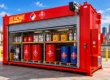
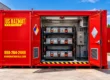
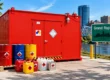
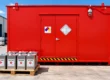
US Hazmat Rentals has fire-rated storage buildings in inventory for Class I flammable and Class II through IIIA combustible liquid applications, with two-hour and four-hour configurations, ventilation, and secondary containment ready to deploy. Schedule a free site consultation today and confirm the right configuration before your next inspection window closes. Book your consultation here.
FAQ
What is the difference between combustible vs flammable under NFPA 30?
Flammable liquids under NFPA 30 are Class I: flash point below 100 degrees Fahrenheit. Combustible liquids are Class II through IIIB: flash point at or above 100 degrees Fahrenheit. The combustible vs flammable split at that threshold determines the applicable quantity limits, fire-rated construction requirements, and ventilation criteria for storage.
What is the combustible liquid flash point threshold under NFPA 30?
One hundred degrees Fahrenheit. Liquids with flash points between 100°F and 140°F are Class II combustible. Between 140°F and 200°F is Class IIIA. At 200°F and above is Class IIIB. Below 100°F the liquid is a Class I flammable liquid, subject to the most restrictive storage provisions in NFPA 30.
How does OSHA HazCom handle the combustible vs flammable distinction?
OSHA HazCom, aligned with the GHS, does not use the term “combustible liquid.” All liquids in the relevant flash point range are categorized as flammable liquids in Categories 1 through 4. What NFPA 30 calls combustible falls into Categories 3 and 4 under OSHA. The combustible vs flammable framing is an NFPA 30 distinction, not a HazCom one, and the two frameworks govern different compliance obligations.
What is “flammable 1993 class 3” in DOT transport?
UN 1993 is the DOT proper shipping name for “Flammable liquids, n.o.s.,” the not-otherwise-specified entry for DOT Class 3 materials without a dedicated hazardous materials table entry. Class 3 covers flash points below 141°F, which spans both Class I flammable and Class II combustible liquids under NFPA 30. The combustible vs flammable line that NFPA 30 draws at 100°F does not appear in DOT transport classification.
Does a combustible liquid require a fire-rated storage building?
Class II and Class IIIA combustible liquids stored indoors above OSHA’s 25-gallon room limit require storage controls under NFPA 30, which may include fire-rated construction depending on quantity, occupancy type, and whether suppression is installed. The combustible vs flammable class of the specific product determines which provisions govern the storage arrangement.