Every facility that adds hydrogen peroxide to its chemical inventory eventually hits the same wall: nobody agrees on where it belongs. EHS teams file it with the cleaning supplies. Maintenance drops it next to the solvent rack. Procurement buys it in bulk without a storage plan. The question everyone should have asked from the start, is hydrogen peroxide flammable, gets answered with a shrug or a wrong assumption, and the classification error compounds from there.
The correct answer is no. Hydrogen peroxide is not a flammable liquid. Under NFPA 30 and DOT regulations, it carries no flash point classification and no place in a standard flammable storage cabinet. DOT classifies it as a Class 5.1 oxidizer, and NFPA 400 governs its storage, not NFPA 30. That single regulatory distinction shapes every decision downstream: cabinet type, sensor selection, secondary containment material, ventilation rate, and segregation distance from everything else on site.
At US Hazmat Rentals, we field this question regularly from safety managers and procurement teams building a storage plan before, not after, a fire marshal walks through the door. Confirming that is hydrogen peroxide flammable resolves to a “no” is the right starting point, but the compliance work that follows from it is where most facilities underestimate the scope.
What the Regulatory Framework Actually Says
NFPA 30 classifies liquids by flash point. Class IA materials ignite below 73°F with boiling points under 100°F; Class II and Class III materials have progressively higher flash points. Hydrogen peroxide has no flash point in that sense; it does not produce ignitable vapor the way acetone or ethanol does. When procurement teams ask is hydrogen peroxide flammable and look to NFPA 30, they will not find it there, because the chemical belongs to an entirely separate regulatory category.
NFPA 400 is where the classification lives. At concentrations between 8% and 52%, hydrogen peroxide is a Class 2 oxidizer. From 52% to 91%, it is Class 3. Above 91%, which covers industrial bleaching and aerospace-grade product, it is Class 4 with the most restrictive requirements in the standard. Most facilities using H₂O₂ for sanitation, surface treatment, or water purification work in the Class 2 range, but segregation, ventilation, and secondary containment requirements apply at every level.
DOT reinforces that picture. Solutions at or above 8% travel under UN 2014 or UN 2015 as Class 5.1 oxidizers. Placard requirements, storage separation distances, and fire suppression specs all trace back to that designation. Facilities that confirm is hydrogen peroxide flammable through their Safety Data Sheets will find the Class 5.1 oxidizer label clearly stated before the storage question ever gets to a site plan.
The Hazard That a Simple “No” Can Obscure
Hydrogen peroxide does not burn. What it does is feed fires started by everything around it. As H₂O₂ decomposes, it releases oxygen gas; a process accelerated by heat, UV exposure, heavy metal ion contamination, and contact with organic materials. In a confined storage room, that free oxygen raises the ambient O₂ level above the 21% that constitutes normal air. Any flammable material sharing that space now has a lower ignition threshold, a narrower explosive limit range, and a higher fire intensity potential.
Answering is hydrogen peroxide flammable with a plain “no” and treating the chemical as a benign cleaning product misses exactly that dynamic. A warehouse keeping acetone or isopropyl alcohol in the same room as its H₂O₂ drums has not reduced its fire risk by confirming the peroxide itself will not ignite. The oxidizer creates conditions under which everything flammable in proximity becomes more dangerous.
Contact contamination adds a separate risk layer. Organic materials like rags, cardboard, and wood shavings in direct contact with concentrated hydrogen peroxide can ignite spontaneously. Heavy metal salts and concentrated acids catalyze rapid decomposition. For any team asking is hydrogen peroxide flammable as a starting point for risk classification, these contact hazards represent the follow-on questions that determine actual storage and handling protocols.
NFPA 400 Storage Specifics
NFPA 400 Chapter 10 establishes the structural and operational requirements for oxidizer storage: segregation distances, secondary containment, ventilation rates, and construction materials. For Class 2 oxidizers stored above the maximum allowable quantity per control area, which varies by occupancy type and sprinkler status, a dedicated storage room or freestanding outdoor building is typically required.
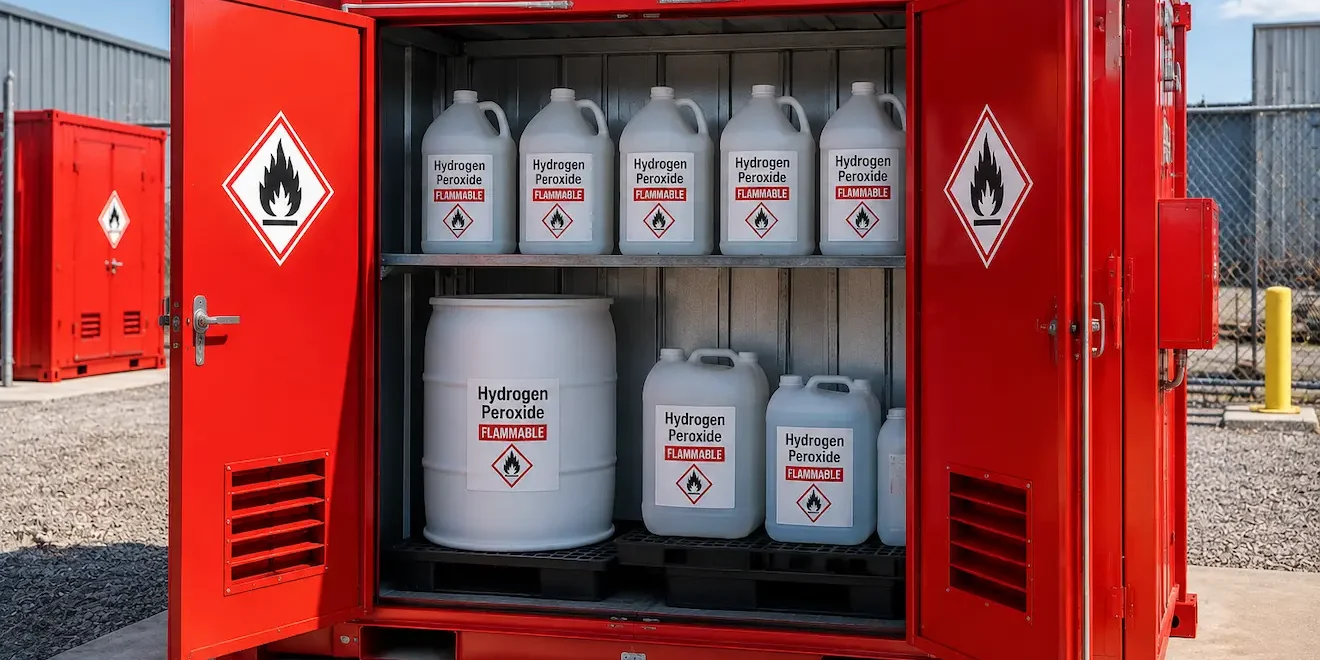
Freestanding outdoor storage is usually the most defensible path for drum or tote quantities. The building needs noncombustible or limited-combustible construction, secondary containment sized to the largest vessel plus an overflow margin, and continuous mechanical ventilation at the rate NFPA 400 specifies for the concentration and quantity stored. Any facility that has answered is hydrogen peroxide flammable correctly but has not addressed the ventilation spec for its oxidizer building has an open compliance gap that AHJ review will identify.
The same facilities that correctly resolved is hydrogen peroxide flammable sometimes overlook the containment spec and introduce a catalytic contamination risk through the wrong sump material. Galvanized steel, carbon steel, and copper all accelerate H₂O₂ decomposition. HDPE suits concentrations up to about 30%; stainless steel 316L, PTFE, and PVDF handle higher concentrations. Bare concrete without a compatible liner introduces mineral contamination risk that AHJ inspectors flag routinely.
Why Your Flammable Gas Sensor Will Not Catch It
Sensor selection is where the is hydrogen peroxide flammable classification has its most direct operational consequence. Catalytic bead and infrared flammable gas sensors detect combustible vapor in air. Hydrogen peroxide vapor is not combustible; it will not trigger either sensor type. A facility running only flammable gas monitoring in a space that also holds H₂O₂ has a real gap in its detection coverage, and that gap is not theoretical.
As decomposing H₂O₂ raises ambient O₂ above 23.5%, the OSHA threshold for oxygen-enriched atmospheres, flammable vapors from any other material in the space become significantly more reactive. A flammable gas sensor may eventually alarm if solvent concentrations climb high enough, but it provides no warning that elevated oxygen has already shifted the hazard profile. This is the monitoring gap most facilities miss when they answer is hydrogen peroxide flammable, conclude “no flammable vapor,” and install only a single sensor type.
The correct specification for any space where hydrogen peroxide and flammable solvents share an environment is dual monitoring: a flammable gas sensor calibrated for the solvents present, and an oxygen monitor set to alarm at 23.5% O₂ or lower. A fire protection engineer or industrial hygienist should specify both in a documented monitoring plan rather than leaving sensor selection to a general contractor working from memory.
Lithium Batteries and Oxidizer Co-Storage
Modern facilities increasingly ask about co-locating battery energy storage systems with chemical inventory. The best way to store batteries from a compliance standpoint depends heavily on what else occupies the same footprint. NFPA 855 governs stationary battery installations and specifies separation distances from hazardous chemical storage, including oxidizers.
Teams that resolve the is hydrogen peroxide flammable question and conclude the chemical poses no flammability concern sometimes stop there and assume battery co-location is acceptable. The overlooked risk is thermal runaway. Under fault conditions, lithium-ion and lithium iron phosphate cells can generate sustained heat, flammable off-gases, and open flame. An oxidizer nearby means the oxygen available to feed that fire exceeds what ambient air alone would provide, often overwhelming suppression systems designed for normal atmospheric conditions.
On cold storage: lithium cells tolerate temperatures as low as -4°F without structural damage, though available capacity drops at low temperatures. Long-term storage in the 50 to 77°F range at a partial state of charge is the standard manufacturer guidance. Temperature planning and oxidizer segregation are separate engineering problems. A facility that resolved both is hydrogen peroxide flammable and can you store lithium batteries in the cold still has the NFPA 855 separation requirement to address before co-location is permissible.
Containers, Material Compatibility, and Drums
For H₂O₂ concentrations up to about 30%, stabilized HDPE drums and intermediate bulk containers are the standard choice, provided they are dedicated to peroxide service and kept free of contamination. Above 30%, the compatible material list narrows to stainless steel 316L, PTFE-lined vessels, and PVDF containers. Carbon steel, galvanized steel, and copper are incompatible at any concentration and should not appear anywhere in the storage or containment footprint.
Facilities still working through the is hydrogen peroxide flammable classification often discover the container compatibility question mid-project, after purchasing drums that do not meet the concentration spec.
Secondary containment around those containers requires the same compatibility review. A galvanized sump, a drip tray with exposed iron fittings, or a carbon steel floor grate introduces catalytic surface area that drives decomposition. Inspectors reviewing oxidizer storage flag incompatible containment materials consistently, particularly at facilities that migrated from flammable liquid storage to peroxide storage without revisiting the containment design.
Disposal and Waste Stream Management
Spent or off-spec hydrogen peroxide carries its own regulatory obligations. Under RCRA, contaminated H₂O₂ may qualify as a characteristic hazardous waste depending on what the peroxide contacted and what reactive properties remain. Dilute solutions below 8% are sometimes accepted by wastewater treatment facilities, but written confirmation from the POTW authority and a review of the facility’s discharge permit are required before assuming drain disposal is permitted.
For any team that started its storage planning by asking is hydrogen peroxide flammable, the disposal question demands the same structured rigor. The oxidizer classification does not change at end of life. Concentrated waste peroxide should not be neutralized, diluted, or combined with other waste streams without written procedures from a qualified chemist or EHS professional. Waste storage pending disposal must satisfy the same incompatibility and containment requirements as the original product.
Two Ways Facilities Get the Classification Wrong
Most classification errors fall into one of two patterns. The first is false clearance: the team asked is hydrogen peroxide flammable, got the correct “no,” and concluded the chemical can go in the general storage room with the cleaning supplies. The second error runs in the opposite direction: a standard NFPA 30 flammable cabinet is installed and treated as satisfying the oxidizer storage requirement.
NFPA 30 cabinets retain flammable vapors and resist fire exposure for a defined period; they are not designed to manage oxygen release, oxidizer incompatibility, or the segregation distances NFPA 400 requires.
Placing concentrated H₂O₂ in a flammable cabinet alongside solvents creates exactly the incompatible co-storage configuration NFPA 400 is written to prevent. Hydrogen peroxide storage is its own compliance project.
Every site that has asked is hydrogen peroxide flammable and received a correct “no” still needs a dedicated NFPA 400 program: container specs, ventilation requirements, secondary containment design, and a monitoring plan that goes beyond what the flammable storage program requires. When oxidizer and flammable storage must coexist in the same structure, both frameworks have to be satisfied simultaneously, which requires an engineering review before construction begins.
AHJ Coordination and Local Requirements
The baseline regulatory framework runs through NFPA 400, OSHA 29 CFR 1910.119 for PSM-covered facilities, and EPA’s Risk Management Program for sites above RMP threshold quantities. In practice, local AHJ enforcement frequently adds requirements that exceed the federal and NFPA baseline. Metropolitan areas and states with active fire code programs often impose lower permit thresholds for oxidizer storage, additional pre-installation plan review, or supplemental monitoring requirements absent from the model codes.
Engaging the AHJ before finalizing a storage layout avoids required modifications after the unit is already in service. Permit applications and pre-inspection documentation that clearly answer is hydrogen peroxide flammable, identify it as a DOT Class 5.1 oxidizer, and present the full NFPA 400 storage plan signal to the reviewer that hazard classification was handled correctly from the outset. The US Hazmat Rentals flammable storage protection page covers how oxidizer and flammable storage requirements interact when both chemical types are present on the same site.
Building a Storage Plan That Holds Up
A formal hazard assessment before any storage unit selection is not paperwork overhead; it is the step that prevents retrofits. That assessment should document concentration and total quantity, proximity of flammable liquid storage, material compatibility of existing secondary containment, local AHJ requirements beyond NFPA 400, and the current monitoring configuration for both flammable vapors and oxygen enrichment.
The is hydrogen peroxide flammable question anchors the assessment by placing the material under NFPA 400 rather than NFPA 30, which determines every specification that follows. Facilities that skip the assessment and select a storage unit based on the “no flammability” answer alone routinely discover mismatches between their unit and the AHJ’s actual requirements.
A freestanding outdoor oxidizer storage building with verified ventilation, NFPA 400-compliant secondary containment, and integrated dual-sensor monitoring is the most defensible configuration for quantities above the per-control-area maximum for your occupancy class. It is also the configuration most likely to clear an AHJ review without requiring changes after installation.
To work through your site specifics and get storage options matched to your actual inventory, reach out to the US Hazmat Rentals team through the site consultation page. Schedule a free site consultation today.
FAQ
Is hydrogen peroxide flammable under NFPA 30?
No. NFPA 30 governs flammable and combustible liquids classified by flash point. Hydrogen peroxide has no flash point in the traditional sense and is not listed under that standard. It is a DOT Class 5.1 oxidizer regulated by NFPA 400.
What is the difference between an oxidizer and a flammable liquid for storage purposes?
Flammable liquids ignite through their own vapor; oxidizers release oxygen that accelerates combustion in nearby materials. They require separate storage standards, different containment specs, and different sensor types. Placing them in the same room without engineered controls is an NFPA 400 violation.
Does a flammable gas sensor detect hydrogen peroxide vapor?
No. Catalytic bead and infrared sensors detect combustible vapor concentrations. Hydrogen peroxide is not combustible, so it will not register on either sensor type. An oxygen monitor is required to detect the elevated O₂ that H₂O₂ decomposition creates in enclosed spaces.
What NFPA 400 classification applies to common industrial hydrogen peroxide concentrations?
Solutions from 8% to 52% are Class 2 oxidizers. Concentrations from 52% to 91% are Class 3. Most industrial and laboratory applications fall in the Class 2 range, but segregation, ventilation, and secondary containment requirements under NFPA 400 apply at all levels.
Can hydrogen peroxide be stored in the same room as lithium batteries?
Not without engineered controls per NFPA 855. Lithium battery thermal runaway events produce heat and flammable off-gases; the oxygen released by H₂O₂ decomposition can intensify those fires significantly. NFPA 855 specifies separation distances that must be satisfied before co-location is permissible.
Can you store lithium batteries in the cold?
Yes, within limits. Cells tolerate storage as low as -4°F without permanent damage, though capacity decreases temporarily at cold temperatures. Optimal long-term storage is 50 to 77°F at a partial state of charge. Cold temperature planning and oxidizer segregation requirements are independent problems; satisfying one does not address the other.