Walk through any paint shop, nail salon lab, or solvent-cleaning operation and you will find acetone in use. It cuts through adhesives, strips cured coatings, and dilutes resins with an efficiency that keeps it on purchasing lists across dozens of industries. But, is acetone flammable? That question should precede every purchasing decision, every storage layout, and every cabinet spec. The answer is an unambiguous yes.
Acetone carries a flash point of -4°F (-20°C), which means it produces ignitable vapor well below room temperature, far below the threshold that defines even the most aggressive Class IA flammable liquids under NFPA 30. Understanding exactly where acetone sits in the regulatory framework determines every downstream compliance decision, from the cabinet type on the shop floor to how waste solvent leaves the building.
Most facilities already know acetone burns. What trips up EHS teams and plant managers is the gap between that general awareness and the specific NFPA 30 classification that governs storage quantity limits, cabinet specifications, and room requirements.
Is acetone flammable enough to trigger the 25-gallon outside-cabinet threshold? Yes, immediately. Is acetone flammable at concentrations that require Class I electrical equipment in the storage zone? Depending on ventilation and quantity, yes. The compliance consequences of a correct answer go further than most teams expect.
At US Hazmat Rentals, we field this question from safety managers building storage programs for new facilities, plant managers adding solvents to an existing flammable storage footprint, and procurement teams trying to confirm that the cabinet they already have covers the acetone they just added.
NFPA 30 Classification: Class IB Flammable Liquid
NFPA 30, the Flammable and Combustible Liquids Code, organizes materials by flash point and boiling point into a tiered classification system that determines storage requirements at every quantity level. Class IA covers liquids with flash points below 73°F and boiling points under 100°F. Class IB, where acetone lives, covers flash points below 73°F and boiling points at or above 100°F. Acetone’s flash point of -4°F and boiling point of 133°F place it squarely in Class IB.
Is acetone flammable at room temperature? Yes, and below it. At standard indoor temperatures of 68°F to 72°F, acetone is already producing ignitable vapor well above its flash point. The lower explosive limit (LEL) for acetone vapor in air is 2.5%; the upper explosive limit (UEL) is 12.8%. That range represents a broad flammability window. Any ignition source, including a static discharge from an ungrounded container transfer, a pilot light in an adjacent HVAC system, or a non-rated light switch, can initiate combustion if vapor concentrations reach that range.
The autoignition temperature for acetone is approximately 869°F (465°C), which means it will not self-ignite from surface heat alone under normal industrial conditions. But that number does not reduce the flash point hazard. Is acetone flammable at ignition sources common in industrial environments? Yes, and the -4°F flash point is the specification that controls storage requirements, not the autoignition temperature.
OSHA Storage Thresholds: What the Numbers Require
OSHA 29 CFR 1910.106 establishes the quantity limits that trigger cabinet and storage room requirements for flammable liquids in general industry. The regulation is direct: no more than 25 gallons of Class IA, IB, and IC flammable liquids combined may be stored in containers outside of an approved flammable storage cabinet in any single storage area. Once a facility answers is acetone flammable and confirms Class IB status, that 25-gallon threshold becomes the immediate planning parameter.
Inside an approved flammable storage cabinet, the limit for Class I and II liquids combined is 60 gallons per cabinet. Per-control-area aggregate limits apply beyond individual cabinet specifications: non-sprinklered occupancies are generally limited to 120 gallons of Class I and II liquids across all cabinets in a single control area.
Fully sprinklered buildings typically allow 240 gallons per control area under NFPA 30. Exceeding either threshold without moving to a dedicated storage room or an outdoor storage building is a citable violation, regardless of how compliant the individual cabinets appear.
Facilities that stock acetone in quantities approaching or above those aggregate limits need to think in terms of storage rooms or freestanding outdoor units rather than cabinet additions. The regulatory answer to is acetone flammable defines which compliance path applies; the quantity in use determines which point on that path the facility occupies.
DOT Classification and Transport Requirements
The Department of Transportation classifies acetone as a Class 3 flammable liquid under 49 CFR 172.101, assigned UN 1090 and Packing Group II. That classification governs labeling, placarding, packaging specifications, and shipping paper requirements whenever acetone moves in commerce or between facilities. Any operation that receives, ships, or transfers acetone between locations needs to understand that is acetone flammable as a DOT matter carries specific documentation and packaging obligations that begin at the receiving dock.
Packing Group II places acetone in the middle tier of hazard severity for Class 3 liquids, requiring UN-rated packaging, proper labeling with the Class 3 flammable liquid diamond, and placarding for shipments at or above the reportable quantities. For facilities receiving acetone in bulk quantities via tanker or IBC, the DOT requirements for offloading, transfer equipment, and interim storage during receipt apply from the moment the vehicle enters the property.
The Class 3 DOT designation also matters for emergency response planning. Facilities above threshold planning quantities under OSHA’s PSM standard or EPA’s RMP must account for acetone as a flammable liquid in their hazard analysis. Most solvent-cleaning operations fall below PSM thresholds, but the DOT classification shapes the emergency information on placards and Safety Data Sheets that first responders use.
Any facility whose emergency response plan was built before confirming is acetone flammable under DOT should verify the incident classification and response protocols reflect the Class 3 designation.
Acetone Safety: Vapor Behavior and Ignition Control
Acetone vapor is approximately 2.0 times heavier than air, which means it accumulates in low points: sumps, floor drains, below-grade pits, and the lower portions of enclosed rooms. This vapor density behavior is the most underappreciated element of acetone safety in facilities that store the solvent in enclosed spaces. A spill on an elevated shelf does not stay at shelf height; the vapor migrates down and can travel significant distances to reach an ignition source that is not adjacent to the storage area.
Any acetone safety program that does not address low-point vapor accumulation is incomplete. Floor drains in storage areas that hold acetone should either be sealed or equipped with liquid seals rated for flammable solvent service. Is acetone flammable in low-drain areas even after the main storage container is closed? Yes, because residual vapor from prior handling or minor spills continues to settle and accumulate until ventilation clears it.
Container transfer operations require grounding and bonding cables to prevent static discharge ignition. Acetone has low electrical conductivity, which means static charge can build during transfer and discharge at the container opening. Approved safety cans with spring-loaded lids and flame arrestors reduce this risk significantly.
Open-top containers during any transfer operation in a non-classified area are an unacceptable practice for a material with a -4°F flash point. Teams that confirmed acetone flammability at the procurement stage and then set up transfer stations without grounding hardware have addressed the storage question without closing the handling gap.
Storage Containers and Cabinet Specifications
The answer to is acetone flammable directly determines the container and cabinet specifications that apply. HDPE (high-density polyethylene) plastic containers are compatible with acetone for short-term storage at concentrations up to approximately 100%, but HDPE is not rated for long-term storage of acetone due to swelling and permeability concerns over extended periods. The preferred containers for acetone storage are steel safety cans with spring-loaded lids and UN-certified drums for larger quantities.
Flammable storage cabinets used for acetone must be FM Global or UL-listed for flammable liquid service. Under NFPA 30 and OSHA 1910.106, a compliant cabinet has at least 18-gauge steel construction on the door, 16-gauge on the body, a three-point latch, self-closing door mechanism, a 2-inch raised sill, and vent openings with fusible-link closures. A cabinet that lacks FM or UL listing is not an approved container under either standard regardless of its construction quality or appearance.
Facilities asking is acetone flammable that then select a non-listed cabinet to handle the storage gap below the 25-gallon outdoor limit have not closed the compliance gap. The listing is the compliance mechanism, not the steel gauge or the locking handle. Our flammable chemicals storage page covers compatible cabinet and building specifications for Class IB solvents including acetone.
Waste Acetone: RCRA Classification and Disposal
Acetone used as a solvent in industrial cleaning, paint thinning, or resin dilution becomes a hazardous waste at end of life under RCRA. Spent acetone from solvent-cleaning operations is classified as F003, a listed hazardous waste from non-specific sources where acetone is used as a solvent. Regardless of whether the F003 listing applies, spent acetone with any remaining ignitability (flash point below 140°F) also qualifies as D001 characteristic hazardous waste.
The hazardous waste classification means spent acetone cannot be disposed of in municipal trash, poured to a drain without a permitted wastewater treatment authorization, or combined with other waste streams without a written waste management procedure. Storage of waste acetone while awaiting pickup by a licensed hazardous waste hauler must meet the same cabinet and aggregate quantity requirements that apply to the virgin product. Is acetone flammable waste subject to separate storage limits from fresh product? Yes; the same OSHA and NFPA 30 thresholds apply to waste solvents in the same control area.
RCRA also prohibits the disposal of acetone waste into containers that previously held incompatible materials without decontamination. Facilities that co-generate acetone waste with oxidizing chemical waste, such as hydrogen peroxide disposal streams, must ensure complete waste stream separation.
Acetone is a Class 3 flammable liquid; hydrogen peroxide disposal involves a Class 5.1 oxidizer waste stream. Combining them is an incompatibility violation under both RCRA and DOT. The same EHS team that asked is acetone flammable during procurement needs to ask the same question about the waste stream during disposal planning, because the flammable classification does not end when the solvent is spent.
Ventilation Requirements and Electrical Classification
Ventilation is a code requirement, not a best practice, for enclosed spaces where acetone is stored or handled. NFPA 30 requires that storage areas for Class I flammable liquids maintain vapor concentrations below 25% of the LEL through continuous or demand-based mechanical ventilation. For acetone, 25% of the 2.5% LEL is 0.625% vapor by volume. Achieving that concentration limit requires ventilation rate calculations based on the storage quantity, room volume, and ambient temperature.
Electrical equipment within classified areas where acetone vapor may accumulate must meet National Electrical Code (NEC) Article 500 requirements for Class I, Division 1 or Division 2 locations depending on whether vapor concentrations are likely under normal or only abnormal conditions. Standard commercial light switches, standard electrical outlets, and non-rated motors within the classified zone are ignition sources. Facilities that confirm it is acetone flammable and then fail to classify the electrical environment around the storage area have left a significant compliance and safety gap.
The classified area boundary extends beyond the cabinet itself. NEC and NFPA 30 both define the extent of the hazardous area in terms of distance from the source and height above the floor, accounting for the heavier-than-air vapor behavior of Class IB solvents. Facilities that completed a storage layout after confirming is acetone flammable but skipped the electrical classification step are a common inspection finding in facilities with mixed-chemical storage programs.
When Cabinet Storage Isn’t Enough
There is a compliance ceiling on what any cabinet configuration can address. When aggregate acetone quantities across a control area approach the per-control-area limits under NFPA 30, the next compliant step is a dedicated flammable liquid storage room or a freestanding outdoor storage building. This transition is not optional once the aggregate limit is exceeded, and it requires the same fire-resistive construction, ventilation, and electrical classification that applies to any other enclosed flammable storage.
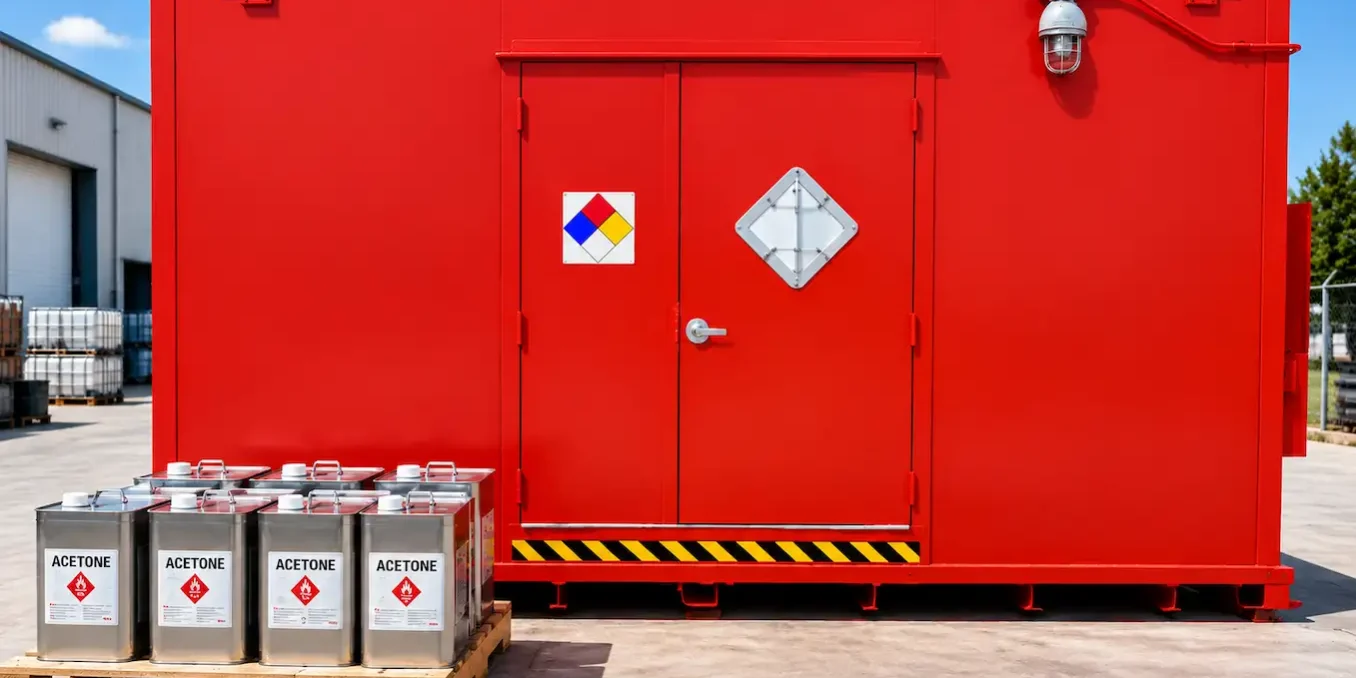
Outdoor freestanding storage buildings are often the most practical solution for operations that have outgrown the cabinet configuration. They eliminate the indoor aggregate quantity problem, reduce the fire load inside occupied production areas, and place the storage at a code-compliant separation distance from the facility. Is acetone flammable enough to require secondary containment in those outdoor buildings? Yes; NFPA 30 requires secondary containment for outdoor flammable liquid storage capable of holding the volume of the largest container plus a safety margin.
For facilities in transition between cabinet storage and dedicated buildings, or for job sites that need temporary compliant storage for acetone during a project phase, a rental outdoor flammable storage unit is often the fastest path to compliance without a capital construction commitment.
Reserve Before the Next Order Cycle
A Class IB flammable liquid with a -4°F flash point leaves no margin for storage improvisation. Is acetone flammable in a way that waits for a near-miss before requiring a storage plan? No. The flash point is the governing parameter from the first gallon received, and the OSHA and NFPA 30 requirements scale with every gallon added to the inventory.
Facilities that have confirmed is acetone flammable, mapped their aggregate quantities, and identified gaps in cabinet capacity, ventilation, or electrical classification have a clear compliance path. The first step is matching the storage solution to the regulatory requirements before the next purchasing cycle adds volume that the existing setup cannot accommodate.
Reserve your unit or building before the next order cycle. Reach out to US Hazmat Rentals through our flammable chemicals page to see what listed cabinet and outdoor storage options are available for Class IB solvents with fast delivery to your site.
FAQ
Is acetone flammable at room temperature?
Yes. Acetone has a flash point of -4°F (-20°C), which means it produces ignitable vapor well below room temperature. At any standard indoor temperature, acetone is already generating combustible vapor above its flash point threshold.
How does NFPA 30 classify acetone?
NFPA 30 classifies acetone as a Class IB flammable liquid based on its flash point below 73°F and boiling point at or above 100°F. That classification triggers the most stringent flammable liquid storage requirements under the code.
What are the OSHA storage limits for acetone?
OSHA 29 CFR 1910.106 limits storage of Class IB flammable liquids to 25 gallons outside an approved cabinet in any storage area. An approved cabinet holds up to 60 gallons. Aggregate per-control-area limits are 120 gallons in non-sprinklered occupancies and 240 gallons in sprinklered buildings.
Does hydrogen peroxide freeze, and is it stored with acetone?
Hydrogen peroxide freezes at slightly above 32°F depending on concentration. It must never be co-stored with acetone. Acetone is a Class 3 flammable liquid; hydrogen peroxide is a Class 5.1 oxidizer. NFPA 400 prohibits incompatible co-storage of oxidizers with flammable liquids.
Is acetone waste a hazardous waste under RCRA?
Yes. Spent acetone from solvent use is F003 listed hazardous waste. If ignitable, it also qualifies as D001 characteristic hazardous waste. It requires storage in approved containers, segregation from incompatible waste streams, and pickup by a licensed hazardous waste hauler.
What containers are approved for acetone storage?
Steel safety cans and UN-certified steel drums are the preferred containers for acetone. HDPE containers are chemically compatible short-term but not recommended for long-term storage due to permeability concerns. All containers should be clearly labeled and kept in a listed flammable storage cabinet or approved building.