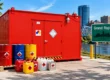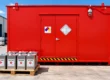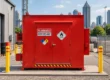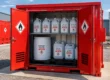
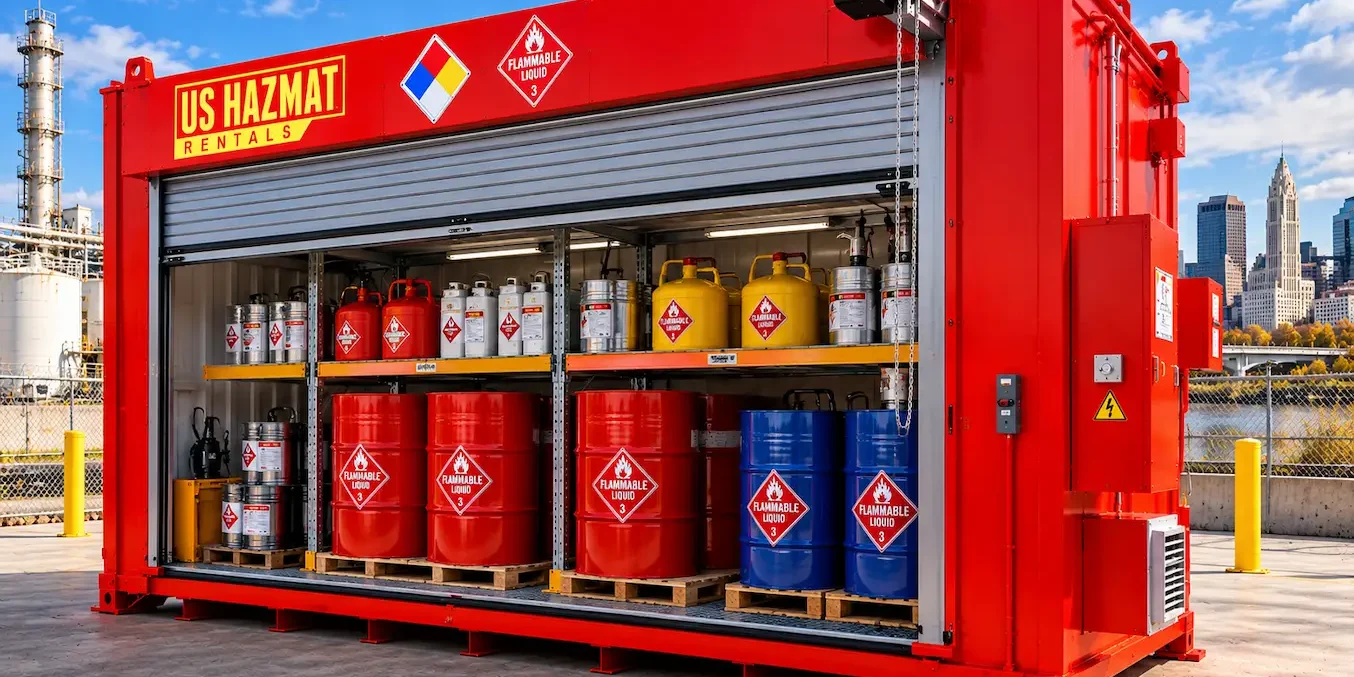
Columbus runs on chemicals. The distribution centers along I-71 and I-70, the manufacturing corridors in the northwest industrial belt, the automotive and aerospace component shops scattered across Franklin and Delaware Counties. Every one of them moves or stores liquids that carry a DOT hazard classification. For most of those operations, the classification that matters first is Class 3. Class 3 hazardous materials Columbus facilities encounter in day-to-day procurement include everything from acetone in a parts-cleaning bay to diesel in an on-site fuel tank to toluene in a paint or adhesive line.
What they share is a flash point low enough to produce ignitable vapor under normal conditions, and a regulatory framework that assigns specific storage, labeling, transport, and documentation requirements from the first container received.
In your role as a procurement and EHS manager at a facility in Columbus you are faced with more than just determining whether your facility stores Class 3 hazardous materials. Storage, ventilation, signage and emergency response plans must be adequate for the actual material (class and quantity) stored at your facility. Determining the appropriate match right is a multi-layer compliance problem that spans DOT, OSHA, NFPA, and local fire code, and it has real consequences when the match is off.
US Hazmat Rentals works with Columbus-area facilities to close those gaps before an inspection or incident brings them to light, and the first step in that conversation is always a review of the class 3 hazardous materials Columbus operations are actually carrying versus the classification and quantity the storage program was designed to cover.
What DOT Class 3 Actually Covers
In transportation, flammable liquids are classified under the DOT Class 3 hazard. The Class 3 flammable liquid is defined as a liquid that has a flash point of 60°C (140°F) or less as determined by Test Method NY 819A, Flash Point by Closed Cup Test. Note that the DOT Class 3 does not have a Packing Group associated with it. However, the flammable liquids are assigned to Packing Group I (flash point below 23°C with initial boiling point at or below 35°C), Packing Group II (flash point below 23°C with initial boiling point above 35°C, or flash point between 23°C and 60°C with a flash point correction per 49 CFR), or Packing Group III (flash point between 23°C and 60°C, lower hazard tier).
There are many classes of hazardous materials, but the Class 3 hazardous materials that are commonly found in production and maintenance areas of Columbus facilities are listed below. These materials have been assigned a UN number and a PG (Packing Group) for the material. The requirements for the shipping paper, label, and placards are based on the material’s composition of industrial solvents, adhesives, coatings, and cleaning agents. Each material has been assigned its own UN number and packing group assignment, and the shipping paper, label, and placard requirements follow from those designations.
Knowing where a particular product falls within Class 3 is important beyond simply completing shipping documents. The Packing Group that a hazardous material is classified into determines the type of packaging that it can be shipped in, maximum size of containers for ground transport and hazard communication for employees who come into contact with the material. A facility receiving class 3 hazardous materials Columbus suppliers have shipped under UN 1202 (diesel, PG III) is working with a material that has more forgiving storage and ventilation requirements than one receiving UN 1294 (toluene, PG II) in the same volume.
Toluene: A Class 3 Material That Demands Close Management
Toluene is a product that is frequently found on the purchasing lists of paint shops, adhesive manufacturers, rubber compounders and chemical blenders. As a hazardous material, toluene is classified as hazmat 407 toluene (UN 1294, PG II). Toluene is a Class 3 flammable liquid with a flash point of 4°C (39°F) and a vapor density of 3.14 relative to air.
The primary storage design driver for a room or cabinet storing class 3 hazardous materials Columbus such as toluene is the vapor accumulation behavior. As a result, storage rooms for class 3 hazardous materials such as toluene, a flammable, typically fail AHJ ventilation inspections because they were designed for storage of lower-vapor-pressure materials. A flammable storage room or cabinet holding toluene needs ventilation that exhausts from floor level, not from the ceiling.
That exhaust point requirement is the defining feature of a hazardous location exhaust fan installation for Class I flammable vapor storage: the fan motor must carry an explosion-proof or listed rating appropriate to the hazard classification of the space under NEC Article 500, and the intake and exhaust points must be positioned to sweep the floor-level accumulation zone rather than the upper air volume where vapor concentrations are lower.
The electrical classification of the storage area around toluene follows from the vapor pressure and accumulation behavior, and it is a specification that applies to every class 3 hazardous materials Columbus storage room where Class I flammable vapors are present, not only to toluene. The space within 5 feet of a toluene storage point at floor level, and the space around any container opening or transfer point, is a Class I, Division 1 or Division 2 location under NEC Article 500. Standard commercial electrical equipment within that classified zone is an ignition source.
Light fixtures, outlets, and fan motors that are not rated for the classified environment represent the gap between a storage room that looks compliant and one that passes an AHJ electrical review. Class 3 hazardous materials Columbus facilities storing toluene or other high-vapor-pressure solvents need the electrical classification completed as part of the storage room design, not as an afterthought during commissioning..
Diesel and UN 1202: The Class 3 Material Most Facilities Underestimate
Diesel fuel under DOT classification travels as UN 1202 hazardous material, Packing Group III, Class 3. Its position in the lower packing group and its higher flash point compared to PG I and PG II solvents lead many Columbus facility managers to treat diesel storage as a lower-priority compliance item. That reading is partially correct for NFPA 30 purposes: diesel’s flash point in the Class II combustible range reduces some of the most stringent Class I flammable liquid requirements.
But the DOT Class 3 designation persists for transport purposes regardless of the flash point tier, and the on-site storage requirements under Columbus fire code and OSHA 29 CFR 1910.106 still apply to aggregate quantities.
Many facilities are unaware that the quantity of diesel fuel stored for backup generators, equipment refueling on-site, or bulk transfer of fuels and other hazardous materials exceeds the typical 25-gallon outside cabinet quantity limit for such materials. For Class 3 hazardous materials Columbus facilities, the aggregate quantity for Class I and II must include both categories against the same per-control-area cap. A 275-gallon IBC or a 500-gallon on-site fuel tank is well above the aggregate per-control-area limits for Class I and II combined inventory in a non-sprinklered building.
Hazardous Location Exhaust Fan Requirements for Class 3 Storage
Every enclosed storage space for Class I flammable liquids under NFPA 30 requires mechanical ventilation to maintain vapor concentrations below 25% of the lower explosive limit. That requirement drives the selection of the ventilation equipment, and the selection of a hazardous location exhaust fan is the most consistently missed specification in storage room retrofits and new installations across Columbus industrial facilities.
For class 3 hazardous materials Columbus operations that are retrofitting existing buildings rather than building new, the exhaust fan specification is often the first correction an AHJ inspector issues.
A hazardous location exhaust fan for Class I flammable vapor service must meet two independent requirements: the fan motor must be rated for the hazardous electrical environment under NEC Article 500 (typically explosion-proof or TEFC motor with Class I, Division 1 or Division 2 listing), and the fan blade and housing materials must not generate static discharge or sparks during operation. Standard commercial exhaust fans fail both requirements. A storage room installing a commercial fan to satisfy an NFPA 30 ventilation requirement is not compliant.
The sizing of the hazardous location exhaust fan depends on the room volume, the quantity and vapor pressure of the stored materials, and the ambient temperature range the space experiences through a Columbus winter and summer. NFPA 30 requires that the ventilation system achieve at least one air change per minute or 1 cfm per square foot of floor area, whichever is greater, to maintain concentrations below 25% LEL. Class 3 hazardous materials Columbus storage operations in older buildings often find that the existing exhaust equipment does not meet the rated capacity for current inventory volumes after a quantity increase.
The ventilation calculation should be updated any time stored volumes change by more than 25% from the baseline at which the system was originally sized. Class 3 hazardous materials Columbus storage programs that grew incrementally over several years frequently find the ventilation system was never recalculated as volumes increased, leaving a gap between the rated airflow and the volume the current inventory actually requires.
Columbus Fire Code and Ohio AHJ Coordination
The Columbus Division of Fire enforces the fire code for Columbus in accordance with the Columbus Enforcement Statement for the Ohio Fire Code. The Ohio Fire Code was adopted from the International Fire Code with State Amendments. The International Fire Code (IFC) incorporates by reference NFPA 30 and other NFPA Standards. Class 3 hazardous materials Columbus facilities store above the permit-required threshold quantities, fire code permit applications to the Columbus Division of Fire are required before new storage installations go in or existing configurations expand.
Departments located outside of Columbus’ city limits fall under the jurisdiction of the fire marshals for the township or municipality in which they are located. These fire marshals also enforce the Ohio Fire Code with the exception of certain local AHJ amendments such as the permit threshold for Class 3 flammable liquids, property line separation distances and sprinkler requirements, vary enough that pre-permit coordination with the AHJ before ordering or installing equipment is always the faster path.
The Columbus fire code inspection program pays particular attention to aggregate quantity compliance in buildings with mixed chemical inventories, and class 3 hazardous materials Columbus facilities that have expanded their chemical footprint without updating the permit record are the most common source of correction orders in the Franklin County industrial zones.
Class 3 hazardous materials Columbus industrial operations manage alongside other hazard classes (Class 5.1 oxidizers, Class 8 corrosives, or Class 2.1 flammable gases) require incompatibility separation planning that goes beyond the NFPA 30 framework alone. An AHJ pre-application conversation that maps the full chemical inventory against the relevant separation and quantity requirements prevents the retrofit work that follows an inspection finding in a facility that built its storage program one chemical at a time without a system-level review.
Building the Right Storage Program for Class 3 Materials in Columbus
A compliant storage program for a Class 3 flammable liquid such as gasoline in a Columbus facility is not a cabinet to purchase. Incorrectly treating a compliant storage program as just a cabinet instead of a complete program causes Class 3 hazardous materials Columbus operations to continue to receive identical findings in correct cabinets, wrong quantity calculations, unrated ventilation, and training records that predate the current chemical inventory.
A documented system would include: 1) a written chemical inventory listing all materials in storage with corresponding DOT and NFPA 30 classifications; 2) a per-control-area quantity calculation updated to reflect the most current inventory after each procurement cycle; 3) a storage configuration plan outlining cabinet locations and required a hazardous location exhaust fan specification and maintenance log, a grounding and bonding procedure for all container transfer operations involving Class I liquids, and training records for every person who accesses materials from the storage area.
Speak with an expert about your specific requirements. The class 3 hazardous materials Columbus facilities we work with most often are the ones that have outgrown their original storage configuration and need a compliant solution before the next inspection cycle.
Contact US Hazmat Rentals to help Columbus and central Ohio facilities match compliant storage solutions to their actual Class 3 flammable liquid inventory, from single-cabinet configurations to outdoor storage buildings for facilities that have exceeded indoor aggregate limits. Reach out through our hazardous materials storage page for a same-day response.
FAQ
What are Class 3 hazardous materials?
Class 3 hazardous materials are flammable liquids as defined by DOT under 49 CFR 173.120: liquids with flash points at or below 60°C (140°F), or materials meeting certain criteria regardless of flash point. Common examples include acetone, toluene, gasoline, diesel, and industrial solvents. The classification governs transport labeling, packaging, shipping papers, and placarding requirements.
How does class 3 hazardous materials Columbus storage differ from general DOT compliance?
DOT Class 3 classification governs transport. Once a material is on-site in Columbus, NFPA 30, OSHA 29 CFR 1910.106, and the Ohio Fire Code govern storage. A material’s DOT packing group and NFPA 30 flash point class may not align directly, so facilities managing class 3 hazardous materials Columbus operations need both classifications mapped for every material in the inventory.
What is UN 1202 hazardous material, and how does it affect storage?
UN 1202 is the DOT designation for diesel fuel, Class 3, Packing Group III. Its higher flash point (typically above 125°F) places it in the NFPA 30 Class II combustible range rather than the Class I flammable range, which relaxes some storage requirements. However, large diesel inventories (on-site tanks, IBCs) still trigger OSHA 1910.106 aggregate quantity thresholds and Ohio EPA/BUSTR registration requirements for storage tank installations.
What permits are required for Class 3 flammable liquid storage in Columbus?
Class 3 hazardous materials Columbus facilities store above permit-required threshold quantities must submit fire code permit applications to the Columbus Division of Fire before new storage installations go in or existing configurations expand. The Columbus Division of Fire requires fire code permits for flammable liquid storage above threshold quantities under the Ohio Fire Code / IFC framework. Quantities vary by occupancy type and building construction, but the 25-gallon outside-cabinet threshold and 120/240-gallon per-control-area limits are the standard planning parameters.
How do I know if my Columbus facility needs a hazardous location exhaust fan?
Any enclosed space where Class I flammable liquids are stored or handled requires mechanical ventilation under NFPA 30, and that ventilation must be rated for the hazardous electrical environment under NEC Article 500. If your storage room currently uses a standard commercial exhaust fan, it does not meet the rated requirement.