NFPA for ethanol is not a single document or a single rule; it is a cross-referenced set of requirements drawn from NFPA 30, NFPA 704, NFPA 77, and in certain occupancies, NFPA 45. Understanding which standards apply to a given operation, and in what order, is the first step toward a storage configuration that survives an AHJ inspection.
Ethanol is considered to be a Class IB flammable liquid according to the classification found in NFPA 30: Flammable and Combustible Liquids, the national standard for the storage, handling and fire protection of such materials in industrial, and commercial facilities. The Class IB rating has direct consequences for every storage decision a facility manager makes, from cabinet selection to ventilation rates to distance requirements from ignition sources.
Ethanol has a very low Flash Point of 55°F (13°C). This means that even at Ambient Temperature in most facilities, a container of ethanol at room temperature will be producing a mix of vapor and liquid that can be Ignitable. A storage area holding ethanol must be properly Ventilated, Bonded and Grounded and contain the proper Listed Storage and Use equipment is not just a compliance problem; it is a fire waiting for an ignition source. Regulatory frameworks built around NFPA for ethanol reflect that reality, not bureaucratic caution.
US Hazmat Rentals works with EHS managers, plant managers, and operations teams to match storage configurations to their specific ethanol inventory, site conditions, and inspection timeline. Getting the classification framework right before selecting equipment is what prevents the most expensive corrections down the line.
What NFPA 30 Actually Requires for Ethanol Storage
NFPA 30 is one of the key documents from NFPA that addresses ethanol in industrial and commercial applications. According to NFPA 30 ethanol is classified as a Class IB liquid because its flash point is below 73°F and the initial boiling point above 100°F. Ethanol at standard purity levels fits that definition precisely, which triggers the most restrictive storage requirements in the flammable liquids code.
For Class IB liquids, outside of listed storage cabinets in control areas, there is a 10 gallon maximum quantity. Many facility managers first come across NFPA information when trying to determine the amount of ethanol that is allowed in a control area. In a dedicated storage room that is properly vented, has sprinklers and is construction meeting NFPA 30 requirements for liquid storage rooms, quantities up to the room’s calculated capacity are permitted, subject to occupancy limits.
Most frequent deficiencies are found in the requirement for ventilation of storage rooms. NFPA 30 requires that storage rooms shall be provided with mechanical or natural ventilation to keep vapor concentrations below 25% of LFL (Lower Flammable Limit) for the stored product. As the LFL for ethanol (a mixture of 92.5% ethanol and 7.5% water) is 3.3% by volume in air, that means keeping ambient concentrations below approximately 0.82%. The ventilation system serving an NFPA for ethanol storage room must draw from floor level, because ethanol vapor at 1.59 times the density of air accumulates at the floor, not the ceiling.
NFPA 704: The Diamond That Defines the Hazard Profile
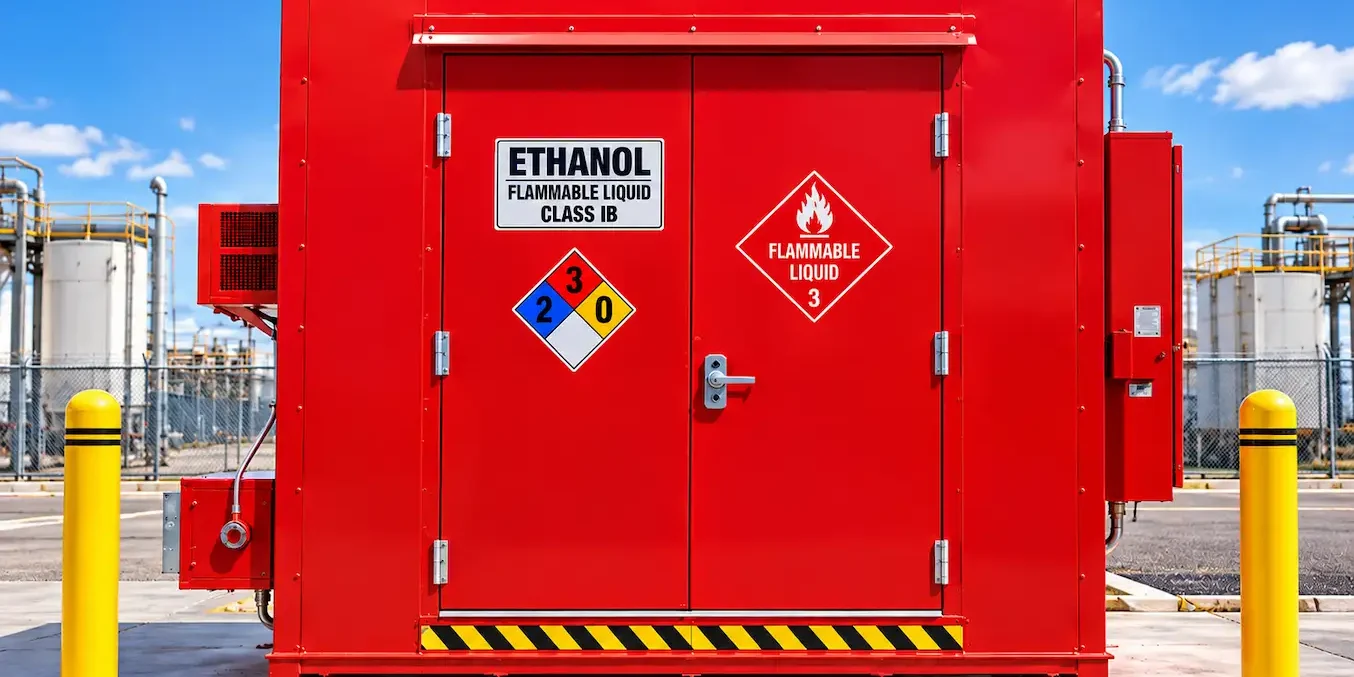
NFPA 704 is utilized in conjunction with NFPA 30 within the larger framework of NFPA for ethanol. This information is translated into the familiar four-number diamond used by emergency responders and facility personnel. The Health, Flammability, Reactivity, and Special Hazard for ethanol are: Health 2, Flammability 3, Reactivity 0, Special Hazard none. The flammability rating of 3 reflects ethanol’s ability to ignite under almost all ambient temperature conditions, a direct consequence of its Class IB flash point classification.
The NFPA 704 0 reactivity rating for ethanol is one of its favorable properties. Ethanol does not self-react, polymerize or detonate under normal storage conditions. As such, it does not need to be segregated from the majority of other chemicals on reactivity grounds. However, it does need to be kept away from strong oxidizers and ignition sources as mandatory under NFPA 30. For facilities managing mixed inventories, the NFPA 704 profile for each material determines both the placard requirement and the segregation logic for shared storage areas.
How NFPA for Ethanol Compares to NFPA Acetone Requirements
Storage requirements for a typical Class IB solvent such as acetone compared to ethanol as required by the NFPA for storage in a facility that contains a mixture of inventory types is shown in this table. Note that NFPA classifies acetone in the same Class IB category as ethanol but with a flash point of -4°F (-20°C) as compared to ethanol. That lower flash point means acetone generates ignitable vapor at temperatures well below what ethanol requires, placing more demanding limits on storage near heat-generating equipment.
Ethanol and acetone are flammable liquids with a NFPA 704 flammability rating of 3. They require storage in listed storage cabinets and may require floor-level ventilation. During dispensing, both ethanol and acetone must be bonded and grounded. In terms of vapor accumulation and migration, acetone has a higher vapor density than ethanol. Facilities that store both materials should size their ventilation system to the more demanding material, which in most configurations is acetone.
So, an NFPA for a configuration of ethanol storage using minimum-compliant ventilation may be acceptable for ethanol alone but not when mixed with acetone. This is often found during the inspections of laboratories and light industrial facilities by AHJ’s inspections of laboratory and light industrial facilities that add solvents incrementally without reassessing their baseline compliance framework.
Bonding, Grounding, and Static Ignition Control
NFPA requirements for ethanol compliance are frequently overlooked in aspects related to bonding and grounding during ethanol dispensing. The framework for liquid transfer is established by NFPA 77, Static Electricity, a standard that NFPA 30 references. The charge accumulation rate is sufficient to produce a spark capable of igniting ethanol vapor at concentrations above the lower flammable limit.
This requirement applies to any transfer of material (in a drum, tote, etc. portable container) from one container to another vessel or to other equipment &in a process. A bonding wire connects the receiving container to the source container(s) to equalize charge. A grounding wire connects the two bonded containers to a verified earth ground. Both connections must be made before the dispensing operation begins, and the ground point must be tested periodically to confirm electrical continuity.
For facilities managing NFPA for ethanol compliance across multiple dispensing points, bonding and grounding equipment should be included in the storage room design from the outset. Listed bonding and grounding clamps with visual verification indicators are the standard approach for operations subject to NFPA 30 dispensing requirements.
Secondary Containment and Spill Prevention
NFPA 30 addresses secondary containment for ethanol storage in the liquid storage room construction requirements as well as in the cabinet sill requirements for flammable liquid storage cabinets. Cabinets must have a raised sill or bottom of at least 2 inches to contain any spills. Secondary containment for storage rooms must have a floor constructed to retain a spill from the largest single container in the room, or the room must drain to a safe location with provisions to prevent drainage from entering the wastewater system untreated.
The secondary containment requirement intersects with EPA Spill Prevention, Control, and Countermeasure regulations for facilities holding more than 1,320 gallons of oil products in aggregate or more than 660 gallons in a single container. Ethanol-blended fuels qualify as oil products under the SPCC definition. Facilities using ethanol as a fuel additive or holding large quantities of fuel-grade ethanol should confirm whether their inventory crosses the SPCC threshold as a separate analysis from the NFPA for ethanol assessment.
The US Hazmat Rentals NFPA 30 compliance solutions page covers prefabricated storage options with integral containment sumps that satisfy both NFPA 30 and SPCC secondary containment requirements for short- and long-term ethanol storage projects.
Electrical Classification of Ethanol Storage Areas
NEC Article 500 and NFPA 30 jointly govern the electrical classification of spaces where ethanol is stored or handled. The area immediately surrounding an ethanol dispensing point and within a ventilated storage room is classified as a Division 2 space at minimum, and Division 1 where ethanol vapors are present under normal operating conditions. That classification requires all electrical equipment within the zone to carry a listing for Class I, Division 1 or Division 2 service, depending on the zone designation.
Electrical classification is a core requirement under NFPA for ethanol and is triggered not only by storage rooms but by any process area where ethanol is used as a solvent, cleaning agent, or fuel blend component. Facilities that use ethanol in a manufacturing process and store it adjacent to process equipment need a classified locations drawing prepared by a licensed electrical engineer before selecting ventilation equipment, lighting, or other electrical devices for those spaces.
Common field errors in electrically classified ethanol areas include standard commercial light fixtures in Division 2 zones, HVAC fan motors without explosion-proof listings, and convenience outlets within the classified boundary. Each is a correction notice during inspection and a potential ignition source during normal operations.
Fire Suppression and Detection for Ethanol Storage
NFPA 30 requires automatic fire suppression for ethanol storage rooms that exceed the quantity thresholds for unprotected areas. Wet-pipe sprinkler systems are the standard for most commercial and industrial applications where a water supply is available. Where foam suppression is specified for high-volume applications, standard film-forming AFFF is not suitable for ethanol and other polar solvents; alcohol-resistant AR-AFFF must be used, as ethanol destroys conventional foam blankets on contact.
Detection systems for NFPA for ethanol storage areas should include combustible gas detectors calibrated for ethanol vapor alongside thermal detection. Photoelectric smoke detectors are poorly suited to flammable vapor detection before ignition. A combustible gas detector set to alarm at 10 to 20% of the lower flammable limit provides advance warning that allows evacuation before concentrations reach the ignition threshold.
Temporary Storage Solutions for NFPA 30 Compliance
Facilities facing a compliance deadline, a production surge, or an expansion project often need ethanol storage capacity faster than permanent construction can deliver it. Prefabricated storage buildings listed to NFPA 30 requirements offer a compliant interim solution that can be deployed in days. A listed modular unit for Class IB liquids typically includes pre-installed floor-level ventilation, a containment sump, interior bonding and grounding provisions, listed electrical components for the classified zone, and a manufacturer compliance documentation package aligned with the adopted edition of NFPA 30.
The decision between a permanent room and a modular building for NFPA for ethanol storage depends on inventory volume, duration of need, site conditions, and available lead time before the compliance deadline. A modular unit on a concrete pad with appropriate setback distances and connected to a compliant ventilation system satisfies the NFPA for ethanol requirements for most commercial-scale inventories.
For operations where inventory changes frequently or site footprint is constrained, the flexibility of a modular solution often outweighs the long-term cost advantage of a permanent room. US Hazmat Rentals can help you identify the right modular configuration for your ethanol volume and permit timeline; get a same-day quote through the hazardous materials storage solutions page.
Permit Applications and AHJ Coordination
The permit path for a new or modified ethanol storage area runs through the local fire code official, who enforces the adopted edition of the International Fire Code or state equivalent. The permit application typically requires a site plan showing setback distances, a classified locations drawing, the ventilation calculation, the sprinkler design or exemption basis, and listing documentation for all storage equipment.
Pre-application coordination with the AHJ before submittal is the most reliable way to identify jurisdiction-specific requirements for NFPA for ethanol storage that differ from the base standard. Some jurisdictions have adopted local amendments with more restrictive quantity limits or additional containment requirements. Others have specific requirements for the format of the classified locations drawing or the engineer qualifications for the ventilation calculation.
Get a same-day quote for your project. The team at US Hazmat Rentals can help you identify the right listed storage solution for your ethanol inventory, match it to your permit timeline, and provide the manufacturer documentation your AHJ needs for the application.
FAQ
What does NFPA classify ethanol as?
NFPA 30 classifies ethanol as a Class IB flammable liquid, based on its flash point of 55°F and boiling point above 100°F. This classification triggers the most restrictive storage requirements in the standard, including listed cabinet requirements, floor-level ventilation, and bonding and grounding provisions during dispensing.
What is the NFPA 704 diamond for ethanol?
The standard NFPA 704 diamond for ethanol reads Health 2, Flammability 3, Reactivity 0, with no special hazard designation. The flammability rating of 3 reflects ethanol’s ability to ignite at ambient temperatures. The NFPA 704 0 reactivity rating indicates it does not self-react or detonate under normal storage conditions.
Where can I find the NFPA 704 pdf download for ethanol compliance?
NFPA 704 is not freely available as a public-domain download. The current edition is available for purchase from NFPA’s website and in read-only format through NFPA’s online access system. Facilities should source the edition adopted by their jurisdiction directly from NFPA to ensure they are working from the correct regulatory version.
How does NFPA for ethanol compare to NFPA acetone requirements?
Both ethanol and acetone are Class IB flammable liquids under NFPA 30 and carry a flammability rating of 3 under NFPA 704. Acetone has a lower flash point, making it more demanding in high-temperature storage conditions. Facilities storing both materials should design ventilation and containment to the more volatile of the two.
Do I need an electrically classified zone for ethanol storage?
Yes. Under NEC Article 500 and NFPA 30, any area where ethanol is stored in quantities sufficient to generate ignitable vapor concentrations must be electrically classified. Storage and dispensing areas are typically Class I, Division 2 at minimum. All electrical equipment within the classified boundary must carry an appropriate listed rating for the assigned Division.
What sprinkler system is required for ethanol storage?
NFPA 30 requires automatic sprinkler protection for ethanol storage rooms exceeding unprotected quantity thresholds. Wet-pipe systems are standard for most applications. Where foam suppression is used, standard AFFF is not suitable for ethanol; alcohol-resistant AR-AFFF must be specified, as ethanol destroys conventional foam blankets on contact.