The fan comes out of service during an AHJ inspection, not because it stopped working, but because it was never the right equipment for the space. The storage room goes offline. The replacement specification starts from scratch under deadline pressure, and the facility ends up paying twice for a decision that looked routine the first time around. This pattern repeats across industrial sites every quarter, and the thread running through each case is the same: a standard commercial exhaust unit went in where a rated hazardous location exhaust fan was required.
The difference was treated as a label distinction. It is not. A commercial motor inside a flammable vapor cloud is an ignition source. A rated hazardous location exhaust fan is built, tested, and listed to prevent that ignition under the specific chemistry of the space it serves.
Every flammable liquid storage room, solvent transfer area, battery enclosure, and fuel dispensing zone that falls under NFPA 30, NFPA 855, or NEC Article 500 has a ventilation requirement that hazardous location exhaust fans satisfy and standard commercial units cannot. Managers who work through the hazardous location exhaust fans specification before the equipment order goes out avoid the retrofit entirely.
US Hazmat Rentals works with facilities at every stage of this process, from initial site assessment through equipment selection and compliant storage configuration.
What the Code Actually Means by “Hazardous Location”
The phrase ” location” has a clear and specific meaning in NEC Article 500. This meaning is not about how a place is managed. It refers to a type of area where flammable vapors, gases or combustible dust might reach levels that can catch fire during operations or during possible problems. This classification affects all equipment in that space starting with the motor on the exhaust fan.
NEC Article 500 divides Class I locations, which’re areas with flammable gases and vapors based on how often dangerous levels appear. Division 1 includes areas where these levelsre present during normal work or come up often during maintenance. Division 2 includes areas where dangerous levels appear during unusual situations like broken containers or accidents. Hazardous location exhaust fans must have a label that matches the Division. A fan meant for Division 2 used in a Division 1 area is not a choice. It is a mistake.
The IEC Zone system covers the kind of places. Zone 0. Zone 1 are similar to Division 1. Zone 2 is similar to Division 2. Which system is used depends on the place and the project rules.
What really decides the classification is the type of materials stored and how those materials act as vapors. Some of the common Class 3 hazardous materials that cause NEC Article 500 to apply include acetone (flash point -20°C vapor density 2.0) toluene (flash point 4°C vapor density 3.14) methyl ethyl ketone (flash point -9°C vapor density 2.41) and gasoline (flash point -43°C vapor density 3 to 4). All of these are heavier than air. That one fact decides not just the motor label the fan needs. Also where the air intake must be placed compared to the floor.
Hazardous location exhaust fans for materials that’re heavier, than air must take in air from the floor. The classification and the placement are linked. A plan that decides the Division without checking the height is not complete. Facilities that do one part and not the other end up with a fan that has the right label but the wrong height or the right height but the wrong label.
Skipping the classification and choosing a fan from a HVAC catalog is even worse. The result is not a system that follows the rules. It is a fan that is not rated and could start a fire in a place where hazardous location exhaust fans were needed.
How Hazardous Material Classes Map to the Fan Specification
Not every material with a DOT hazard classification triggers a rated ventilation requirement. The first step in the specification process is identifying which hazardous material classes actually cross that threshold.
DOT divides dangerous goods into nine classes. The ones that most directly determine the fan listing are Class 2 (flammable gases, including hydrogen and propane), Class 3 (flammable and combustible liquids), and certain Class 4 materials that produce flammable vapor. Corrosives, oxidizers, and toxics rarely require hazardous location exhaust fans by themselves, though mixed-inventory storage can extend the classified zone past what the primary material alone would establish.
OSHA’s GHS system under 29 CFR 1910.1200 organizes flammable liquids by flash point category, from Category 1 (flash point below 73.4°F, boiling point at or below 95°F) through Category 4 (flash point below 140°F). The OSHA category identifies which materials generate ignitable vapor at ambient temperature; that is the practical trigger for NEC Article 500 classification of the storage space and, from there, the rated fan requirement.
When a room holds materials from multiple hazardous material classes, the most volatile material controls the electrical classification for the entire zone. A mixed-inventory space storing toluene alongside Class 8 corrosives is classified for toluene’s vapor behavior, not the corrosives. Hazardous location exhaust fans for that room need to carry the toluene specification: Group D, Class I, at the Division appropriate to the storage layout.
The Group designation is the item most consistently missing from bid specifications. Group D covers the broadest range of common industrial solvents. Group C handles diethyl ether, ethylene oxide, and certain ketones. Group B covers hydrogen; Group A covers acetylene. Each Group reflects a different minimum ignition energy, and the construction requirements tighten as the letter approaches A. A facility that stores both toluene and hydrogen (common in sites with solvent storage and battery systems running in adjacent areas) must specify the fan to Group B, the more stringent of the two. Getting that Group right before the equipment order goes out is the step that prevents the most expensive field correction in the hazardous location exhaust fans specification process.
Need help mapping your material inventory against these classification thresholds? The US Hazmat Rentals hazardous materials storage planner walks through the classification decision framework for each material type in the inventory, including the NEC Group assignments.
The Two Specifications Most Installations Fail
Two distinct engineering requirements define a compliant hazardous location exhaust fan. Most non-compliant installations fail at least one. Many fail both.
The motor requirement is better understood. A fan motor running inside a flammable vapor environment can produce ignition through electrical arcing, brush contact sparks, or surface temperatures above the vapor’s auto-ignition point. Standard commercial motors are not designed or tested against any of these failure modes, and they make no claim for vapor environments because they are not built for them.
An explosion-proof motor for Class I service uses a housing that contains any internal ignition without propagating it to the surrounding atmosphere, and limits external surface temperature to stay below the auto-ignition threshold of the target vapor family. The UL or FM listing mark on the motor specifies Class, Division, Group, and temperature class. All four must match the space’s classification. A partial match is a non-compliant installation.
The blade and housing requirement draws fewer questions and causes more correction notices. A rotating blade in a classified zone can spark by contacting the housing under vibration, or by shedding a fragment that strikes the housing wall. A bearing running hot from contamination can reach a surface temperature above the vapor’s auto-ignition point. Hazardous location exhaust fans rated for Class I service use non-sparking blade and housing materials: aluminum alloys, bronze, or fiberglass-reinforced polyester are the standard choices. Bearing specifications and maintenance intervals are part of the listed assembly, not field decisions.
Hazardous location exhaust fans without a UL, FM, or CSA listing mark specifying Class, Division, and Group cannot be verified at plan review or inspection. Verbal assurances from a manufacturer do not substitute for the listing. The listing is the only document the AHJ can use to confirm that the hazardous location exhaust fans shown on the electrical plan actually match the rated requirements for the classified space. Units sourced from distributors who cannot produce full listing documentation should not appear in a permitted installation, at any price point.
Why the Exhaust Point Cannot Be at Ceiling Level
The listing documentation tells the AHJ what the equipment is rated to do. It does not say where to put the intake or how air the system must move. Those choices come from NFPA 30 and from how the vapor behaves in the room. For materials than air both sources point to the same answer: the exhaust intake must be at floor level.
NFPA 30 says ventilation in liquid storage rooms must keep vapor concentrations below 25% of the lower explosive limit in every part of the space. To do that you need least one air change per minute or 1 CFM per square foot of floor area whichever is higher. A 500-square-foot room needs least 500 CFM running all the time during storage. That number isn’t just based on room size. It must match the materials stored and the expected temperature. For example a room storing high-vapor-pressure solvents like acetone in summer heat needs airflow than the minimum. Hazardous location exhaust fans must be sized to meet this calculated need, not the room’s dimensions.
Once you know the vapor is heavier than air the placement makes sense. Most industrial solvents. Like toluene, MEK, acetone and gasoline. Fall into Class 3 hazmat. Are denser than air. Toluene for instance is 3.14 times denser than air. It doesn’t. Spread toward the ceiling. It sinks, pools at the floor fills low spots and drain sumps and moves along the floor surface. A ceiling-mounted exhaust fan, with a properly rated motor pulls air from where the vapor is already thinnest. The dangerous buildup at floor level stays untouched. This isn’t a small problem. It’s a major flaw in the ventilation system.
To meet NFPA 30 hazardous location exhaust fans for Class I flammable vapor storage must pull air from within 12 inches of the floor. The makeup air inlet should be near the ceiling to create a top-to-bottom airflow through the room. This flow helps dilute the vapor buildup at floor level, where the risk of igniting’s highest. Any facility that runs fans at ceiling height is not following NFPA 30. No matter how good the motor listing or airflow measurement is. Moving those fans to floor level is the common fix that AHJ inspectors require when reviewing existing storage ventilation setups.
One thing often forgotten: the makeup air inlet in a Division 1 space has its electrical classification needs. Any parts inside that area. Like damper actuators, motorized louvers or control devices. Must have ratings. The ventilation system isn’t the fan. It’s the setup from intake to exhaust and everything in, between.
When Hazardous Waste Storage Areas Need Rated Fans
Facilities that handle regulated waste and also store liquids often treat the ventilation for the waste area as a separate issue.. In many cases it should be considered part of the same safety analysis as the main storage room.
Under RCRA regulations 40 CFR 265.17 ignitable waste must be stored away from any ignition sources. Ventilation must be adequate to prevent dangerous vapor buildup. The regulation clearly states that electrical equipment that is not rated for locations is an ignition source.
So if a waste storage area contains materials like spent acetone spent MEK or any solvent-soaked waste that is ignitable the rules from both RCRA and OSHA 1910.106 lead to the conclusion: exhaust fans in that space must be rated for hazardous locations. Commercial fans are not acceptable.
The same listing standards apply to the waste storage area as to the storage room if the waste area is in the same classified electrical zone or contains materials with vapor hazards similar to those, in the main storage area. It’s not about compliance—it’s about safety. Using the fan could create a serious risk.
Spent solvents carrying ignitable fractions are classified under both RCRA (D001 characteristic hazardous waste or F-listed spent solvents) and OSHA 1910.106 as flammable liquids. That classification travels with the waste regardless of its RCRA designation. A satellite accumulation area near the generating process falls under both frameworks at once. Hazardous location exhaust fans serving those satellite areas must meet the same listing requirements as the units on the primary storage room, provided the waste produces ignitable vapor.
Treating satellite accumulation areas as lower-priority compliance items (which they often appear to be because the stored volumes are smaller) produces the same inspection finding as the primary storage room. The finding is always the same: unrated ventilation functioning as an ignition source in a classified zone where hazardous location exhaust fans were required.
Getting the Permit Package Right
Hazardous location exhaust fans appear on three separate permit applications in most jurisdictions: the building permit mechanical plan, the fire code permit ventilation calculation, and the electrical permit classified locations drawing. Mismatches between those three documents are the most common source of formal correction notices during plan review.
The building permit needs fan location, duct routing, exhaust discharge point, and makeup air inlet on the mechanical plan. The fire code permit needs the ventilation rate calculation showing design airflow against the NFPA 30 minimum. The electrical permit needs the classified locations drawing with Class, Division, Group, and listed equipment for each zone. All three must reference the same fan model, the same listing designation, and the same airflow number. Hazardous location exhaust fans specified at different listing tiers across permit documents draw correction notices without exception.
Pre-application conversations with the fire marshal or building department resolve most of those issues before they become formal corrections. Facilities that arrive at a pre-application meeting with a draft classified locations drawing and a preliminary ventilation calculation move through formal review faster than those asking the AHJ to define the requirements at that same meeting. The pre-application is also the right time to confirm whether the hazardous location exhaust fans specified for Division 2 service are sufficient, or whether the storage layout and handling patterns require stepping up to Division 1.
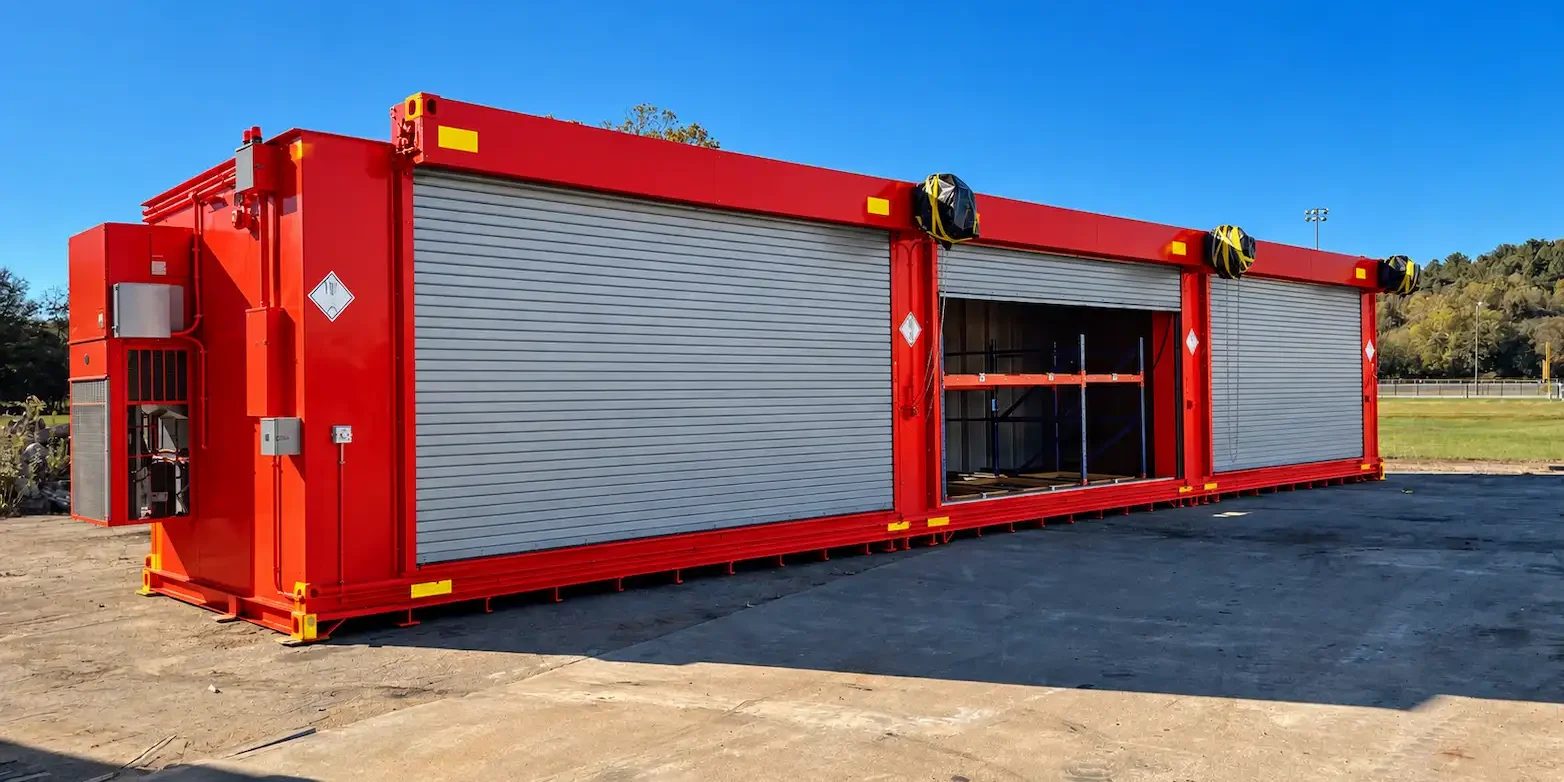
Reserve your storage unit or building before the next order cycle closes. US Hazmat Rentals connects facilities with engineers experienced in flammable vapor storage compliance and supplies prefabricated storage solutions with rated ventilation already built in. Start the conversation at our contact page before lead times shift.
FAQ
What is a hazardous location exhaust fan?
A hazardous location exhaust fan is a ventilation unit with motor and assembly components rated and listed for service in environments where flammable vapors, gases, or combustible dust may reach ignitable concentrations. The listing mark from UL, FM, or CSA identifies the NEC Article 500 Class, Division, Group, and temperature class the equipment is approved for. Standard commercial exhaust fans carry no such listing and act as ignition sources in classified environments.
How do hazardous material classes determine which fan listing a facility needs?
The DOT and OSHA hazardous material classes identify what materials are present and their vapor hazard characteristics. For fan specification, the relevant question is whether those materials generate flammable vapor at ambient temperature. DOT Class 3 flammable liquids and Class 2 flammable gases are the primary triggers. Once the material is identified, NEC Article 500 classification assigns Class, Division, and Group to the space, and those three values establish the minimum listing required for the hazardous location exhaust fans installed there.
What are common class 3 hazmat examples that require rated exhaust fans?
The most frequently encountered class 3 hazmat examples requiring hazardous location exhaust fans include acetone (UN 1090, PG II), toluene (UN 1294, PG II), methyl ethyl ketone (UN 1193, PG II), gasoline (UN 1203, PG II), isopropyl alcohol (UN 1219, PG II), and mineral spirits with flash points below 100°F. All produce heavier-than-air vapor at ambient temperature, which means all also require floor-level exhaust placement in addition to the rated motor and housing.
Does a hazardous waste storage area require the same fan as a primary flammable liquid storage room?
For ignitable waste streams, yes. RCRA under 40 CFR 265.17 requires storage away from ignition sources, and OSHA 1910.106 applies flammable liquid storage standards to waste with matching flash point characteristics. Hazardous location exhaust fans rated to the applicable NEC Article 500 Class and Division serve ignitable waste accumulation areas under the same requirements as primary flammable liquid storage, wherever those areas fall within or adjacent to a classified electrical zone.
Can the fan motor be positioned outside the classified zone and duct into the room?
In some configurations, yes. If the motor is physically outside the classified boundary and the ductwork prevents vapor migration back to the motor, an explosion-proof rating may not be required for the motor itself. This arrangement requires a documented zone boundary on the classified locations drawing and AHJ confirmation. Most industrial storage room configurations do not provide the physical depth needed for that separation, and a listed hazardous location exhaust fan installed within the space is the standard approach.
How often should hazardous location exhaust fans be inspected?
NFPA 30 requires continuous operation during flammable liquid storage. Maintenance intervals beyond that follow manufacturer guidance and the facility preventive maintenance program. Annual checks covering bearings, belt tension on belt-drive units, motor electrical condition, and verified airflow against the design calculation are a reasonable baseline. Outdoor and chemically exposed installations warrant more frequent inspections. Every check should be logged and kept with the fire code permit file.