Contact Us

Lead acid batteries are what power the forklifts, the backup units and the standby equipment that’s running through most industrial sites. They are also one of the most consistently overlooked sources of chemical exposure risk in the warehouse and manufacturing environment.
If you have an electrolyte leak, a cracked battery case or a bad discharge during handling in a charge area the sulphuric acid will run down the floor, down the drain and in some cases into the groundwater before any of the incident response plans have even got a chance to be triggered. The requirement for battery containment is precisely to deal with that sequence of events.
Facilities that have treated battery containment as an afterthought will typically only come up against the problem during an OSHA walk-through or an AHJ pre-occupancy review. By that stage the cost of fixing it is immediate: the inspection picks up the deficiency, a tight timeframe is imposed and you’re running operations to a compliance deadline.
The sensible approach is to get the containment infrastructure in place prior to that point and that starts with a clear understanding of what the standards actually require.
Procurement and project managers throughout the country use US Hazmat Rentals to build out their battery containment infrastructure to OSHA and EPA spec from the very first delivery. They’re the company that can support multi-site facilities and project based timelines with delivery ready containment and storage systems that are configured prior to delivery.
What Regulators Look for in a Battery Containment Setup
The regulatory regime for a battery charging area is one of two agencies with overlapping jurisdiction and different enforcement mechanisms. OSHA is the agency that deals with the worker safety aspects: exposure to sulphuric acid aerosol and hydrogen gas during the charging process, the physical layout of the charging area and access to flush and neutralise facilities in the event of an acid contact. EPA is the agency that deals with what happens to the electrolyte once it’s removed from the battery. When the spent electrolyte is removed, stored or collected (whether as a result of a spill or otherwise) it falls into the EPA’s RCRA hazardous waste regime as a D002 corrosive waste under 40 CFR 261.
Facilities that do it right will maintain two separate but linked compliance records: an OSHA compliant battery room setup and an EPA compliant waste accumulation plan for the collected electrolyte. The failure point for the majority of facilities isn’t a failure of either of those two regimes in themselves but the gap between them. It’s the point at which electrolyte runs out of a cracked case, pools up in some unmarked container and then becomes an OSHA and an EPA issue at the same time.
OSHA 29 CFR 1910.178(g) and the Battery Charging Area Designation
OSHA 29 CFR 1910.178(g) lays down the physical requirements for battery charging areas in industrial truck operations. There must be a designated charging area, ventilation adequate to keep hydrogen concentrations below the lower explosive limit, protection of the battery cell caps and terminals during handling and the availability of facilities for flushing and neutralising any electrolyte spill. All of the requirements in 1910.178(g) are predicated on the reality that acid exposure is a question of ‘when’ rather than ‘if’ and that’s why battery containment infrastructure is a required element of a compliant charging area rather than an optional add-on.
Battery Electrolyte as a RCRA Hazardous Waste
Sulfuric acid at the concentrations present in the lead acid battery electrolyte (typically 30-50% by weight) satisfies the D002 corrosivity characteristic under 40 CFR 261.22 when it’s taken out of service. If a facility is removing spent electrolyte as part of normal maintenance, exchanging battery packs or collecting material after a discharge event, that electrolyte will be subject to either RCRA satellite accumulation or small quantity generator rules. Secondary containment is a must at any point where D002 waste could potentially accumulate and the documentation of compliance begins with the containment design rather than the disposal receipt.
Satellite accumulation is limited to 55 gallons of hazardous waste or one quart of acutely hazardous waste per point of generation and the accumulation area must be at or very near the point of generation under the control of the operator who is generating the waste. Exceeding that limit triggers a more demanding regulatory tier with shorter accumulation time limits and additional notification requirements.
IBC Totes and Liquid Containment for Battery Acid Management
Industrial battery maintenance operations that handle electrolyte at any scale benefit from a structured liquid tote approach. A complete battery containment plan at the equipment level typically starts with an IBC tote rated for concentrated acid service: it provides a centralized collection point for spent electrolyte, a known storage volume that satisfies RCRA satellite accumulation requirements when properly labeled, and a system that can be inspected, maintained, and documented as a single compliance unit. The key specification parameters for a liquid tote in this application are chemical compatibility across all wetted surfaces and total storage volume relative to accumulation rate.
Sulfuric acid at battery concentrations is compatible with high-density polyethylene (HDPE) and polypropylene IBC totes but will attack carbon steel, galvanized fittings, and most uncoated metals. Any liquid tote deployed for electrolyte service must carry documentation confirming acid compatibility for the valve assembly, dip tube, outlet connection, and any secondary component within the system. Under RCRA satellite accumulation rules, the container must be labeled with the words “Hazardous Waste” along with the identity of the waste and any associated hazards. The accumulation start date must be marked on the container from the moment the first waste is added. Containers that are missing this labeling are treated as unlabeled waste regardless of how clearly the contents are identified by other means.
Sizing Your Spill Containment Sump for a Battery Charging Area
The spill containment sump beneath an IBC tote or a battery rack must hold the volume of the largest container it supports. EPA’s secondary containment sizing standard under 40 CFR 264.175 requires the greater of 10 percent of the aggregate volume of all containers present or 100 percent of the volume of the largest single container. For a 330-gallon IBC tote, the minimum spill containment sump capacity is 330 gallons before any precipitation allowance is added for outdoor setups.
Sump material must also be chemically compatible with the stored substance. A polypropylene or polyethylene spill containment sump rated for concentrated acid service meets the EPA requirement. A galvanized steel drip pan does not, and using one in a RCRA-regulated accumulation area constitutes a documentation deficiency separate from the physical setup.
Review US Hazmat Rentals for IBC tote containers and battery containment systems engineered for acid and corrosive service in battery management applications. Reserve your unit or building before the next order cycle.
Battery Acid Spill Containment: Design Points That Determine Inspection Outcomes
Battery acid spill containment is the bit of battery containment that the inspector looks at most directly during a site walk. The design factors that determine whether a system passes are containment volume, material compatibility, drainage and documentation. A system that meets three of the four criteria still gets a citation and a citation in this category will generally have both an OSHA and an EPA component depending on the state of the waste accumulation records.
Volume Calculations and the 110 Percent Rule
The 110% containment rule is very much a part of industry practice but you have to have a regulatory basis for it before you can use it properly. Under RCRA 40 CFR 264.175 for hazardous waste container storage areas you’re required to have the greater of 10% of the aggregate container volume or 100% of the volume of the largest single container. NFPA 30 for flammable and combustible liquid storage is the same, it’s 100% of the largest tank.
For lead acid battery electrolyte service RCRA is normally the controlling regulation and the 110% figure is a typical safety factor above the minimum required. A facility that applies the 110% rule without actually checking what specific RCRA regulation their battery containment system is designed to meet could end up undersizing relative to what RCRA actually requires when you have multiple containers as the aggregate volume can be greater than the single container baseline.
Material Compatibility and AHJ Documentation Requirements
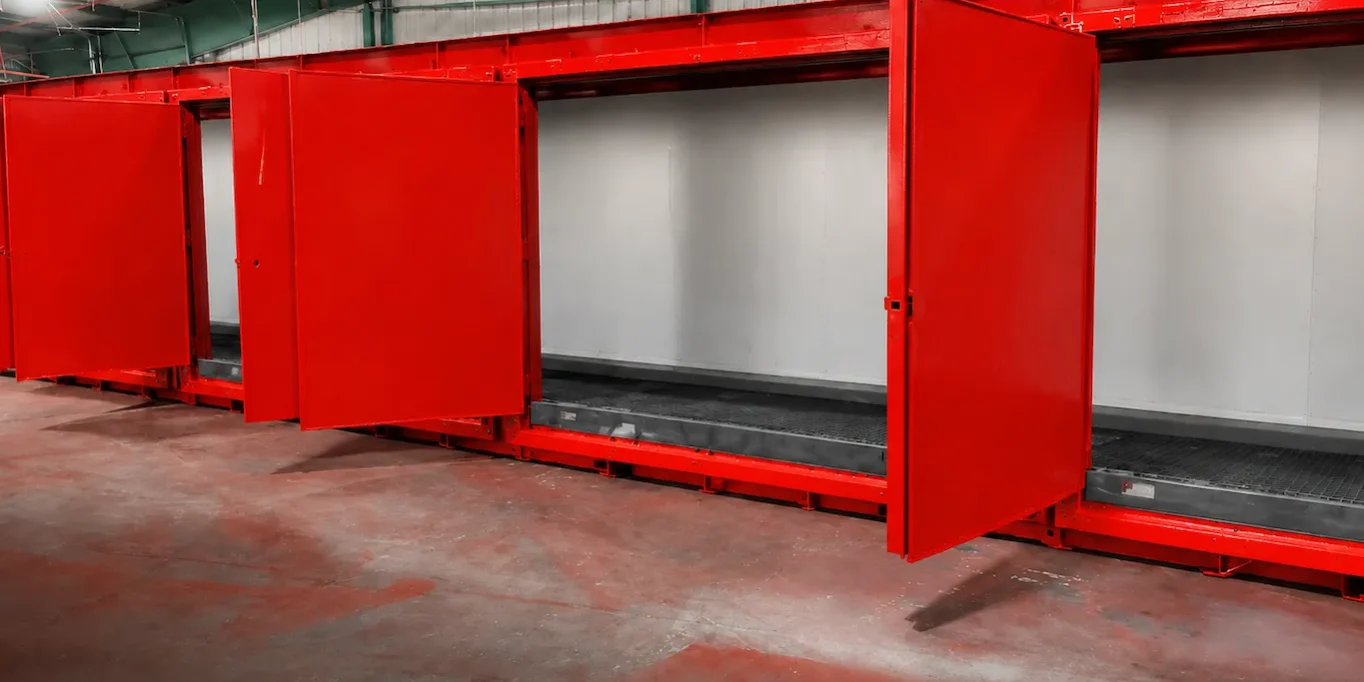
An inspector looking at a battery containment installation will check three things in addition to the volume. The containment material must be compatible with concentrated sulphuric acid, the containment assembly must be a single, unbroken unit with no unsealed penetrations and there must be a documented inspection and maintenance record on file. Polyethylene and FRP systems with acid compatible liners will meet the material requirement.
FRP is the material for larger secondary containment berms, it is resistant to both sulphuric acid and the usual cleaning agents and can be arranged to drain into a sump or collection point. A sump of the correct size with unsealed conduit penetrations will fail in any event and any penetrations through the floor or walls of the containment must be sealed with acid compatible material and this must be reflected in the as built record.
The documentation gap is invariably going to be bigger than the physical gap in the case of a facility that has bought or rented containment without setting up a corresponding compliance protocol. A facility that installs battery acid spill containment without an inspection log, a maintenance record and a compatibility datasheet for the containment components is going to be well behind on documentation at the very first AHJ review.
US Hazmat Rentals provides dedicated secondary spill containment solutions built to meet the volume, material compatibility, and documentation requirements that AHJ inspectors evaluate in battery acid spill containment reviews. Reserve your unit or building before the next order cycle.
What an AHJ Battery Containment Inspection Looks Like in Practice
An AHJ site inspection of a battery containment area follows a predictable sequence that experienced EHS professionals can anticipate and prepare for. The inspector examines the physical space first: the defined boundary of the designated charging area, the containment structure beneath the battery racks or IBC totes, the labeling on any waste containers present, and the availability of acid neutralizing materials. Documentation follows: the OSHA 1910.178(g) compliance record, RCRA waste accumulation logs, and maintenance and testing records for the containment system.
The most common citation triggers in battery containment inspections are unlabeled waste containers with no accumulation start date recorded, containment sumps with no documentation of material compatibility, battery charging areas without a defined physical boundary separating them from the general work floor, and missing or expired acid neutralization materials.
Each of these deficiencies is fully preventable. Facilities that establish correct infrastructure and documentation protocols before an inspection is scheduled move through the process without correction notices. Those that address deficiencies after a citation is issued operate against a compressed timeline, typically 30 days or less, while managing the operational disruption of building a compliant setup under deadline.
Build Your Battery Containment Plan Before the Inspector Arrives
Getting battery containment right means specifying the correct IBC tote and sump system for the volume and chemistry involved, establishing the documentation records regulators require, and confirming that the physical setup will pass a walk-through before a compliance officer requests one. Facilities that complete this sequence before an inspection date move through the process without correction notices. Those that complete it after receiving the deadline alongside the deficiency.
US Hazmat Rentals works with procurement managers and facility teams across the country to deliver battery containment systems configured for OSHA and EPA compliance from the first day on site. If your facility is setting up or expanding a battery charging or storage area, contact our team to discuss your project timeline and site requirements. For an overview of OSHA’s requirements for industrial battery charging and maintenance areas, that guidance is a useful starting point before bringing a compliance gap analysis to the site consultation.
FAQ
What is battery containment and why is it required?
Battery containment refers to the physical systems that prevent lead-acid battery electrolyte (sulfuric acid) from migrating to floors, drains, or groundwater during storage, charging, or maintenance. OSHA 29 CFR 1910.178(g) requires battery charging areas to provide facilities for flushing and neutralizing electrolyte spills, and EPA RCRA classifies spent electrolyte as D002 corrosive hazardous waste requiring secondary containment wherever it may accumulate.
How much secondary containment capacity is required for a battery charging area?
Under EPA 40 CFR 264.175, the minimum secondary containment volume for hazardous waste container storage is the greater of 10 percent of aggregate container volume or 100 percent of the volume of the largest single container. For a 330-gallon IBC tote holding spent electrolyte, the minimum sump capacity is 330 gallons. A 110 percent safety margin above the regulatory minimum is the standard design practice.
Can IBC totes be used to store battery electrolyte?
Yes, provided the tote is rated for concentrated acid service. IBC totes constructed of HDPE or polypropylene with acid-compatible fittings and valves are appropriate for battery electrolyte storage and satellite accumulation under RCRA. Carbon steel or galvanized totes are not chemically compatible with sulfuric acid at battery concentrations and should not be used in this application.
What does OSHA 29 CFR 1910.178(g) require for a battery charging area?
OSHA 29 CFR 1910.178(g) requires that battery charging areas be designated, have adequate ventilation to prevent hydrogen accumulation above the lower explosive limit, protect battery terminals during handling, and provide facilities for flushing and neutralizing electrolyte spills. These requirements apply to all industrial truck battery charging operations regardless of battery size or frequency of use.
When does battery electrolyte become a hazardous waste under RCRA?
Battery electrolyte at the concentrations found in lead-acid batteries meets the D002 corrosivity characteristic under 40 CFR 261.22 when removed from service. At that point, it must be managed as hazardous waste under RCRA satellite accumulation or small quantity generator rules, with proper labeling, secondary containment, and disposal through a licensed hazardous waste transporter.