Contact Us

Operations that handle warehouse lithium equipment face a storage and safety challenge that most standard facility planning tools were not designed for. Lithium-ion batteries are present in a growing share of industrial equipment, from Class I electric forklifts to autonomous guided vehicles and robotic picking systems, and each of those assets carries a thermal runaway risk that changes what compliant storage means in a warehouse environment.
The core issue is that warehouse lithium equipment occupies a category that blends material handling, energy storage, and hazardous materials compliance. Anyone who treats it as a standard equipment purchase, without factoring in NFPA 855 quantity thresholds, AHJ permit requirements, or the ventilation and fire-rating specifications that govern storage structures are building cost estimates and timelines that will be revised during the permitting or inspection phase.
US Hazmat Rentals works with industrial and operations teams across the country to deliver compliant storage solutions for facilities that store, charge, or manage lithium-powered equipment at scale. This guide covers what buyers need to know before procurement begins.
What Makes Warehouse Lithium Equipment a Different Storage Problem
Standard chemical storage protocols were written for liquids, compressed gases and solids with known reactivity profiles. Warehouse lithium equipment does not fit into those categories. A lithium-ion battery pack contains a system that can enter thermal runaway without an external ignition source, generate its own oxygen during combustion, and release toxic hydrogen fluoride gas that standard fire suppression systems are not designed to neutralize on their own.
The OSHA guidance on controlling lithium-ion battery hazards identifies storage location, quantity limits, ventilation, and continuous gas monitoring as the primary engineering controls for facilities that store lithium batteries at any scale. These controls apply whether the batteries are standalone packs on chemical storage racks or inside powered industrial truck equipment in a dedicated charging zone.
NFPA 855 and the Quantity Thresholds That Trigger AHJ Review
NFPA 855, standard for the Installation of Stationary Energy Storage Systems, establishes the quantity thresholds at which battery storage transitions from a general facility management issue to a permit-required installation subject to AHJ review.
For lithium-ion systems, indoor storage in a control area requires separation distances, ventilation, and in many cases fire suppression once the installation reaches defined energy storage quantities. Facilities that exceed those thresholds without AHJ approval and a documented suppression and ventilation plan carry compliance exposure regardless of how the batteries are classified within their equipment.
Where Standard Chemical Storage Racks Fall Short
Chemical storage racks designed for drums, totes, and packaged chemicals provide shelving and secondary containment but no thermal protection and no path for heat or gas dissipation if a battery on the rack enters thermal runaway.
For small quantities of replacement battery packs, a racked configuration may be workable with proper spacing and gas detection. For anything beyond that scale, the solution moves to an engineered structure with rated fire separation, ventilation, and suppression.
Procurement managers who spec chemical storage racks as the primary solution for lithium battery storage without that engineering layer are creating a gap that AHJ inspectors and insurance underwriters will find.
Ventilation Planning for Lithium Battery Storage Facilities
Ventilation is a code-driven requirement under NFPA 855 and a critical control under OSHA guidance for warehouse lithium equipment storage. Lithium-ion batteries off-gas flammable and toxic compounds during both normal charging and thermal runaway events. In an enclosed storage structure without mechanical ventilation, those vapors accumulate to concentrations that are both flammable and immediately hazardous.
NFPA 855 requires that ventilation systems for indoor energy storage systems be designed to prevent the accumulation of flammable vapors above 25 percent of the lower flammability limit. That standard applies to dedicated battery rooms and to storage structures that hold battery inventory, including any charging zone where multiple units are connected simultaneously.
Gas Detection, Exhaust, and Pool Chemical Storage Room Ventilation Requirements
The same engineering logic that governs pool chemical storage room ventilation requirements applies to battery storage environments: maintain vapor concentrations below threshold limits, exhaust to a safe external discharge point, and trigger an alarm before concentrations reach a hazardous level.
For battery storage specifically, the detection system should monitor for hydrogen gas, produced during certain failure modes and charging cycles, and for volatile organic compounds associated with electrolyte decomposition.
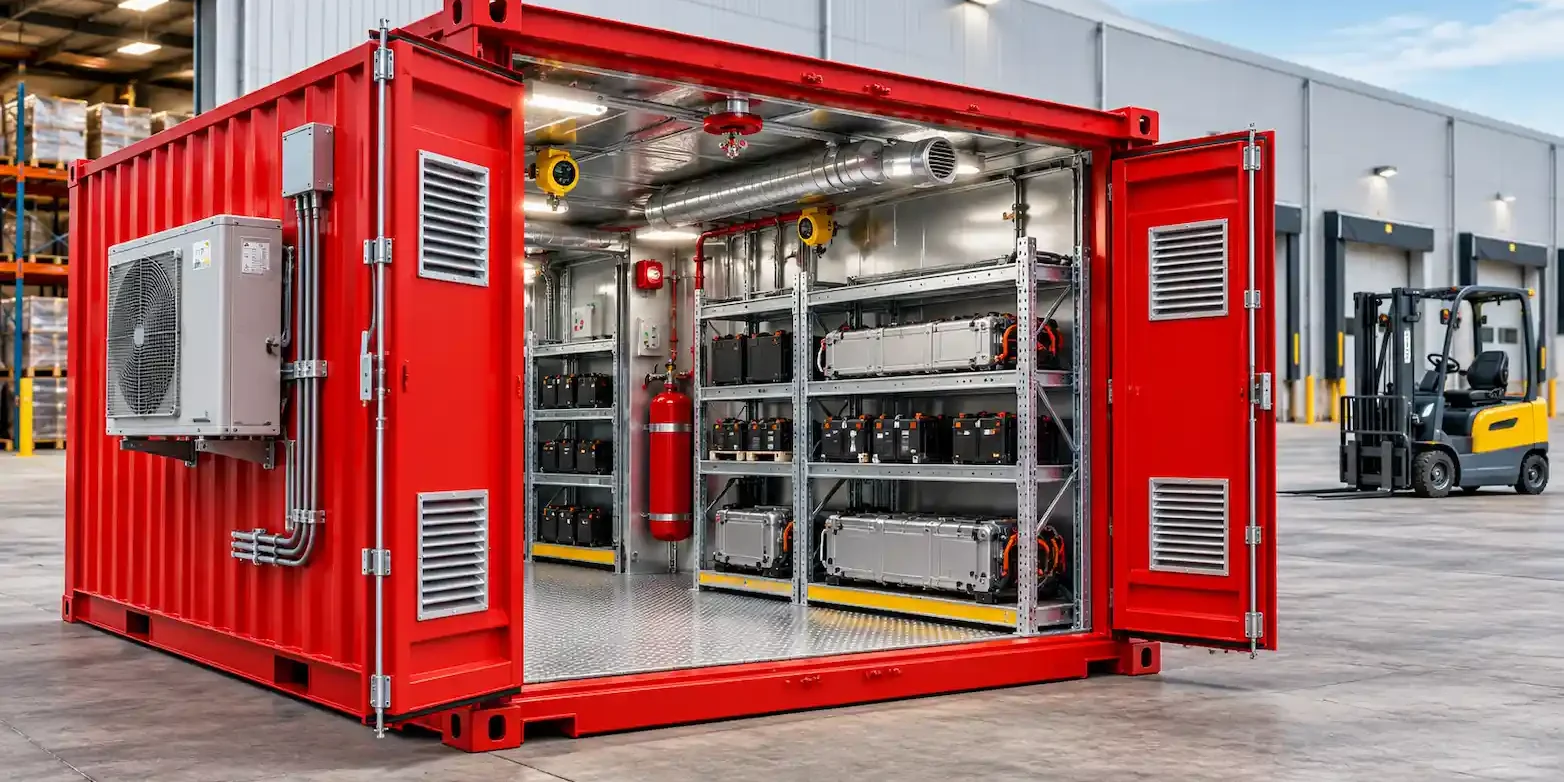
Local exhaust ventilation, continuous gas monitoring tied to an alarm system, and makeup air supply that prevents negative pressure buildup are the three core components of a defensible ventilation plan for any lithium battery storage structure. Each element needs to be documented in the AHJ submission package for facilities that require a permit.
Climate-Controlled Storage for Lithium Battery Systems
Temperature directly affects both the performance and the safety profile of lithium-ion batteries. Storage at elevated temperatures accelerates cell degradation and increases the probability of spontaneous thermal runaway, while storage below the manufacturer’s specified minimum can cause lithium plating on the anode during subsequent charging cycles, reducing capacity and creating internal short-circuit risk over time.
Climate-controlled equipment storage for warehouse lithium equipment is not exclusively a performance-preservation measure. For facilities that store battery inventory between deployments, particularly those in regions with significant seasonal temperature variation, maintaining storage temperatures within the manufacturer’s specified range is part of the compliance and risk management program.
A storage structure without temperature control may be holding batteries outside manufacturer-defined safe parameters, which creates a liability exposure that extends well beyond the initial equipment cost.
US Hazmat Rentals offers a full range of chemical storage buildings configured with climate control options for lithium battery inventory and equipment. Request specs, pricing, and delivery timelines for your operation today.
Evaluating Fire-Rated Buildings for Lithium Battery Storage
A fire-rated storage building addresses the most critical gap in a warehouse lithium equipment storage program: the lack of rated separation between the battery inventory and the rest of the facility. When thermal runaway occurs in an area that is not separated by a rated fire assembly, the fire load reaches the adjacent occupancy in minutes. A two-hour or four-hour fire-rated building gives suppression and evacuation teams the most valuable response window.
The applicable OSHA standards for lithium-ion battery installations reference NFPA 855 and FM Global data sheets that treat fire-rated separation as a primary engineering control for large-scale lithium battery storage. For procurement managers sourcing a compliant solution for a facility with an existing compliance program, adding a fire-rated building to the site plan is the best configuration change available.
2-Hour vs. 4-Hour Fire-Rated Buildings: What the Specification Difference Means
A 2-hour fire-rated building is designed to contain a fire event for 120 minutes without structural failure, giving suppression teams and occupants the response window that rating provides. A 4-hour rated building extends that window and is typically required when the warehouse lithium equipment storage quantity, the adjacent occupancy type, or the AHJ’s local amendment to NFPA 855 or the International Fire Code demands a higher separation rating.
Procurement managers should confirm the required rating with the AHJ before specifying a building, since selecting a 2-hour rated structure for a site that requires a 4-hour rating will require re-specification and can delay the project by weeks.
US Hazmat Rentals carries both 2-hour and 4-hour fire-rated buildings configured for lithium battery storage with optional ventilation, climate control, and suppression system integration. Talk to a specialist to confirm the right fire rating and configuration for your site.
Warehouse Lithium Equipment Documentation Before an AHJ Inspection
NFPA 855 and the International Fire Code require that the installation record, ventilation specifications, suppression system documentation, and electrical drawings be accessible during the review. For facilities in jurisdictions that require a permit before occupying a battery storage structure, those documents are part of the permit application, not an afterthought.
The documentation baseline for a compliant installation includes the building’s fire-rating certificate, the ventilation system design and exhaust calculations, gas detection equipment specifications and alarm setpoints, suppression system design documentation, and the AHJ’s permit or approval letter. Project managers who build that file before the first site visit close inspection findings faster and with less exposure than those who assemble it reactively.
Building a Compliant Warehouse Lithium Equipment Storage Program
A warehouse lithium equipment storage program that covers fire-rated separation, compliant ventilation, temperature management, and documented installation parameters is not a multi-month construction project. It is a configured rental and delivery program that most operations teams can have on-site and operational within days of confirming the specification with the right supplier.
Get the specs, pricing, and delivery timeline your site needs. Contact US Hazmat Rentals to confirm availability and lock in a compliant storage configuration before your next AHJ review.
FAQ
What NFPA standard applies to warehouse lithium equipment?
NFPA 855 (Standard for the Installation of Stationary Energy Storage Systems) sets out the primary requirements for warehouse lithium equipment with respect to quantity limits, separation distances, ventilation and fire suppression. For charging areas specifically OSHA 1910.178(g) applies to industrial truck battery charging areas. Local AHJ amendments to these standards may impose additional requirements on top of the base code.
How much lithium battery storage requires an AHJ permit?
NFPA 855 sets quantity thresholds by control area and occupancy type. Any warehouse lithium equipment battery storage installation in a single control area exceeding 20kwh should be reviewed with the local AHJ prior to finalising the storage configuration. Going over the permit threshold without approval creates a compliance exposure which is not remediable by simply moving the equipment afterwards.
Does warehouse lithium equipment require ventilation?
Yes. NFPA 855 requires ventilation of indoor energy storage systems to prevent the accumulation of flammable vapours above 25% of the lower flammability limit. That applies to dedicated battery rooms as well as storage buildings where a number of battery powered units are stored or charged at the same time. Gas detection as part of the ventilation system is a standard requirement for a compliant installation.
What’s the difference between a 2 hour and a 4 hour fire rated building for battery storage?
A 2hr fire rated building provides 120 minutes of structural containment under fire exposure. A 4hr rated building will of course provide a longer containment period and is required in many jurisdictions depending on the quantity stored, the type of adjacent occupancy and the specific amendments to the local fire code. Procurement managers should confirm with the AHJ what rating is required prior to specifying a building in order to avoid the potential for re-specification.
Can chemical storage racks be used for lithium battery inventory?
Standard chemical storage racks can be useful for small quantities of replacement battery packs provided there’s sufficient spacing and gas detection. If you’re looking at the storage of multiple battery units or any configuration that’s approaching the NFPA 855 quantity thresholds then an engineered fire rated structure with rated separation, ventilation and suppression is the only defensible option.