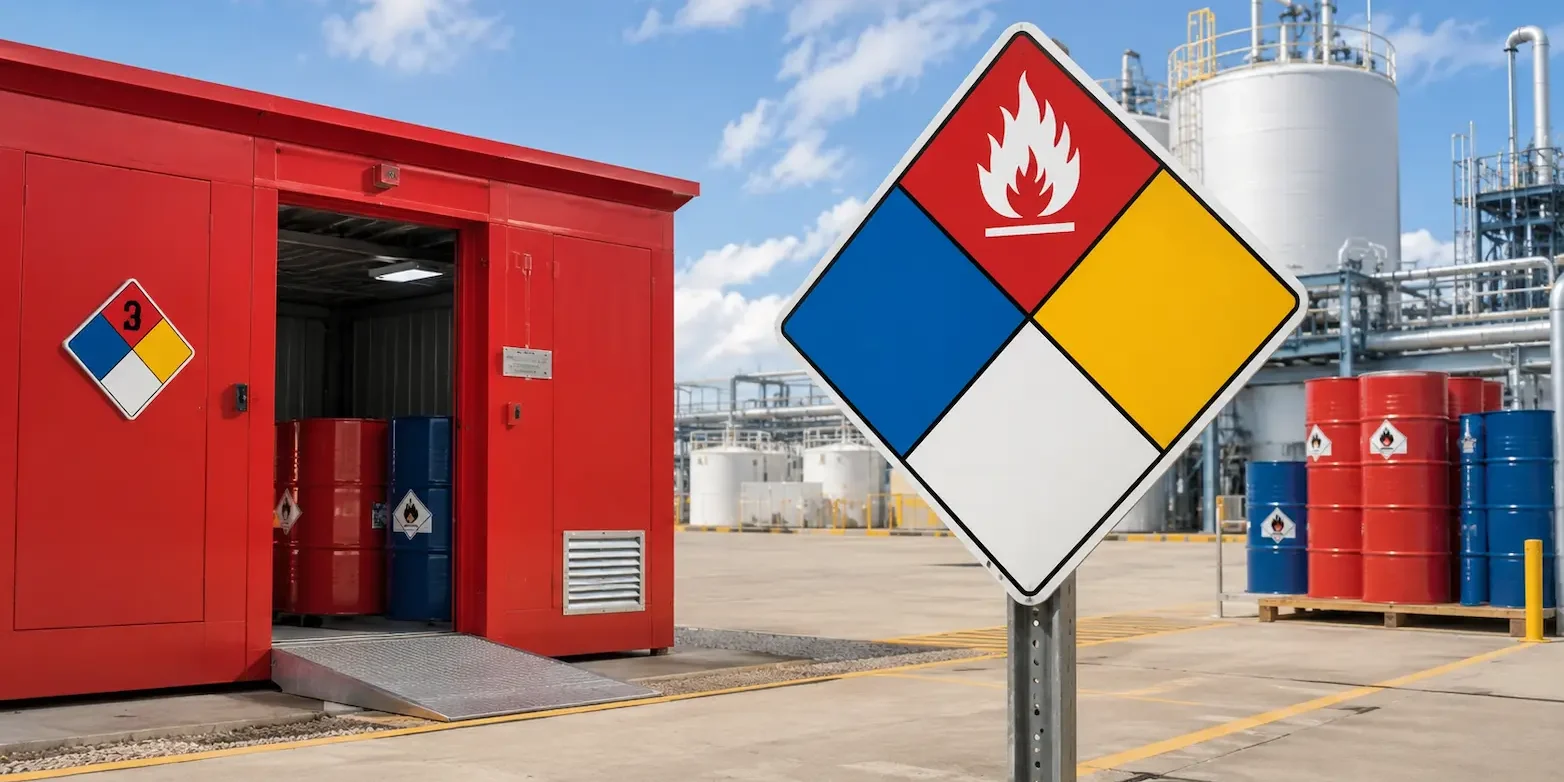
The NFPA red diamond meaning is simple at first glance: it points to flammability risk. The problem is that job sites, labs, manufacturing areas, contractors, and temporary storage zones often treat that red number like a quick label instead of a planning signal. A red 1, red 2, red 3, or red 4 can change how a substance should be stored, separated, handled, documented, and reviewed before it enters a project site.
The NFPA hazard diamond is designed for fast recognition. It gives emergency responders and safety teams a visual way to understand major hazard categories before they walk into a room, storage area, container, or building. The red quadrant focuses on fire behavior. It does not replace the Safety Data Sheet, local fire code review, OSHA requirements, or NFPA 30 compliance planning.
That distinction matters for US Hazmat Rentals customers. A project may need flammable liquid storage for coatings, solvents, fuels, adhesives, resins, or cleaning agents, but the red diamond alone does not tell the whole story. The SDS still drives the deeper review. The storage unit must match the actual material, container type, quantity, site conditions, and authority having jurisdiction requirements.
What the Red Quadrant Actually Tells You
The NFPA red diamond meaning refers to the flammability hazard rating shown in the red section of the NFPA 704 diamond. The rating runs from 0 to 4. A higher number means the material can present a greater fire hazard under the conditions described by the NFPA system.
That number is useful because it gives teams a fast warning. It can help workers recognize that a substance needs more attention before it is placed near ignition sources, incompatible materials, occupied areas, work zones, or general storage. It can also help emergency responders understand the fire behavior of materials before they approach a hazard area.
The red quadrant should never be read in isolation. A red 3 on one product and a red 3 on another product may not lead to the exact same storage decision. Flash point, boiling point, vapor behavior, container size, ventilation, concentration, compatible materials, and local code conditions still matter.
A practical reading looks like this:
| Red Rating | General Meaning | Storage Planning Signal |
| 0 | Will not burn under typical fire conditions | Confirm SDS, but flammability may not drive storage design |
| 1 | Must be preheated before ignition can occur | Review heat exposure and nearby materials |
| 2 | Must be moderately heated or exposed to high ambient temperatures before ignition | Review temperature, ventilation, and storage separation |
| 3 | Can ignite under many ambient temperature conditions | Evaluate flammable storage, ignition control, and containment |
| 4 | Extremely flammable under normal conditions | Requires serious fire-risk planning and qualified review |
This table is a starting point, not a substitute for the SDS, code review, or safety professional guidance.
Why the NFPA Red Diamond Meaning Matters on Temporary Sites
Temporary projects create storage pressure. Materials arrive before the permanent storage area is ready. Containers move between contractors. A crew may store a solvent beside paint, adhesive, rags, fuels, or cleaning agents because the site only has one available space. That is where the NFPA red diamond meaning becomes more than a label.
The red quadrant tells the team that fire behavior needs attention before the material becomes part of the daily workflow. For US Hazmat Rentals, this is one reason modular storage can be useful. A rental unit can help separate flammable materials from general supplies, incompatible chemicals, or active work zones without waiting for permanent construction.
The risk is not only whether a substance can burn. The risk is how quickly storage becomes disorganized when nobody uses the hazard information correctly. A clear red rating can support better decisions around:
- Storage location
- Separation from ignition sources
- Access control
- Ventilation review
- Fire-rated storage needs
- Secondary containment
- Signage and labeling
- SDS availability
- Inspection routines
- Emergency response planning
When the red quadrant is treated as an early warning, teams make better storage decisions before materials are crowded into the wrong space.
The Red Number Does Not Replace the SDS
The NFPA red diamond meaning should always lead back to the Safety Data Sheet. The diamond gives a fast hazard signal. The SDS gives the detailed information needed for storage planning.
A strong SDS review should confirm:
- Product identity and manufacturer
- Flammability classification
- Flash point and boiling point where applicable
- Vapor pressure and vapor density where applicable
- Recommended storage conditions
- Incompatible materials
- Firefighting measures
- Spill response information
- PPE expectations
- Handling restrictions
- Disposal considerations
- Transport classification when relevant
This matters because some teams assume the red number is enough. It is not. The red quadrant helps identify fire hazard severity, but it does not tell you every condition required for safe storage. Two materials may both show flammability concerns, yet one may require tighter temperature control, stronger ventilation review, or stricter separation from oxidizers.
For NFPA 30 compliance planning, the SDS should be part of the first conversation. The right rental storage option depends on what the material actually requires, not only how the label looks.
Red 3 and Red 4 Materials Need More Than Ordinary Space
A high red rating should slow the decision down. Red 3 and red 4 materials are not good candidates for improvised storage, crowded general-use containers, or open project areas where traffic, heat, sparks, and changing inventory create avoidable risk.
The NFPA red diamond’s meaning becomes especially important when materials can ignite at normal ambient temperatures or under common site conditions. That is when storage choices should be reviewed against NFPA 30, OSHA flammable liquid requirements, fire code expectations, and the local authority having jurisdiction.
A project team should ask:
- Is the material a flammable liquid, combustible liquid, gas, aerosol, or another form?
- Does the SDS require special temperature conditions?
- Is the storage area protected from ignition sources?
- Is ventilation needed or already built into the storage plan?
- Are containers approved and compatible?
- Are quantities within allowable limits?
- Is the storage separated from oxidizers or reactive materials?
- Is the unit placed where emergency access remains practical?
- Are workers trained to recognize the hazard?
- Is inspection assigned to a responsible person?
The goal is not to overcomplicate every storage decision. The goal is to stop high-flammability materials from being treated like ordinary inventory.
How the Red Quadrant Connects to NFPA 30 Compliance
NFPA 704 and NFPA 30 are not the same thing. The NFPA 704 diamond supports hazard identification, especially for emergency response. NFPA 30 focuses on safeguards for flammable and combustible liquids. Still, the two conversations often meet in the same storage area.
The NFPA red diamond meaning helps a team notice that a material may need closer review. NFPA 30 compliance helps guide how flammable and combustible liquids should be stored, handled, and managed in a safer system.
For US Hazmat Rentals customers, that connection is practical. A site may not need a permanent chemical storage building. It may need a temporary rental solution that supports the project phase, quantity, timeline, access needs, and hazard class. If flammable liquids are involved, the storage decision should be matched to the material profile and site conditions.
This is where the NFPA 30 compliance section becomes useful. It gives project teams a stronger frame for thinking about fire risk, containment, storage design, and compliance support instead of choosing a rental unit based only on square footage.
Common Mistakes When Reading the Red Diamond
The NFPA 704 diamond is simple by design, but simple labels can still be misread. The most common mistake is assuming the red quadrant tells the entire storage story. It does not.
Common mistakes include:
- Treating the red number as a complete storage instruction
- Ignoring the SDS because the diamond seems clear
- Storing all red-rated materials together without compatibility review
- Confusing NFPA 704 ratings with GHS pictograms
- Assuming a low red number means the material is harmless
- Ignoring blue, yellow, and white quadrant warnings
- Failing to update labels after inventory changes
- Using faded or damaged labels in active storage areas
- Placing flammables near oxidizers, combustibles, or ignition sources
- Choosing a storage rental based only on size or delivery speed
The NFPA red diamond meaning should help teams ask better questions. It should not become a shortcut that replaces hazard review.
Labeling, Training, and Documentation Keep the System Useful
A hazard diamond only works when people can see it, understand it, and connect it to the correct material. If labels are faded, blocked, inconsistent, or missing, the storage area becomes harder to manage. That problem becomes worse on temporary sites where multiple crews may use the same space.
A stronger documentation plan should include:
- Current SDS access for every hazardous material
- Clear container labels
- Visible NFPA 704 markings where appropriate
- Inventory records
- Storage area signage
- Employee training documentation
- Emergency contact information
- Inspection logs
- Fire extinguisher and spill response checks
- Records of material movement in and out of storage
OSHA’s Hazard Communication requirements make labels, SDS access, and training central to workplace chemical safety. For flammable materials, documentation is not paperwork for its own sake. It helps workers understand what they are handling and gives safety managers a better way to maintain control as project conditions change.
Rental Storage Helps When Hazard Classes Need Separation
Many sites do not have one chemical hazard. They have several. A project may include flammable solvents, corrosive cleaners, oxidizers, fuels, adhesives, coatings, and waste materials. When everything is placed into one general storage area, the red quadrant loses its value because the system around it has already failed.
The NFPA red diamond meaning should push teams to separate hazards before the site becomes congested. A rental storage unit can help when an existing facility does not have enough dedicated space or when a temporary project needs a compliant storage approach for a defined period.
Rental storage can support:
- Faster deployment for short-term projects
- Separate storage by hazard class
- Improved organization for inspections
- Better access control
- Reduced congestion in work areas
- More practical relocation during project phases
- Lower capital commitment than permanent construction
- Purpose-matched storage for flammable materials
US Hazmat Rentals helps project teams think through these storage needs without forcing every situation into the same permanent model. The rental approach is especially useful when the material mix changes, the timeline is limited, or the site needs separation quickly.
Inspection Habits That Protect Flammable Storage Areas
A storage plan can look good on day one and fall apart by week three. Containers move. Labels get damaged. New materials arrive. Workers place items where they fit instead of where they belong. That is why inspection habits matter.
Routine inspections should check:
- Label visibility
- SDS availability
- Container condition
- Leaks, stains, or residue
- Closed container status
- Housekeeping inside and around the unit
- Separation from incompatible materials
- Ventilation condition where applicable
- Fire extinguisher access
- Spill kit readiness
- Unauthorized materials
- Changes in inventory
- Access control
- Signage condition
For materials with a meaningful flammability rating, inspections should focus on preventing small storage shortcuts from becoming normal site behavior.
How US Hazmat Rentals Supports Safer Flammable Material Storage
US Hazmat Rentals assist project teams match storage equipment to real chemical storage needs. That includes flammable liquids, combustible materials, corrosives, oxidizers, and other regulated substances that should not be placed in ordinary site storage.
Understanding the NFPA red diamond meaning is one part of that process. The next step is turning that understanding into a storage layout that supports the SDS, NFPA 30 compliance planning, OSHA communication requirements, inspection routines, and safer daily use.
A modular rental solution can help teams avoid rushed permanent construction, reduce mixed-storage problems, and create a cleaner setup for changing project phases. For sites with flammable substances, that flexibility can make the difference between controlled storage and a crowded area that becomes harder to defend during review.
Read the Red Quadrant Before the Storage Problem Grows
The NFPA red diamond meaning gives safety teams a fast signal: pay attention to flammability. That signal should start a larger review, not end it. The SDS, NFPA 30 compliance needs, OSHA labeling and training requirements, site conditions, quantity, compatibility, and local fire authority expectations all shape the right storage decision.
US Hazmat Rentals gives project teams a practical way to respond when flammable material storage needs change quickly. If your site is using temporary storage, mixed chemical storage, or project-based hazardous material staging, contact US Hazmat Rentals to plan safer flammable material storage.
FAQ
What does the red diamond mean in NFPA labeling?
The red diamond shows flammability risk. Higher numbers indicate greater fire hazard under the NFPA 704 rating system.
Is the NFPA red diamond the same as NFPA 30?
No. NFPA 704 identifies hazards visually. NFPA 30 focuses on storage, handling, and use of flammable and combustible liquids.
Does a red 4 mean a substance needs special storage?
Yes. A red 4 signals extreme flammability and should trigger qualified SDS, code, storage, and site-condition review.
Can I choose a rental unit based only on the red number?
No. The red number helps guide review, but the SDS, quantity, container type, ventilation, compatibility, and AHJ requirements matter.
How can US Hazmat Rentals help with flammable storage?
US Hazmat Rentals can help match modular storage options to flammable material risks, project duration, site layout, and compliance planning needs.