Facilities teams ask whether is bleach flammable more often than most people in the industry expect, and the timing is almost always the same: right before a scheduled inspection, during a chemical inventory consolidation, or when a fire marshal shows up for a site walkthrough. The short answer is no. Standard bleach, sodium hypochlorite in liquid form, doesn’t meet the definition of a flammable liquid under OSHA, NFPA, or EPA regulatory frameworks.
But that answer alone does not close the compliance conversation, and facilities that treat is bleach flammable as the only relevant question often find out why during an inspection. Bleach is an oxidizing chemical, and oxidizers change the risk equation for everything else stored near them. A plant manager who files bleach under is not a problem because bleach flammable checks out as a no on the SDS is working with half picture.
Sodium hypochlorite does not burn, but it accelerates combustion in materials that do. It reacts with acids at room temperature to release chlorine gas. It off-gases in poorly ventilated spaces under heat exposure. None of those hazards require an ignition source. They require proximity to the wrong chemical or a storage environment never designed with oxidizer behavior in mind.
At US Hazmat Rentals, we have this conversation regularly with EHS managers, plant managers, and procurement leads managing mixed chemical inventories under real operational pressure. Getting the storage configuration right for that environment spans fire code, environmental compliance, ventilation design, and AHJ review.
What Bleach Is and Why the Chemical Classification Matters
When safety teams first raise the question of is bleach flammable, the SDS answers the flash point question clearly. Industrial bleach in liquid form is an aqueous solution of sodium hypochlorite, ranging from roughly 3-8% in janitorial products to 10-15% in the industrial formulations used for water treatment and sanitation.
Calcium hypochlorite the granular or tablet form used in agriculture and pool treatment, is a chemically distinct product with higher oxidizing potential and more restrictive storage requirements. The specific form and concentration on site determines which NFPA 400 sections apply and how containment must be configured.
Neither sodium hypochlorite solutions nor calcium hypochlorite is classified as flammable under NFPA 30 or OSHA’s Hazard Communication Standard. Standard bleach has no reportable flash point because it does not generate ignitable vapors at ambient temperatures. That is what keeps bleach outside the flammable liquid categories NFPA 30 governs, and it is also what leads some facility teams to underestimate the storage obligations that do apply.
The classification that matters for compliance is oxidizer. Sodium hypochlorite is an oxidizing liquid. Calcium hypochlorite is a solid oxidizer, with the NFPA 400 category depending on concentration. Oxidizers supply oxygen to combustion reactions, meaning materials that would otherwise need a significant ignition source can ignite more readily when an oxidizer is nearby.
A confirmed no to “is bleach flammable” does not resolve the segregation requirements that flow from oxidizer classification, and confusing those two questions is the source of most compliance gaps involving bleach storage.
Is Bleach Flammable or Combustible Under Federal Code?
The regulatory record is consistent. OSHA’s Hazard Communication Standard (29 CFR 1910.1200) classifies sodium hypochlorite solutions as oxidizing liquids and corrosives. The SDS flammability section will indicate no flash point detected or not applicable for standard formulations. NFPA 30, which governs flammable and combustible liquid storage, does not apply to bleach directly because bleach does not meet the flash point threshold that defines those categories.
NFPA 400, the Hazardous Materials Code, is where bleach lands for storage compliance. That standard addresses oxidizer storage in detail: quantity thresholds, construction requirements for storage rooms, required separation distances from incompatible materials, and ventilation criteria. The edition your local AHJ has adopted determines which specific provisions are enforceable at your site.
Facilities handling calcium hypochlorite should note that is bleach flammable in its dry granular form still resolves as no under federal code, but NFPA 400 Class 3 oxidizer requirements for concentrated dry calcium hypochlorite are considerably more demanding than those for liquid sodium hypochlorite. Improperly stored dry calcium hypochlorite has caused documented warehouse fires when contaminated with organic material or moisture.
The Real Hazard: Incompatibility and Oxidizer Behavior
Facility teams that have confirmed that bleach is flammable often move on without fully accounting for the incompatibility hazards that make bleach storage consequential regardless of flammability classification. Sodium hypochlorite reacts with hydrochloric acid, acetic acid, and most descaling or pH-adjustment products to release chlorine gas at concentrations that can reach immediately dangerous levels without heat or ignition.
Contact with ammonia-containing cleaners produces chloramine vapors. Reactions with hydrogen peroxide or certain metals generate exothermic events that can rupture containers.
OSHA General Industry standards and the International Fire Code both require oxidizers to be physically separated from flammable and combustible liquids, organic materials, reducing agents, and acids. Any facility storing bleach alongside solvents, degreasers, or agricultural chemicals without physical separation is carrying compliance risk that exists regardless of whether is bleach flammable has ever been formally addressed internally.
The segregation requirement applies because of what oxidizers do to combustible materials in proximity, not because bleach itself burns. In facilities with mixed chemical inventories, a storage layout review by an EHS officer or fire protection engineer is the baseline for a defensible compliance position.
Ventilation, Temperature Control, and Degradation
Sodium hypochlorite degrades faster under heat, releasing dissolved chlorine as it breaks down. Facilities storing industrial bleach over extended periods in warm enclosed spaces will see increased off-gassing that creates air quality concerns. OSHA’s permissible exposure limit for chlorine gas is 1 part per million as a ceiling value, and enclosed bleach storage areas can exceed that threshold during a slow leak or drum failure without adequate air exchange.
Ventilation design should account for the maximum expected chlorine release within the space, the room’s cubic volume, and the air changes per hour needed to stay below the OSHA ceiling. That calculation should be done by someone qualified to assess it, particularly for quantities above a few hundred gallons.
Calcium hypochlorite in granular or tablet form adds a moisture sensitivity requirement that liquid bleach does not carry to the same degree. Dry hypochlorite can self-heat when contaminated with organic material, requiring controlled humidity, water infiltration protection, and separation from combustible packaging.
When Bleach Shares Space With Flammable Solvents
This is the real-world scenario most facilities navigate: bleach stored alongside cleaning solvents, degreasers, or maintenance chemicals that carry flammable liquid classifications. Is bleach flammable enough on its own to require a fire-rated storage building?
No. But the moment acetone, methanol, isopropyl alcohol, or any Class I or Class II flammable liquid enters the storage inventory alongside it, fire-rated construction requirements under NFPA 30 apply to the structure, and the oxidizer nature of bleach adds a segregation layer the internal layout must address separately.
A fire-rated storage building contains a fire for two or four hours, giving personnel time to evacuate and emergency responders time to engage. In a mixed inventory, the fire-rated structure handles the flammable liquid hazard while the internal layout addresses the incompatibility issue. The fire rating does not substitute for physically separating bleach from reactive materials inside the enclosure. Both dimensions have to be met independently.
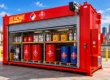
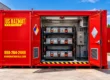
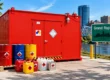
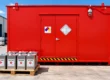
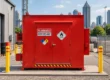
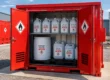
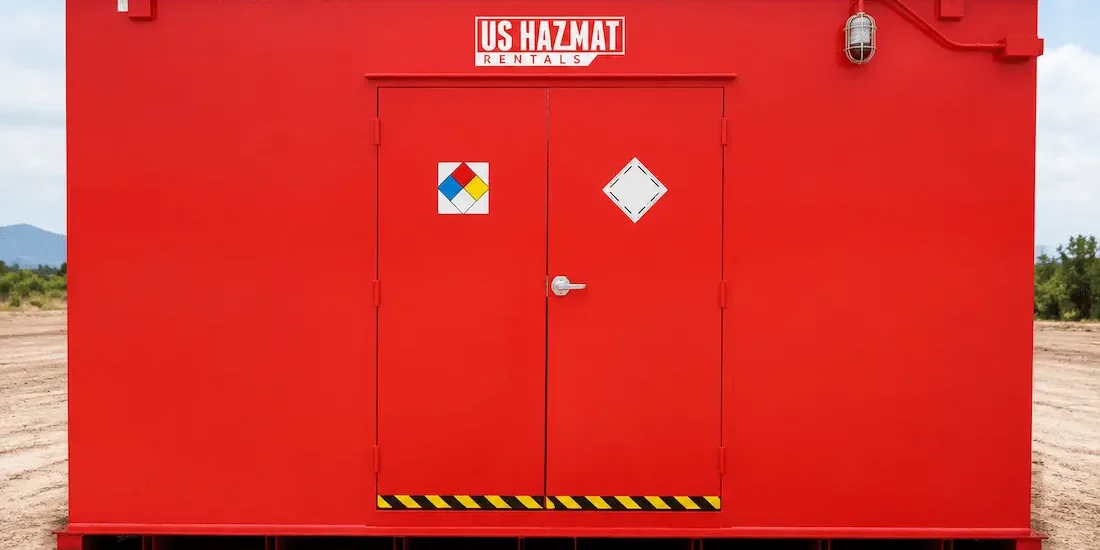
Our chemical storage building rentals include two-hour and four-hour fire-rated configurations with integrated secondary containment, ventilation systems, and accessory options matched to your actual chemical inventory. The specification for a bleach-plus-solvents scenario differs meaningfully from a bleach-only unit, and that conversation happens before anything ships.
Storage hardware that fits the compliance requirement from day one consistently costs less than retrofitting after an inspection.
Placement, Drainage, and the AHJ Review
The site placement question often follows directly from is bleach flammable getting resolved during an initial code review. Bleach, as an oxidizer, must be physically separated from flammable liquid storage by minimum distances established under the IFC and local fire code, with specific values varying by oxidizer class and quantity. Proximity to emergency response access, stormwater drainage paths, and occupied structures all factor into placement decisions the AHJ will review.
For facilities managing both bleach and flammable products, two separate storage enclosures with clearly documented separation is the cleanest compliance path. Co-locating oxidizers and flammables within a single structure, even with internal barriers, generates a more complex code analysis that may not satisfy the AHJ’s interpretation of required separation.
Two purpose-built rental units at appropriate separation are easier to inspect, easier to document, and faster to approve. Drainage and secondary containment require equal attention. Bleach spills that reach stormwater drains create EPA liability under SPCC regulations independently of any fire code issue, and the containment basin material must be compatible with sodium hypochlorite.
Practical Review Before the Next Inspection
A pre-inspection review starts with the SDS for every hypochlorite product on site: form, concentration, and GHS classification. Those details determine the applicable NFPA 400 category and drive every downstream decision about segregation and containment. Verify physical separation from flammable liquids, acids, and ammonia-based products.
Confirm secondary containment volumes and basin material compatibility. Verify that ventilation has been assessed against the actual hazard scenario, not just installed and assumed sufficient. GHS labels on all containers, oxidizer and corrosive hazard placarding in the storage area, and current HazCom training records for personnel working near bleach storage are standard inspection checkpoints.
Facilities that structured their bleach storage around the assumption that is bleach flammable produces a no and therefore no dedicated infrastructure is needed are carrying compliance exposure that may not surface until an inspector documents it. The flammability classification answers one question and leaves others open: oxidizer designation, segregation requirements, ventilation obligations, secondary containment, and labeling.
The US Hazmat Rentals team can walk through your specific chemical profile and site conditions. Reach out for a free consultation and get matched with the right configuration before your next regulatory deadline.
Getting Storage Right Before It Becomes a Problem
The answer to is bleach flammable is no, and that is a code-accurate answer. What it does not mean is that bleach storage is uncomplicated or that general-purpose infrastructure will satisfy an inspector. Oxidizer classification, incompatibility management, secondary containment, ventilation, and AHJ approval are live requirements for any facility handling sodium hypochlorite at industrial scale. None of those obligations go away because bleach lacks a flash point.
For facilities working against an inspection timeline, a rental storage solution closes the gap between a compliance problem and a compliant operation faster than any permitted permanent structure can. Units are configured for specific chemical inventories, delivered to the site, and placed in service ahead of regulatory deadlines.
For any facility currently storing bleach alongside flammable or combustible materials in a setup that was never designed with oxidizer requirements in mind, that timeline advantage matters.
US Hazmat Rentals has inventory available now, ready to ship to facilities across the country. Our units are built for the chemical storage scenarios that real industrial operations navigate every day. Speak with an expert about your specific requirements and let us put the right configuration in place before your next compliance window closes. Request a free consultation today.
FAQ
Is bleach flammable under OSHA or NFPA standards?
No. Sodium hypochlorite solution is not classified as a flammable liquid under OSHA’s Hazard Communication Standard or NFPA 30. Whether is bleach flammable under those frameworks resolves clearly as a no, but bleach is designated as an oxidizing liquid under NFPA 400, which carries its own storage.
Can bleach be stored in the same building as flammable liquids?
In most cases, separate enclosures are the cleaner compliance path. Co-locating bleach and flammable liquids in a single structure creates a more complex code analysis and may not satisfy your local AHJ’s interpretation of required separation distances.
Does bleach require secondary containment?
Yes, in most industrial storage scenarios involving significant quantities of liquid sodium hypochlorite. Bleach is corrosive and will damage concrete, certain metals, and standard floor coatings on contact.
What happens when bleach contacts acids or ammonia-based products?
This question is generally “no” for the same reasons that is bleach flammable is “no” for liquid sodium hypochlorite (and calcium hypochlorite solution). However, as dry products (solid, granular, tablet form), they are considered to be of a higher NFPA 400 oxidizer classification.
Is calcium hypochlorite more hazardous to store than liquid bleach?
This question is generally “no” for the same reasons that is bleach flammable is “no” for liquid sodium hypochlorite (and calcium hypochlorite solution). However, as dry products (solid, granular, tablet form), they are considered to be of a higher NFPA 400 oxidizer classification.
Does a facility need a fire-rated storage building specifically for bleach?
The comments do not apply for the bleach alone as it is not a flammable liquid. The flammable solvents, fuels, and degreasers that are typically stored with the bleach will determine the fire-rated construction requirements for storage of that material (NFPA 30, etc. local fire code).