Every 55 gallon drum Dallas operation stores represents a decision that touches four separate compliance areas before the first bung is ever opened: DOT UN specification requirements for the drum itself, NFPA 30 quantity limits and storage building requirements for the chemical it holds, OSHA chemical drum handling procedures for dispensing and transfer, and the local Dallas fire code that governs what storage infrastructure a facility must have in place before that drum arrives.
Treating a 55-gallon drum like an ordinary container is how facilities end up with a drum of Class IB flammable solvent sitting in a general-purpose storeroom without secondary containment, bonding and grounding, or approved storage.
The drum is just the container. What determines the compliance picture is what goes inside it, how much of it is already on site, and whether the storage space around it meets the requirements for that chemical at that quantity. A single 55 gallon drum Dallas facilities use for acetone at 55 gallons sits right at the NFPA 30 per-cabinet limit for Class I flammable liquids. Add a second drum and the operation needs a purpose-built storage building, not a cabinet.
At US Hazmat Rentals, we work with Dallas-area EHS managers, procurement leads, and facility teams setting up compliant drum storage for the first time or who have outgrown their current arrangement. The 55 gallon drum Dallas compliance picture involves specifying the drum type, the storage building or cabinet, the chemical drum handling procedures for dispensing, and the temperature and ventilation management the Texas climate makes necessary.
What a 55-Gallon Drum Actually Is and What It Requires
A standard 55-gallon drum holds 55 US gallons (208 liters). Drums used for regulated hazardous materials must carry a UN specification marking indicating they meet transport performance testing requirements. Tight-head steel drums (UN 1A1) are sealed with threaded bung closures for liquids that do not require frequent access.
Open-head steel drums (UN 1A2) have removable lids secured with a ring clamp for more viscous materials or products requiring top access. HDPE plastic drums (UN 1H1 and UN 1H2) are used for chemicals incompatible with steel, including acids, alkalis, and oxidizers.
The NFPA 30 limit that matters most for any 55 gallon drum Dallas site manages is the 60-gallon per-cabinet limit for Class I flammable liquids in an approved safety cabinet. A single 55-gallon drum of acetone, ethanol, or lacquer thinner is right at that threshold. Any secondary containers of the same or other Class I materials count toward the 60-gallon aggregate.
The moment a second drum enters the space, the operation crosses into storage building territory, and the 55 gallon drum Dallas storage plan needs to account for that transition before it happens.
Chemical Drum Handling Procedures for Dallas Operations
OSHA 29 CFR 1910.106 governs dispensing from drums of flammable liquids. For Class I flammable liquids, dispensing requires bonding the drum to the receiving container to equalize electrical potential, plus grounding to a verified earth ground before any transfer. Both are required at every dispensing event. A drum pump or pressure-dispensing system rated for the chemical is required for controlled, closed-path transfer.
The chemical drum handling procedures a 55 gallon drum Dallas operation follows for a Class I solvent are more demanding than those for diesel or lubricating oil because the lower flash point means ignition risk is present at ambient temperatures rather than only at elevated temperatures.
Drum movement requires rated drum dollies. A full 55-gallon drum of a typical flammable solvent weighs 350 to 400 pounds.
Rolling a drum on its rim is not a compliant handling practice and can damage structural integrity. For outdoor chemical storage cabinet or building applications where drums are stored on pallets or drum saddles, a forklift or drum handler is needed for safe placement and removal. All bungs or lids must be secured whenever not actively dispensing. In a Dallas outdoor chemical storage cabinet during summer months, an unsealed bung creates continuous vapor release in a space where heat accelerates vapor generation significantly above what cooler climates produce.
The Dallas Climate Problem: Heat, Vapor Pressure, and Drum Storage
Dallas ambient temperatures exceed 100 degrees Fahrenheit routinely from June through September. A 55-gallon steel drum of flammable solvent in direct sun in an unventilated outdoor enclosure can reach exterior surface temperatures of 140 degrees Fahrenheit or higher. The internal vapor pressure of Class I flammable liquids increases significantly at those temperatures.
Every 55 gallon drum Dallas painting and manufacturing operations store outdoors needs heat management built into the storage specification from the start, not added as an afterthought after the first summer.
Temperature for paint storage is both a product integrity question and a safety one. Oil-based paints should be stored between 50 and 85 degrees Fahrenheit per manufacturer SDS guidelines. Dallas outdoor storage without climate control routinely exceeds the 85-degree upper limit throughout summer, degrading viscosity and shortening shelf life. Climate control is not optional for oil-based paint drum storage in the DFW market.
Outdoor chemical storage cabinet units in Dallas need active ventilation that performs in ambient temperatures above 100 degrees Fahrenheit, heat mitigation to limit solar gain on drum surfaces, and chemical-compatible secondary containment. Passive ventilation that relies on temperature differential becomes less effective when outdoor temperatures approach indoor cabinet temperatures. Active mechanical ventilation with an explosion-proof fan is the reliable solution for Class I flammable liquid outdoor chemical storage cabinet installations in Dallas.
NFPA 30 Quantity Limits and the Storage Building Threshold
For Dallas operations storing multiple chemicals in drum format, the aggregate Class I quantity triggers the building requirement more quickly than a single-product calculation suggests. A facility with one 55-gallon drum of acetone, one 55-gallon drum of lacquer thinner, and one 5-gallon safety can of isopropyl alcohol is storing 115 gallons of Class I flammable liquid in a single fire area.
That exceeds the per-cabinet limit and requires either a second approved cabinet or a storage building. For any 55 gallon drum Dallas site approaching those thresholds, the storage building conversation needs to happen before the inventory arrives, not after.
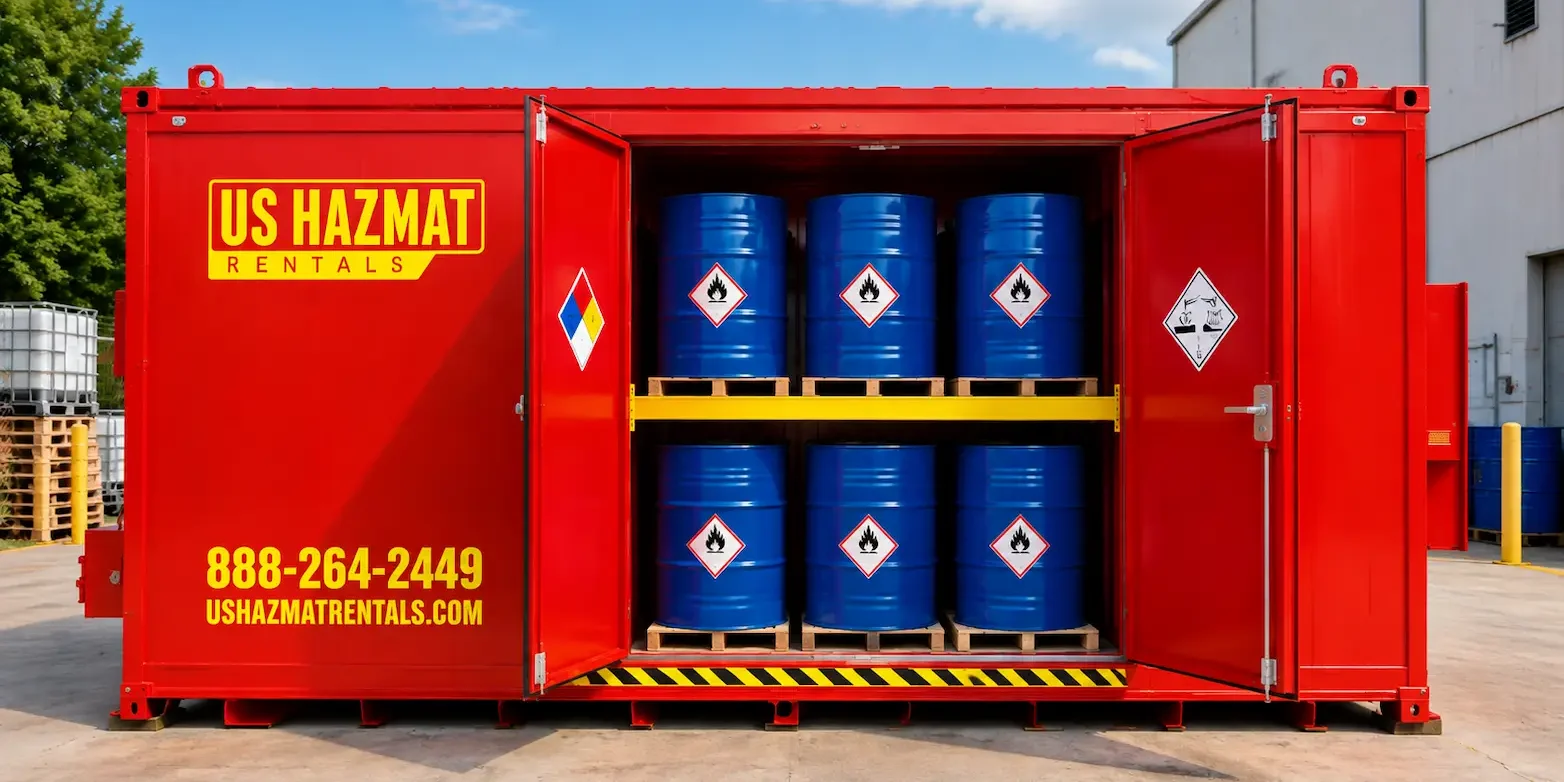
The 55 gallon drum Dallas storage buildings available for multi-drum configurations range from two-drum units for small painting operations up to larger buildings with forklift-accessible roll-up doors, drum racks, ventilation, and secondary containment sized for the maximum drum count. Our flammable liquid storage cabinet and building resource covers the NFPA 30 quantity limits, fire rating requirements, and cabinet-to-building transition criteria for Dallas drum storage across chemical types.
Secondary Containment and Site Planning for Dallas Drum Operations
Secondary containment for 55 gallon drum Dallas sites follows the standard calculation: 110 percent of the volume of the largest single container, compared against 10 percent of the aggregate volume of all containers, with the larger number governing. For a single 55-gallon drum, the minimum containment basin is 60.5 gallons. For a two-drum setup holding 110 gallons total, 10 percent of aggregate is 11 gallons, which is less than 60.5 gallons, so the single-drum calculation controls.
The containment material must be compatible with the stored chemical. Steel containment under an HDPE drum of acid is a materials mismatch. HDPE or polymer-coated containment is required for corrosive chemical drum storage. For flammable solvent drums in steel, a powder-coated steel containment basin is standard, provided the coating is appropriate for the specific solvent.
Getting the Complete Drum Storage Picture Right Before the First Delivery
For any 55 gallon drum Dallas facility planning to receive, the compliance picture needs to be complete before the delivery truck arrives: drum type verified for the chemical, storage building or cabinet in place and permitted, chemical drum handling procedures established for the handling crew, temperature management confirmed for the Dallas summer, and bonding and grounding equipment ready for the first dispensing event.
US Hazmat Rentals has drum storage configurations available now for Dallas and the DFW area. Get a custom proposal for your facility and our team will confirm availability and lead time before your next delivery schedule. Request your proposal here.
FAQ
What are the NFPA 30 quantity limits for 55 gallon drum Dallas storage?
A single 55-gallon drum of Class I flammable liquid falls just below the 60-gallon per-cabinet limit under NFPA 30 and OSHA. Two drums at 110 gallons exceed the per-cabinet limit and require either an additional approved cabinet or a fire-rated storage building. The 55 gallon drum Dallas compliance calculation must account for all Class I products in aggregate, not just the primary drum.
What chemical drum handling procedures apply to 55-gallon drum dispensing?
OSHA 29 CFR 1910.106 requires bonding between the drum and the receiving container during Class I flammable liquid dispensing, plus grounding to a verified earth ground. Drums should be moved on rated dollies. Drum pumps or approved faucets are required for controlled dispensing. All bungs or lids must be secured when not actively dispensing.
What is the recommended temperature for paint storage in a Dallas drum setup?
Oil-based paints should be stored between 50 and 85 degrees Fahrenheit per most manufacturer SDS guidelines. Dallas outdoor storage without climate control regularly exceeds that upper limit throughout summer, degrading viscosity and shelf life. Climate-controlled storage is the correct specification for oil-based paint drum storage in the DFW climate.
Does a 55 gallon drum Dallas facility stores outdoors need a special cabinet?
Yes. Outdoor drum storage in Dallas requires ventilation adequate for elevated summer vapor pressure conditions, heat mitigation to limit direct solar gain on drum surfaces, secondary containment of at least 110 percent of the drum volume, and explosion-proof ventilation for Class I flammable liquids. Passive ventilation alone is typically insufficient for outdoor flammable liquid drum storage in Dallas summer conditions.
What is the secondary containment requirement for a single 55-gallon drum?
The minimum containment volume is 60.5 gallons (110 percent of 55 gallons) under NFPA 30 and EPA SPCC guidance. For multi-drum configurations, the containment calculation compares 110 percent of the largest single drum against 10 percent of the aggregate volume and uses the larger number. The containment material must be compatible with the specific chemical stored.
What UN specification does a 55-gallon drum need for hazmat transport from Dallas?
The specific UN specification depends on the chemical and its packing group. Steel tight-head drums are typically UN 1A1, steel open-head drums are UN 1A2, HDPE tight-head drums are UN 1H1, and HDPE open-head drums are UN 1H2. The drum supplier should confirm the appropriate specification for the chemical and packing group applicable to the stored material.