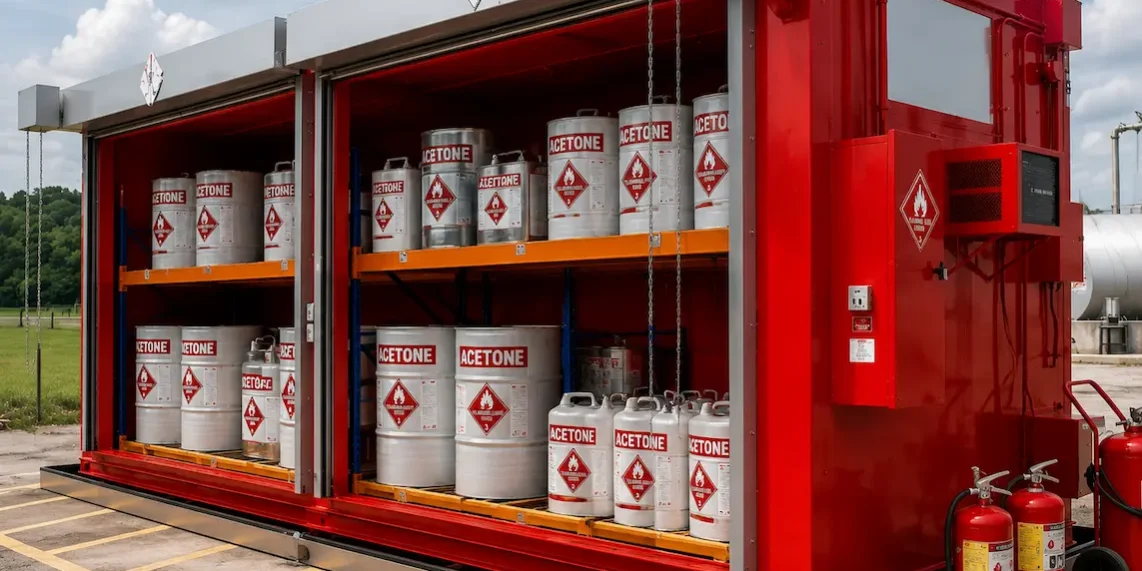
Plenty of facilities store acetone under a general “flammable” label without knowing exactly what that means in regulatory terms. The answer matters more than the label. Acetone NFPA classification under NFPA 30 is Class IB, the flammable liquid category with a flash point below 73 degrees Fahrenheit and a boiling point at or above 100 degrees Fahrenheit.
Acetone hits both marks: flash point of negative 4 degrees Fahrenheit, boiling point of 133 degrees Fahrenheit. That puts it in the same regulatory tier as methanol and ethanol, with storage requirements that are far more demanding than most facilities expect until a fire marshal walks in with a code reference.
The flash point of negative 4 degrees Fahrenheit means acetone produces ignitable vapors at every temperature a normal storage space will ever reach. Its lower explosive limit is 2.5 percent and the upper is 12.8 percent. Any ignition source, open flame, electrical arc, static discharge, a non-rated light switch, that contacts an acetone-air mixture in that concentration range produces a flash fire or explosion.
Understanding the acetone NFPA classification is not an academic exercise. It is the starting point for every storage decision that follows: how much you can store, in what type of enclosure, with what electrical equipment, and with what ventilation.
At US Hazmat Rentals, we field the same call from EHS managers and plant managers across manufacturing, automotive, laboratory, and cleaning operations, usually after they have realized that their current acetone storage arrangement does not match what their local AHJ or insurance carrier expects to see.
What NFPA 30 Actually Requires for Acetone Storage
The acetone NFPA 30 classification as Class IB immediately determines several things. Outside of any approved storage cabinet or building, OSHA caps flammable liquid storage in a room at 25 gallons. That limit gets crossed in a single day of normal operations at most facilities using acetone for cleaning, degreasing, or formulation.
An approved safety cabinet extends the threshold to 60 gallons of Class I liquids per unit, with a maximum of three cabinets per fire area under NFPA 30. Beyond that, you need a storage building.
A purpose-built flammable storage building opens up the quantity limits substantially, with the ceiling set by NFPA 30 Table 9.4 based on the building’s fire rating, its construction type, and whether suppression is installed.
For facilities storing acetone in drums, totes, or bulk containers, those larger numbers are usually where the operation actually lives. Six 55-gallon drums of acetone is 330 gallons, five times the safety cabinet maximum. That configuration needs a fire-rated building, not a cabinet.
The mixed-product calculation complicates things further. If acetone shares a storage building with methyl ethyl ketone, toluene, isopropyl alcohol, or any other Class I flammable liquid, the aggregate quantity of all Class I products counts against the applicable NFPA 30 limit.
An acetone NFPA 30 analysis that reviews only the acetone quantity while ignoring the rest of the flammable liquid inventory produces a number that is almost always too low and leaves a compliance gap that is invisible until an inspector does the math.
Electrical Classification and Why It Follows from the Acetone NFPA Rating
This is the part that surprises most teams the first time they go through it. Acetone NFPA storage requirements do not stop at the container or the building. They extend to the electrical equipment inside and around the storage space. NFPA 70, the National Electrical Code, classifies areas where flammable vapors may be present as Class I hazardous locations.
The subdivision, Division 1 or Division 2, depends on whether flammable concentrations are expected under normal operating conditions or only under abnormal ones. Ventilation design determines which division applies.
Class I, Division 1 requires fully explosion-proof electrical equipment throughout the hazardous location zone. Class I, Division 2 permits a somewhat less restrictive set of rated equipment. A storage room with adequate mechanical ventilation, one that sweeps acetone vapors from the floor where they collect, out of the space before concentrations build, may qualify as Division 2 rather than Division 1. A storage room without adequate ventilation defaults to Division 1 regardless of how the space is otherwise set up.
The cost difference between Division 1 and Division 2 equipment is real and measurable. Light fixtures, exhaust fans, electrical panels, outlets, and every other electrical device within the hazardous location boundary must carry the appropriate Class I rating.
An acetone NFPA-compliant storage space with the wrong light fixtures is a fire code violation even if every other element of the storage arrangement is correct. The electrical specification and the ventilation design have to be developed together, not sequentially.
NFPA 30 Ventilation Requirements for Acetone Storage Areas
Acetone vapor is denser than air. In a still or poorly ventilated room, it settles at floor level and migrates horizontally, often reaching ignition sources that are nowhere near the storage area itself. NFPA 30 requires mechanical ventilation for indoor flammable liquid storage, designed to pull vapors from floor level and exhaust them out of the building.
Cross-ventilation matters here. An exhaust fan mounted high on the wall moves ceiling air without addressing the vapor layer at floor level where acetone accumulates. Low-level exhaust intake positioned to draw across the floor in the direction of the makeup air supply is what the acetone NFPA ventilation requirement is calling for in practice.
Makeup air has to be part of the design. Exhaust without supply creates negative pressure in the storage space, pulling air and vapors through unintended pathways: door gaps, electrical penetrations, wall seams. A properly designed system provides both the exhaust capacity and a supply air inlet positioned to maximize sweep path across the storage floor.
NFPA 704 and the Hazard Diamond for Acetone
Acetone NFPA 704 rating: Health 1, Flammability 3, Instability 0, no special designation. That flammability 3 reflects exactly what the flash point data shows. A rating of 3 on the NFPA 704 scale means the material can ignite under most ambient temperature conditions, which acetone can, at negative 4 degrees Fahrenheit. Emergency responders use the diamond to assess a storage area before they enter it.
Facilities storing acetone above threshold quantities are typically required to post NFPA 704 placards on the storage building and, in many jurisdictions, report chemical inventory to the local fire department for pre-incident planning. Those notification requirements are separate from the NFPA 30 storage requirements but are triggered by the same quantity thresholds. The acetone NFPA 704 diamond is how you communicate to everyone outside the building that there is a serious flammability hazard inside.
The NFPA 704 standard, which in Spanish-language searches often surfaces as que es NFPA 704, is available for purchase through NFPA.org. Facilities should obtain the edition their local AHJ has adopted, either the 2021 or the 2017 version, rather than relying on third-party sources. The adopted edition determines exactly which placard specification and which threshold quantities apply to your site.
What a Compliant Acetone Storage Building Looks Like
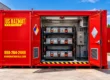
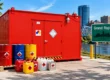
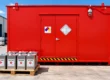
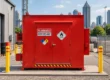
A fire-rated storage building for acetone NFPA 30 applications has fire-rated wall and roof construction, typically a two-hour or four-hour rating depending on the quantity stored and the occupancy classification of the surrounding facility. The ventilation system uses explosion-proof fans and motors rated for Class I hazardous locations.
Secondary containment beneath the floor captures any spill or leak before it reaches the ground. Electrical equipment inside carries the Class I, Division 1 or Division 2 rating appropriate for the ventilation design.
Doors must be self-closing and fire-rated. Ramps for drum or tote access must avoid creating low-point depressions where acetone vapor can pool. Electrical panels and disconnects should be located outside the building or on the exterior wall where possible, so the building can be de-energized during an incident without requiring entry. These are code-driven design elements that an AHJ permit reviewer will check before approving the installation.
For the full framework of NFPA 30 requirements across all flammable liquid product types, our NFPA 30 compliance resource covers classification, quantity limits, and construction requirements in practical terms. For acetone NFPA 30 storage specifically, the right starting point is your actual inventory quantity, your facility occupancy type, and the code edition your local AHJ enforces.
The Cost and Lead Time Question for Acetone Storage
Acetone NFPA-compliant storage buildings are available for both purchase and rental. Rental is the right call for projects with a defined end date, for facilities scaling acetone use without long-term certainty about volumes, or for operations that need compliant storage within a timeline a permanent construction project cannot meet.
A pre-engineered rental unit arrives with fire rating documentation, ventilation specifications, and electrical classification documentation already prepared for AHJ review, compressing the permit timeline compared to a custom installation developing its own package from scratch.
US Hazmat Rentals has fire-rated units in live inventory for acetone NFPA 30 applications. Book a call with our engineering team, share your quantity, site conditions, and timeline, and we will confirm the right configuration and current availability before your next order cycle closes.
Getting the Acetone NFPA Picture Right Before the Inspection
The acetone NFPA framework is a chain, not a checklist. NFPA 30 classification determines quantity limits and construction requirements. The quantity and ventilation design determine the NFPA 70 electrical hazardous location classification.
The electrical classification determines the equipment specification. The NFPA 704 rating determines placarding and emergency notification. Each step follows from the one before it, and a gap at any point shows up during an inspection or after an incident.
US Hazmat Rentals supplies fire-rated flammable storage buildings engineered to NFPA 30 Class IB requirements, with ventilation, secondary containment, and hazardous location-rated electrical infrastructure. Units are ready now. Talk to our engineering team before your next compliance deadline. Request your consultation here.
FAQ
What is acetone’s NFPA 30 classification?
Acetone is a Class IB flammable liquid under NFPA 30. Its flash point of negative 4 degrees Fahrenheit is well below the 73-degree threshold that defines Class I liquids, and its boiling point of 133 degrees Fahrenheit confirms the IB subcategory. Class IB carries the most demanding storage requirements in the NFPA 30 flammable liquid framework.
What does the NFPA 704 hazard diamond show for acetone?
Acetone’s NFPA 704 rating is Health 1, Flammability 3, Instability 0. The flammability rating of 3 reflects that the material can ignite under most ambient temperature conditions. This diamond must be posted on storage buildings, and the same inventory thresholds that trigger NFPA 30 storage building requirements typically trigger NFPA 704 placard and fire department notification obligations as well.
How much acetone can be stored in a production room without a dedicated building?
OSHA sets a 25-gallon limit on flammable liquid storage in a room outside of an approved storage cabinet. An approved safety cabinet extends capacity to 60 gallons of Class I liquids per unit, with a maximum of three cabinets per fire area under NFPA 30. Above those quantities, a compliant storage building is required.
What electrical rating is required in an acetone storage area?
Acetone NFPA 70 requirements classify the storage area as a Class I hazardous location. Division 1 or Division 2 designation depends on the ventilation design. All light fixtures, exhaust fans, electrical panels, and other devices within the hazardous location boundary must carry the applicable Class I rating. Non-rated equipment in those areas is a fire code violation.
Why does acetone vapor accumulate at floor level, and how does that affect ventilation design?
Acetone vapor is denser than air and settles toward the floor in still or inadequately ventilated spaces. NFPA 30 ventilation requirements address this by calling for low-level exhaust intake that sweeps vapors across the floor and out of the building. High-mounted exhaust fans move ceiling air without addressing the vapor layer where it accumulates and where the ignition risk is highest.
Can acetone be stored in the same building as other flammable liquids?
Yes, but the aggregate quantity of all Class I flammable liquids in the space counts against NFPA 30 quantity limits. Acetone is also chemically incompatible with strong oxidizers, concentrated acids, and chlorinated solvents. Those incompatible materials must not share the same storage enclosure regardless of quantity.