
Every IBC tote operation in Dallas eventually faces the same question: where does the chemical go if the container fails? The answer is the secondary spill containment sump Dallas facilities are required to have under EPA and TCEQ standards, but a surprising number of sites size it wrong, build it from incompatible materials, or rely on a drain-to-sewer arrangement that turns a manageable spill into a regulatory incident.
The spill containment sump Dallas regulators come looking for after a release is not merely a basin in the floor: it is a documented, sized, and material-verified system that either satisfies the applicable frameworks or it does not.
Dallas sits at the intersection of a dense industrial manufacturing base and serious stormwater regulation. The Trinity River watershed runs through the metro, and both the City of Dallas and TCEQ maintain active enforcement programs around chemical releases to stormwater systems. A spill containment sump Dallas that serves only as a physical reservoir without documentation, inspection records, and an SPCC plan behind it is a structure that will not hold up during a post-release audit.
At US Hazmat Rentals, we supply IBC tote storage buildings for Dallas-area industrial, manufacturing, and logistics facilities that include integrated secondary containment sumps sized and specified for the actual chemical inventory on-site.
A spill containment sump Dallas teams can rely on for compliance was engineered alongside the storage building, not added as a retrofit. Read on for the regulatory requirements, the sizing rules, the material specifications, and the design features that determine whether a sump passes inspection or creates liability.
What a Spill Containment Sump Actually Does
A spill containment sump is a structurally integrated basin beneath or surrounding liquid chemical storage that captures spilled or leaked material before it can reach the ground, a floor drain, or a stormwater pathway. The sump is a closed system: it does not drain to a sewer or daylight without a controlled valve that is normally closed and manually opened only for inspected release.
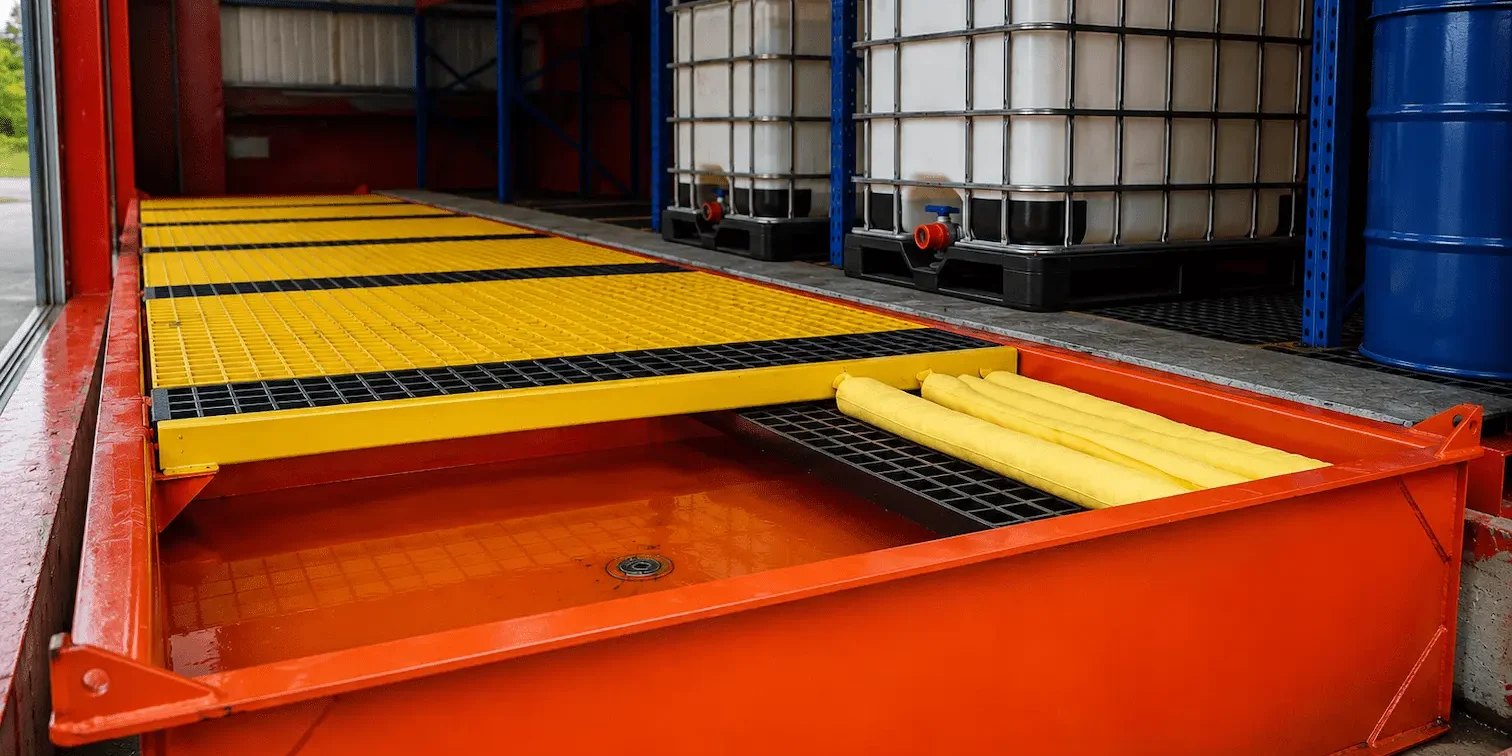
For IBC tote storage, the basin is built into the floor of the storage building, with the tote positioned above it so that any container failure, valve leak, or pump drip stays captured within the containment volume. The spill containment sump Dallas regulators will inspect has all of those features documented before the first tote is ever loaded.
The functional requirements for a spill containment sump Dallas comes from several overlapping frameworks. EPA 40 CFR Part 112 requires secondary containment for facilities above threshold storage quantities. NFPA 30 requires containment for flammable liquid storage areas.
Texas Administrative Code under TCEQ adds state-specific spill prevention and stormwater protection requirements. A sump designed to satisfy only one of those frameworks may fall short of another, and the local AHJ permit process may add a fourth layer.
For IBC tote storage, the sump floor must bear the dynamic load of forklift traffic without cracking. Grating or floor panels over the containment basin must be removable for inspection and cleaning. The drain control valve must be accessible from outside the containment area without requiring entry into the chemical zone. A spill containment sump Dallas inspectors will approve includes all of those operational details alongside the volume and material specifications.
The 110 Percent Rule and How It Scales for Multi-Tote Sites
The most cited sizing requirement comes from EPA SPCC guidance: the containment must hold 110 percent of the volume of the largest single container in the area. For a 330-gallon IBC tote, the minimum sump volume is 363 gallons. For a 275-gallon tote, it is 302.5 gallons. That rule is a floor, not a ceiling.
For multi-tote storage, EPA guidance also requires comparing the single-container calculation against 10 percent of the aggregate volume of all containers in the area. In a building with twenty 330-gallon totes, the aggregate is 6,600 gallons and 10 percent is 660 gallons, which exceeds the single-container minimum.
The larger number controls. Sump capacity should be calculated based on the maximum tote inventory the building will ever hold, not what is on the floor on the day the unit is delivered. A spill containment sump Dallas sites install that is undersized becomes a documented deficiency the moment any release overflows the basin.
Material Compatibility: What the Sump Is Made of Matters
A steel sump under a sulfuric acid IBC tote has a corrosion timeline, not a compliance record. Hydrochloric acid, sulfuric acid, sodium hydroxide, and other aggressive corrosives common in Dallas manufacturing and water treatment operations will attack uncoated carbon steel containment surfaces over time, creating secondary leak pathways through the basin floor or walls.
The spill containment sump Dallas corrosive chemical operations need is a chemically resistant structure whose material specification matches the stored product, verified against the actual chemicals in use rather than assumed from the visible construction of the unit.
Containment solutions for corrosive chemicals typically use polymer coatings, HDPE liners, or fiberglass-reinforced plastic for the basin. Epoxy coatings over steel can provide adequate resistance for moderate concentrations of some acids, but they have limited service life in continuous chemical exposure. A polymer or FRP basin that is inherently resistant to the stored chemical requires less maintenance and provides more reliable long-term protection.
The compatibility requirement applies to every liquid-contact component: grating, drain valve body and seals, structural supports, and any penetrations through the containment zone. Specifying the spill containment sump Dallas against the SDS for the most aggressive chemical in the inventory, rather than against a general materials catalog, is the correct starting point.
Containment Solutions for Corrosive Chemicals in Dallas
Dallas hosts significant concentrations of chemical manufacturing, water treatment, food processing, and industrial cleaning operations that store corrosive liquids in IBC tote format. Sodium hypochlorite solutions, hydrochloric acid, sodium hydroxide, sulfuric acid, and phosphoric acid are all high-volume products for which containment solutions for corrosive chemicals must address both volume requirements and material compatibility simultaneously.
A storage building holding hydrochloric acid at one position and caustic soda at another must have containment that resists both chemicals, since a tote failure places concentrated acid in contact with every surface of the sump. The spill containment sump Dallas serving that type of mixed inventory carries a more demanding specification than one built for a single-product tote operation.
A spill containment sump Dallas chemical operations manage under TCEQ scrutiny should be documented with a written specification identifying the sump material, the chemicals it is rated to contain, the volume calculation against the maximum tote inventory, and the drain control configuration.
TCEQ inspectors reviewing a site after a release will request that documentation immediately, and having it available shortens the inspection and limits the scope of any enforcement action that follows.
IBC Tote Storage and the Integrated Sump Design
The most defensible spill containment sump Dallas IBC tote operations can deploy is one engineered as part of the storage building. Pre-engineered tote storage buildings with integrated sumps address the forklift load requirement, include removable steel grating above the containment basin, and incorporate a drain control valve accessible from outside the storage area.
The sump volume, material specification, and drain control are part of the building’s engineering documentation, available as a package for TCEQ, EPA, or local fire department review.
A retrofit containment pit added to an existing storage area may have the correct volume and materials but lack the engineering documentation that regulators expect to see, which turns a physically compliant installation into a harder-to-defend one during an audit. Starting with an integrated system eliminates that gap from the first day the unit is on-site.
Our IBC tote storage buildings include integrated secondary containment sumps sized to the tote configuration, with fire-rated and non-fire-rated options, forklift-accessible roll-up doors, and optional climate control and ventilation matched to the chemical profile of the deployment. Dallas-area availability is current and delivery timelines are confirmed at the time of quote.
Drain Control and the Closed-System Requirement
A containment basin without a drain is not a compliant secondary containment system. A drain that connects directly to the sewer or stormwater system is equally non-compliant. The spill containment sump Dallas regulators expect uses a controlled drain: a valve that is normally closed and manually opened only after a qualified inspection of the collected material. The valve body and seals must be chemically compatible with the stored product, and each release event must be documented as part of the SPCC compliance record.
Accumulated liquid in the containment sump should be removed on a regular maintenance schedule. Material that collects in the sump is a regulated waste stream. If it triggers hazardous waste designation under RCRA, it must be managed and disposed of accordingly, with disposal documentation available for TCEQ review.
From Containment Pit to Modern Integrated Sump
The term containment pit refers to the older practice of excavating a below-grade basin for secondary containment, common in older industrial facilities and in military applications, including the 2000 military containment unit configurations used at defense logistics sites for bulk liquid field storage. Containment pits provided volume but were difficult to inspect, clean, and maintain, and created groundwater contamination risk when liners failed.
The spill containment sump Dallas industrial operations now standardize on has replaced that approach with above-grade polymer or FRP basins that provide equivalent volume without excavation, groundwater risk, or below-grade maintenance difficulty.
For a Dallas facility managing a temporary chemical inventory expansion, the portability of a pre-fabricated integrated sump changes the economics of the containment decision. The unit arrives, is placed without site modification, and can be removed and redeployed when the storage need ends. That distinction matters when the inspection schedule does not align with the permanent construction timeline.
Getting the Right Specification Before the Inspection Arrives
Sump volume depends on the tote inventory. Material depends on the chemical profile. Drain control depends on the discharge pathway and the disposal plan for collected material. All three have to be resolved before the unit is placed, not after the first inspection reveals a deficiency. A spill containment sump Dallas procured without those inputs confirmed is a compliance risk waiting to be documented.
US Hazmat Rentals works with Dallas-area facility managers, EHS officers, and procurement teams to match the right storage configuration to the actual compliance requirements of the site. Units are in live inventory and ready to deliver. Request a free quote and see pricing for your site, and our team will confirm availability and lead time for Dallas and the surrounding DFW area. Request your free quote here.
FAQ
What size spill containment sump does a Dallas facility need for IBC totes?
The minimum containment volume is 110 percent of the largest single container. For a 330-gallon tote, that is 363 gallons. Multi-tote sites must compare that against 10 percent of aggregate volume and use the larger number. Dallas facilities should also verify applicable TCEQ state-level requirements.
What materials are suitable for a spill containment sump under corrosive chemical totes?
Polymer-coated steel, HDPE liners, and fiberglass-reinforced plastic are standard containment solutions for corrosive chemicals. The material must match the specific chemical stored and its concentration. Bare carbon steel is not appropriate for acid or caustic applications.
Does a spill containment sump Dallas facility need a formal SPCC plan?
Yes, if the facility meets EPA 40 CFR Part 112 thresholds. TCEQ may also require spill prevention planning under state rules independently of the federal threshold. Facilities with significant IBC tote chemical inventories should verify applicable requirements before placing storage.
What is a containment pit and how does it differ from a modern integrated sump?
A containment pit is a below-grade excavated basin used in older industrial and military applications. Modern spill containment sump designs are above-grade, pre-engineered, and arrive with documentation supporting regulatory review, without excavation or groundwater contamination risk.
Can a rental IBC tote storage building include a compliant spill containment sump?
Yes. Pre-engineered rental buildings include integrated secondary containment sumps sized to the tote configuration, with engineering documentation that supports TCEQ, EPA, and local AHJ review at installation.
What drain configuration does a spill containment sump Dallas require?
A compliant sump uses a normally-closed, manually-operated drain valve compatible with the stored chemical. Each authorized release must be inspected and documented as part of the facility’s SPCC compliance record.