Reach for the wrong fire extinguisher for pool chemicals and you may turn a contained oxidizer reaction into something that fills the room with chlorine gas and shows no sign of stopping. That is not a hypothetical. It is what happens when facilities default to the ABC dry chemical unit on the wall because it is close and familiar, without knowing that monoammonium phosphate can accelerate decomposition in a calcium hypochlorite fire rather than suppress it.
The chemistry of pool chemicals is categorically different from a grease fire or a solvent spill. The fire response has to match it.
Most pools use three products in rotation: calcium hypochlorite in granular or tablet form, sodium hypochlorite as a liquid sanitizer, and trichlor as a slow-release tablet. All three are oxidizing compounds. None of them behave the way a flammable liquid behaves in a fire scenario.
Calcium hypochlorite, which is what most people mean when they say pool shock, is classified as a Class 3 oxidizer under NFPA 400. It produces its own oxygen as it decomposes.
It does not need a flame to start reacting. Contamination from moisture, organic debris, or acids can trigger self-heating that escalates to thermal decomposition and chlorine gas release without any spark involved.
At US Hazmat Rentals, we regularly consult with EHS managers and facility teams who discover their storage setup and their fire response plan were designed for general chemical storage rather than oxidizer-specific hazards. Getting the right fire extinguisher for pool chemicals in place is part of the answer.
What You Are Actually Dealing With Chemically
Calcium hypochlorite and sodium hypochlorite are both hypochlorite-based oxidizers, but their physical form creates meaningfully different hazard profiles. The dry granular form of calcium hypochlorite presents the higher reactivity risk. It is moisture-sensitive, meaning water contact at the wrong concentration can trigger rather than suppress the reaction.
Small amounts of water cause an exothermic dissolution event. Large amounts of water can be used to dilute and cool a fire situation, but the threshold between those two outcomes is not intuitive, and the wrong application can accelerate a smoldering situation.
Trichlor is a different animal. It is classified as a flammable solid, not as an oxidizer in the same sense as hypochlorite compounds. Trichlor fires release chlorine gas and can involve secondary ignition of surrounding materials.
The suppression approach for a trichlor fire is not identical to the approach for calcium hypochlorite, and many facilities store both products in the same enclosure without distinguishing between them for fire response purposes. That gap shows up at the worst possible time.
The SDS for each product on your site identifies the reactive incompatibilities, the decomposition temperature, and the specific hazards associated with fire exposure. Those documents are the foundation of every fire extinguisher for pool chemicals decision you make.
If the SDS for calcium hypochlorite says to avoid contamination with organic materials and certain metals, and your storage room has wooden shelving and uncoated steel fixtures, the storage infrastructure is already working against you before the extinguisher question even comes up.
Why CO2 and ABC Extinguishers Make Things Worse
CO2 extinguishers work by displacing oxygen and cooling the combustion zone. That mechanism has zero effect on an oxidizer fire because the oxidizer is generating its own oxygen internally. Pointing a CO2 extinguisher at burning calcium hypochlorite will not stop the reaction.
ABC dry chemical extinguishers introduce a different risk. Monoammonium phosphate, the active agent in ABC units, is an organic phosphate compound. In contact with strong oxidizers, it can become a reactive partner rather than a suppression agent.
The interaction is not always violent, but it is enough that NFPA guidance and most SDS documentation for pool shock explicitly identifies dry chemical agents as inappropriate for oxidizer fires. Using an ABC dry chemical extinguisher as a fire extinguisher for pool chemicals may provide no suppression benefit while introducing an additional chemical incompatibility into an already unstable situation.
Water is the correct suppression agent for calcium hypochlorite fires. Specifically, large volumes of water applied to cool and dilute the material, reducing the concentration until the self-sustaining reaction cannot continue. That is a fundamentally different suppression logic than putting out a solvent fire.
The portable fire extinguisher for pool chemicals that aligns with this approach is a water-based unit: a pressurized water extinguisher or water mist unit, sized and positioned for the first moments of a response while fixed suppression systems engage or fire department resources arrive. It is a bridging tool, not the final answer to a significant oxidizer fire.
What NFPA 10 Actually Requires
NFPA 10, the Standard for Portable Fire Extinguishers, establishes the framework for extinguisher selection, rating, placement, and maintenance across all hazard types. For conventional fire classes, it maps specific extinguisher types to specific hazards. For oxidizer fires, it does not prescribe a single universal unit the way it does for Class B liquids.
The practical result is that the right fire extinguisher for pool chemicals, as specified under NFPA 10 for an oxidizer storage environment, is a pressurized water or water mist unit. The rating size should be sufficient to allow initial response for the specific room volume and chemical quantity stored.
NFPA 10 also sets maximum travel distances: 75 feet for Class A hazard areas, with other hazard classifications having their own distance requirements based on hazard level and extinguisher rating. For pool chemical storage areas, the extinguisher needs to be reachable from outside the storage enclosure so that a person responding to a developing incident does not have to enter the hazard zone to reach it.
That placement logic matters more than most facilities realize. An extinguisher mounted inside a pool chemical storage room that is already producing chlorine gas vapor or undergoing visible decomposition is not accessible to the person who needs it.
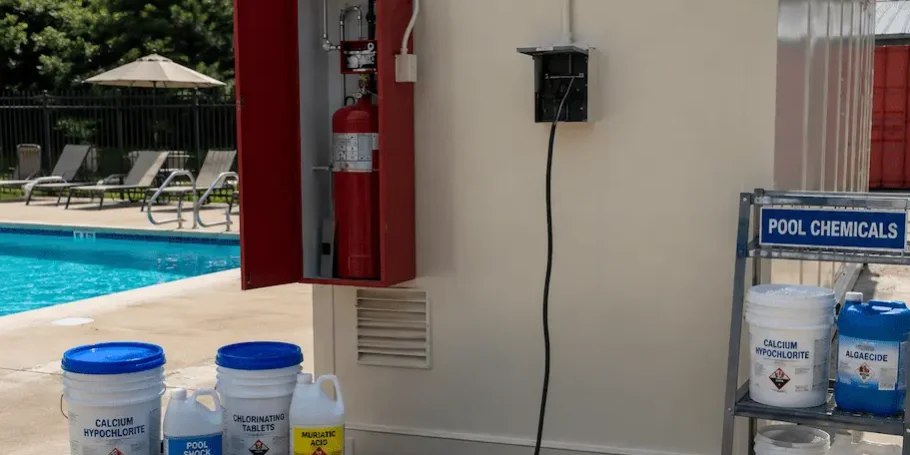
The fire extinguisher for pool chemicals at each required position should be mounted on an exterior wall bracket or inside an accessible fire locker adjacent to, but not inside, the chemical storage enclosure.
Maintenance in a Corrosive Environment
Standard NFPA 10 inspection schedules call for monthly visual checks and annual maintenance by a certified technician. In oxidizer storage environments, those intervals deserve more attention than they typically receive.
Chlorine vapors, even at concentrations below the OSHA ceiling, attack pressure gauge seals, valve stems, and label adhesives over time. An extinguisher that passed its last annual inspection but has been sitting adjacent to a pool chemical storage area for eleven months may have degraded seals that compromise the pressure or agent delivery when the unit is pulled in an emergency.
The monthly visual for a fire extinguisher for pool chemicals in this environment should confirm that the gauge reads in the green range, the safety pin is intact, the hose shows no cracking or corrosion at the connection, and the label is legible.
Any sign of corrosion on the body, valve, or bracket mount should trigger an unscheduled maintenance inspection rather than a wait until the next annual review. Pool chemical storage areas are not kind to fire response equipment, and the inspection frequency should reflect the actual exposure conditions.
Sites That Also Store Explosives
Facilities that need to store HD 1.1D ammunition and explosives alongside pool chemical oxidizers are managing a hazard combination that requires a fundamentally different level of pre-incident planning than either material alone. HD 1.1 is Hazard Division 1.1 under ATF and DoD explosive classification, covering mass-detonating materials.
The 1.1D designation adds a secondary fragmentation hazard. Calcium hypochlorite stored in proximity to any Class 1 explosive material creates an oxidizer-plus-explosive scenario where a pool chemical fire incident can escalate in ways that no portable extinguisher is designed to contain.
For those sites, the fire extinguisher for pool chemicals is one small element of a much larger planning requirement that includes ATF 27 CFR Part 555.208-compliant magazine placement, quantity-distance calculations that account for the combined inventory, fire department pre-incident planning, and a site layout reviewed by both the ATF and the local AHJ before any material arrives on-site.
The portable extinguisher selection still matters, but it is a minor variable compared to the separation distances, the magazine construction standards, and the emergency response protocols that govern the combined hazard profile.
Our explosive storage rentals include Type 2 and Type 4 ATF-compliant magazines built to meet ATF 27 CFR Part 555.208 and DoD 5100 standards, with immediate delivery available. For sites where chemical storage and explosive magazine placement need to coexist, that coordination belongs at the site layout stage, before either structure is placed.
Storage Infrastructure Comes First
The most effective fire extinguisher for pool chemicals on any site is the one that never needs to be pulled from the bracket. That outcome depends on the storage infrastructure: a purpose-built oxidizer storage enclosure with secondary containment, chemical-compatible ventilation, and physical separation from combustible materials and reactive incompatibles. A calcium hypochlorite fire is significantly harder to start in a properly designed storage building than in a shared chemical room with wooden shelving, uncoated metal surfaces, and no drainage management.
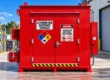
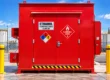
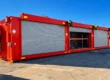
A dedicated fire locker for pool chemicals physically isolates the material from the rest of the site’s chemical inventory, provides containment for a liquid spill before it becomes a reactive mixing event, and supports the ventilation rates that keep chlorine vapor from accumulating to hazardous concentrations during normal storage operations.
None of that is replaced by an extinguisher. All of it reduces the probability and severity of the incident the extinguisher would otherwise be called on to address.
The extinguisher and the enclosure are two parts of the same compliance answer. Facilities that focus on extinguisher selection without addressing the storage infrastructure are investing in last-resort response while leaving the primary hazard conditions unchanged. Getting both right is the complete picture, and that picture is what an AHJ inspection and an insurance review will evaluate together.
Putting It All Together Before the Inspection Arrives
Every pool chemical storage site needs the right fire extinguisher for pool chemicals at the right position, maintained on the right schedule, in front of storage infrastructure that limits both the probability of an incident and the severity if one occurs.
Those elements are reviewed as a package during fire inspections. A properly specified extinguisher in front of a non-compliant storage arrangement is a documented partial solution that will surface during the inspection regardless of how good the extinguisher itself is.
US Hazmat Rentals has compliant storage units in live inventory for pool chemical, oxidizer, flammable liquid, and mixed-hazard deployments. Ventilation, secondary containment, and fire-rated construction are configurable to match the chemical profile of your site. See live inventory and request pricing now, and our team will respond the same day with availability and lead time. Request pricing here.
FAQ
What type of fire extinguisher for pool chemicals is recommended by NFPA 10?
Pressurized water and water mist extinguishers are the agents most consistent with NFPA 10 guidance for oxidizer environments including pool chemicals. CO2 and ABC dry chemical units are not appropriate because they either fail to interrupt the oxidizer reaction or may react with the chemical.
Why can’t you use a CO2 extinguisher on a calcium hypochlorite fire?
Calcium hypochlorite generates its own oxygen as it decomposes. Displacing ambient oxygen with CO2 does not affect that internal oxygen supply or stop the reaction. A CO2 unit on a pool chemical fire provides no suppression and may scatter the material. It is not a suitable fire extinguisher for pool chemicals under any operational guideline.
Where should a fire extinguisher for pool chemicals be placed?
Outside and adjacent to the storage enclosure, mounted where it can be reached without entering the chemical storage area during a developing incident. NFPA 10 sets a 75-foot maximum travel distance for Class A areas. Pool chemical storage areas may have more restrictive placement requirements depending on hazard level and extinguisher rating, and those should be confirmed with the AHJ during permit review.
What is a fire locker and how does it support pool chemical fire safety?
A fire locker is a fire-resistant storage enclosure for hazardous materials including pool chemical oxidizers. It provides physical separation, secondary containment, and ventilation that reduce incident probability and limit severity.
What happens if pool chemicals and HD 1.1D explosives are stored on the same site?
Sites that need to store HD 1.1D ammunition and explosives alongside pool chemical oxidizers require ATF-compliant magazine placement, quantity-distance calculations, and combined site layout review by the ATF and local AHJ before any material is placed.
Does trichlor require a different fire extinguisher than calcium hypochlorite?
Yes. Trichlor is classified as a flammable solid, not an oxidizer in the same classification as hypochlorites, and its fire behavior differs accordingly. The fire extinguisher for pool chemicals appropriate for a calcium hypochlorite environment may not match the suppression requirements for a trichlor fire.