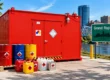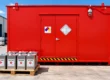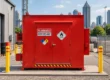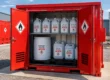
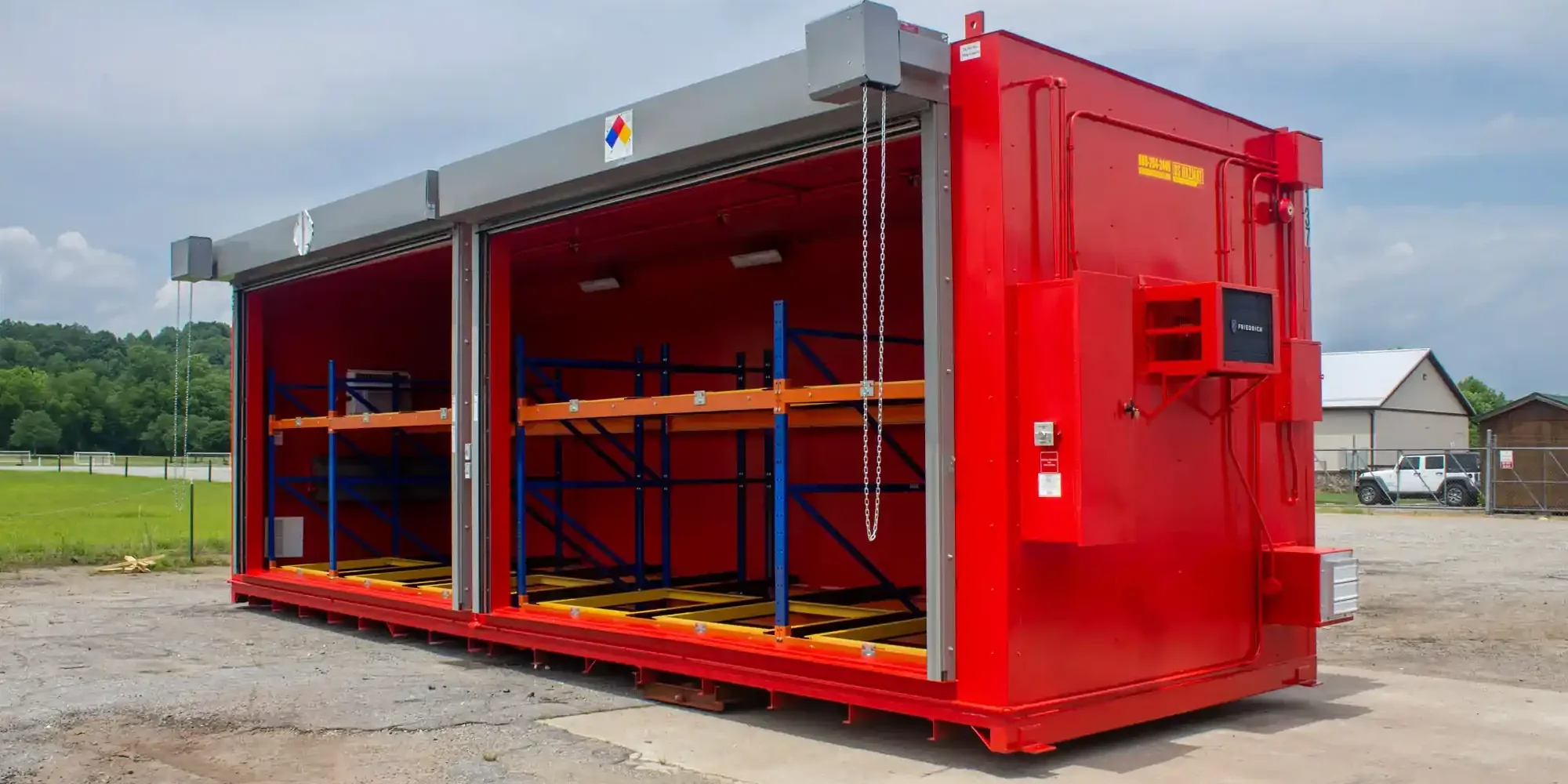
Chemically resistant ventilation systems are the category of equipment designed specifically for that environment, and the gap between a system specified for that purpose and a standard industrial exhaust setup is significant enough to determine whether a facility passes or fails an inspection. The problem is that most standard ventilation components are not built for prolonged chemical vapor exposure. Steel fan housings corrode. Aluminum impellers pit and weaken. Ductwork coatings fail.
When a storage building holds corrosive acids, reactive solvents, or oxidizing agents, the ventilation system is not a secondary accessory. It is the primary engineering control that determines whether the space is safe to work in, compliant with OSHA and NFPA requirements, and capable of managing the vapor load that accumulates during normal storage operations.
An exhaust fan that works perfectly in a general warehouse can degrade rapidly inside a chemical storage enclosure where hydrogen chloride, acetic acid vapors, or solvent off-gases are present at any concentration. Chemically resistant ventilation systems address that problem at the material and design level, not as an afterthought.
At US Hazmat Rentals, we work with EHS managers, facility managers, and operations teams who are setting up chemical storage infrastructure under real timelines. The units we supply include ventilation configurations matched to the chemical profile of what is actually being stored, not generic installations that leave the compliance burden with the customer.
What “Chemically Resistant” Means in a Ventilation Context
The term chemically resistant ventilation systems refers to exhaust and supply air equipment whose material composition can withstand prolonged exposure to chemical vapors without structural degradation, loss of function, or introduction of secondary hazards. The specific resistance required depends on the chemical environment. Polypropylene and fiberglass-reinforced plastic are common housing materials for corrosive applications.
Impellers may be PVC, polypropylene, or FRP depending on vapor concentration and temperature range. Ductwork in corrosive environments is typically PVC, CPVC, or lined with an appropriate polymer coating. Resistance is not a binary property. A material that resists hydrochloric acid vapors at ambient temperature may perform very differently under heat, under higher concentrations, or in the presence of a second chemical.
The chemical resistance chart for any given fan or duct material should be verified against the specific chemicals stored, their maximum expected vapor concentrations, and the temperature range of the storage environment. Relying on a general-purpose chemical resistance claim without that verification is a specification error that leads to premature equipment failure and unexpected maintenance costs.
The distinction between chemically resistant ventilation systems and standard industrial ventilation also applies to seals, motor housings, belt drives, and electrical components exposed to the storage environment. A fan with a polypropylene housing but a standard steel motor support bracket will show corrosion at the bracket even if the housing remains intact.
Full system material compatibility, not component-level resistance in isolation, is the engineering standard that a properly specified chemical storage ventilation system meets.
Which Chemicals Drive the Most Demanding Specs
Hydrochloric acid is the chemical that produces the most demanding ventilation specifications in chemical storage applications. HCl vapors are highly corrosive to most metals including carbon steel, galvanized steel, and aluminum. At concentrations that accumulate in an enclosed space with even a small liquid volume of concentrated HCl, standard steel fan components can show visible degradation within months.
The OSHA permissible exposure limit for hydrogen chloride is 5 ppm as a ceiling value. Ventilation in a space storing concentrated HCl must keep ambient concentrations below that ceiling under normal storage conditions, not just during spill events.
Solvents including acetone, methanol, isopropyl alcohol, and similar materials present a different dimension: flammability. In spaces where flammable solvent vapors may accumulate, all electrical components within the ventilated space must be rated for the hazardous location classification that applies under NFPA 70.
Fan motors not rated for the applicable Class and Division designation are an ignition source in an environment where ignition sources can cause a flash fire or explosion. Chemically resistant ventilation systems for flammable chemical storage require both corrosion-resistant materials and explosion-proof motor ratings, and those requirements must be addressed simultaneously.
Oxidizers including concentrated hydrogen peroxide, ammonium nitrate solutions, and sodium hypochlorite add a third axis. Oxidizer vapors in contact with organic materials in the ventilation system can accelerate degradation and in some cases create ignition conditions within the ductwork itself.
OSHA, NFPA, and the Code Requirements That Apply
OSHA 29 CFR 1910.94 addresses ventilation requirements for hazardous materials storage, establishing general principles for controlling air contaminants through engineering controls rather than reliance on personal protective equipment. NFPA 30, the Flammable and Combustible Liquids Code, specifies ventilation requirements for flammable liquid storage rooms, including minimum air changes per hour and requirements for continuous mechanical ventilation.
For corrosive chemical storage, OSHA’s General Duty Clause and the PEL tables in 29 CFR 1910.1000 establish the exposure limits that ventilation design must achieve. NFPA 45, the Standard on Fire Protection for Laboratories Using Chemicals, provides additional guidance on ventilation design for enclosed spaces with chemical storage, including the relationship between chemical inventory, vapor generation rate, and required air change rates.
Although NFPA 45 is primarily a laboratory standard, its ventilation design principles are widely applied to industrial chemical storage spaces by engineers and AHJs developing specifications where no single more specific standard applies. Ventilation for chemical storage buildings must also address makeup air. A system that exhausts air without supplying equivalent makeup creates negative pressure in the storage space, which can pull air and vapors through unintended pathways including electrical penetrations, door gaps, and structural seams.
Chemically resistant ventilation systems in compliant chemical storage buildings provide both exhaust capacity and a makeup air pathway, positioned to promote cross-ventilation rather than recirculation of the vapor load.
Materials, Fan Selection, and Air Change Rate Design
The minimum air change rate under NFPA 30 is one air change per minute for spaces where flammable vapors may accumulate, or one cubic foot per minute per square foot of floor area, whichever is greater. For corrosive chemical storage where the primary hazard is vapor toxicity rather than flammability, the air change rate is designed to maintain ambient concentrations below the applicable OSHA PEL for the most hazardous material stored.
Fan selection for chemically resistant ventilation systems starts with the airflow rate needed to achieve the design air change rate, then moves to static pressure calculations that account for duct length, fitting losses, and any filtering or scrubbing equipment in the system. Undersizing the fan for the actual static pressure of the duct system is a common design error that produces inadequate air movement even when the fan’s nominal airflow rating meets the air change requirement.
The motor enclosure rating for chemically resistant ventilation systems in flammable storage areas must meet NFPA 70 requirements for the applicable hazardous location classification. Class I, Division 1 locations require explosion-proof motors. Class I, Division 2 locations may allow ignition-protected or totally enclosed fan-cooled motors depending on the specific application.
Determining the correct classification requires a site-specific assessment of the vapors present, their concentration range, and whether that concentration is expected under normal operating conditions or only under abnormal conditions such as a spill.
PPE, HCl Exposure, and Why Ventilation Is the Primary Control
Personal protective equipment for hydrochloric acid, including acid-resistant gloves, face shields, and chemical-resistant aprons, is the second line of defense in a corrosive chemical storage environment. The first line is ventilation. OSHA’s hierarchy of controls explicitly prioritizes engineering controls above PPE for managing chemical exposure.
A storage space where workers must rely on full personal protective equipment for hydrochloric acid during routine access is a space where the ventilation system is not performing its design function. That distinction matters for compliance and for incident liability.
A facility that documents its ventilation design, demonstrates that ambient concentrations remain below the OSHA PEL under normal conditions, and maintains inspection records for the ventilation system is in a materially different compliance position than one that relies on PPE without underlying engineering controls. The former controls exposure at the source. The latter has only reduced the consequence of exposure, not addressed its cause.
For storage buildings housing both HCl and flammable solvents, the ventilation system must satisfy the corrosion resistance requirement for the acid environment and the explosion-proof electrical rating for the flammable environment simultaneously. Choosing equipment that addresses only one of those requirements is a specification gap that becomes a compliance gap during an OSHA inspection or an insurance loss review.
Companies That Build Chemical Treatment and Storage Infrastructure
Not all companies that build chemical treatment and storage infrastructure include ventilation as a specification variable. Some deliver standard building shells with generic exhaust fans installed as a check-box item, leaving chemical compatibility and code compliance assessment to the customer.
The distinction between a provider that specifies chemically resistant ventilation systems as part of the storage system and one that treats ventilation as an optional add-on is significant during an inspection, an insurance carrier review, or when a vapor event puts the adequacy of the engineering controls on record.
What to ask any provider in this space: whether the fan and duct materials have been selected for the specific chemicals being stored, whether the motor is rated for the applicable hazardous location classification, whether the air change rate has been calculated rather than assumed, and whether makeup air is provided.
Companies that build chemical treatment and storage infrastructure to a compliance-first standard can answer all four questions with documentation. Those that cannot are selling a building with ventilation installed, not chemically resistant ventilation systems built to specification.
Our chemical storage buildings are configured with ventilation systems specified to match the actual chemical inventory of the deployment. If your timeline is tight and a compliant unit needs to be on-site before a scheduled inspection or project mobilization date, get a same-day quote and we will confirm availability before the next order cycle closes.
The Case for Renting a Pre-Configured Unit
For operations that need compliant chemical storage with chemically resistant ventilation systems in place before a regulatory deadline, a rental unit from a provider that specifies ventilation as part of the system is faster to deploy than a custom-built installation. The ventilation components are already integrated, the air change rates have been validated, and the documentation package is available for AHJ review without a separate engineering engagement.
The urgency argument for rental is straightforward: a facility out of compliance during an inspection has a limited window to remediate before citations are issued. A pre-configured rental unit with proper chemically resistant ventilation systems can be on-site within days of an order confirmation. A permitted custom-built installation takes months.
For a construction project, a turnaround operation, or a facility managing a temporary chemical inventory expansion, that difference in deployment time is the deciding factor.
Units with availability now are allocated on a first-confirmed basis. If your storage need has a defined start date, confirming availability early protects your timeline. US Hazmat Rentals has units ready to ship with chemically resistant ventilation systems configured for corrosive, flammable, and mixed chemical inventories. Get a same-day quote here.
FAQ
What materials are used in chemically resistant ventilation systems for acid storage?
Polypropylene, fiberglass-reinforced plastic, PVC, and CPVC are the most common materials for fan housings, impellers, and ductwork in chemically resistant ventilation systems for corrosive acid environments. Material selection must be verified against the specific acid, its concentration, and the operating temperature range of the storage space.
What air change rate does OSHA or NFPA require for chemical storage ventilation?
NFPA 30 requires a minimum of one air change per minute or one CFM per square foot of floor area for flammable liquid storage spaces. For toxic corrosive storage, the design rate is calculated to maintain concentrations below the OSHA PEL for the most hazardous chemical stored. Both requirements may apply simultaneously in mixed-inventory storage buildings.
Do fan motors in flammable chemical storage need explosion-proof ratings?
Yes. In Class I, Division 1 locations where flammable vapor concentrations at ignitable levels are expected under normal operating conditions, fan motors must be explosion-proof rated. In Division 2 locations, ignition-protected or TEFC motors may be acceptable depending on the specific application and AHJ interpretation.
Why does ventilation reduce the need for personal protective equipment for hydrochloric acid?
Adequate chemically resistant ventilation systems maintain ambient HCl concentrations below the OSHA PEL, which means workers accessing the storage space under normal conditions are not exposed to harmful concentrations. Personal protective equipment for hydrochloric acid remains required as a secondary control, but the exposure risk is substantially lower when engineering controls are functioning as designed.
Can a rental chemical storage building include chemically resistant ventilation systems?
Yes. Pre-configured rental units from qualified providers include chemically resistant ventilation systems specified for the chemical inventory of the deployment. The ventilation components, motor ratings, and air change rates are part of the unit specification, not add-ons selected after delivery. This distinction is critical when evaluating rental providers.
What is the difference between standard industrial ventilation and chemically resistant ventilation?
Standard industrial ventilation uses steel, aluminum, and galvanized components that corrode rapidly in chemical vapor environments. Chemically resistant ventilation systems use polymer-based materials rated for the specific vapor exposure, explosion-proof motors where flammable vapors are present, and design air change rates calculated for the actual chemical inventory.