Facilities that handle corrosive acids, caustic solvents, or reactive chemicals in outdoor operations across San Antonio face a compliance requirement that often gets addressed last: the outdoor safety shower and eyewash San Antonio installation that OSHA’s General Industry standards make non-negotiable.
When any work area exposes employees’ eyes or body to injurious corrosive materials, OSHA 29 CFR 1910.151(c) requires that suitable facilities for quick drenching or flushing be within accessible reach. That standard applies indoors and outdoors, in climate-controlled labs and on open job sites in 105-degree July heat, and it requires more specific performance than most “we have an eyewash somewhere” arrangements actually deliver.
San Antonio’s climate creates complications for outdoor emergency response equipment that do not exist in every market. Summer ambient temperatures regularly exceed 100 degrees Fahrenheit from June through September. Water sitting in unshaded outdoor supply lines, self-contained tank units, or exposed plumbing can reach scalding temperatures under direct sun exposure. The ANSI Z358.1 standard for emergency eyewash and shower equipment specifies tepid water delivery in the range of 60 to 100 degrees Fahrenheit.
A unit delivering 130-degree water in a San Antonio summer is not a compliant outdoor safety shower and eyewash San Antonio installation. It is an additional injury risk for an employee already dealing with a chemical exposure.
At US Hazmat Rentals, we work with EHS managers, project managers, and facility teams across the San Antonio metro who are setting up outdoor chemical storage operations and need to address both the storage infrastructure and the emergency response equipment as a coordinated system.
What OSHA and ANSI Z358.1 Actually Require
OSHA 29 CFR 1910.151(c) is the federal mandate that triggers the outdoor safety shower and eyewash San Antonio requirement for most industrial and commercial chemical handling sites. The standard does not specify unit type, flow rate, or water temperature directly.
It establishes the general obligation to provide suitable quick-drenching or flushing facilities where corrosive materials are present. The specificity that most compliance plans rely on comes from ANSI Z358.1, the American National Standard for Emergency Eyewash and Shower Equipment, which OSHA references as the benchmark for what “suitable” means in practice.
ANSI Z358.1 sets the performance floor: eyewash units must deliver a minimum flow of 0.4 gallons per minute for 15 minutes. Emergency shower units must deliver at least 20 gallons per minute for 15 minutes. Combined units must meet both specifications simultaneously if both activation heads are used at the same time. These are not maximum ratings. A unit that runs out of water in seven minutes does not meet the standard, regardless of what the product label says.
The tepid water requirement in ANSI Z358.1, the 60 to 100 degree Fahrenheit delivery temperature, is the most frequently violated specification in outdoor installations and the one most consequential in San Antonio. Cold water causes hypothermia and muscle spasm that makes a victim pull away from the unit rather than staying in the flushing stream.
Hot water accelerates chemical absorption through the skin. Tepid water keeps the victim at the unit for the full 15 minutes of flushing that the standard requires. An outdoor safety shower and eyewash San Antonio setup that does not address water temperature is a unit that injured workers will not stay under.
Plumbed vs. Self-Contained: What Works Outdoors in San Antonio
Plumbed outdoor safety shower and eyewash San Antonio units connect to the facility’s potable water supply and provide an essentially unlimited flushing duration. They are appropriate when the site has a permanent water line available at the installation location. Plumbed units generally require a tempering valve to bring water to a tepid range before it reaches the activation heads, and in San Antonio’s climate, that valve has to control for both cold winter supply temperatures and the heat absorbed by supply piping during summer months.
Self-contained units carry their own water supply in a tank, typically 9 to 32 gallons depending on the unit design. They do not require a water line connection, which makes them practical for outdoor construction sites, remote chemical storage areas, and job sites without utility infrastructure.
The limitation is capacity: a 9-gallon self-contained eyewash unit provides approximately 22 minutes of eyewash flow at the ANSI minimum rate, which meets the 15-minute requirement. The tank water must be changed on a regular schedule and treated with a preservative to prevent bacterial growth, including Legionella, which is a documented risk in stagnant water systems.
In San Antonio’s summer conditions, a self-contained unit stored in direct sun without shading or insulation can reach water temperatures well above the ANSI tepid range before anyone ever pulls the activation handle. Units installed outdoors in this climate need either a shaded mounting location, an insulated enclosure, or a temperature management system to ensure the water that reaches the flushing heads is in the compliant range.
The 10-Second Travel Time Rule and Site Layout
ANSI Z358.1 requires that emergency eyewash and shower equipment be accessible within 10 seconds of the hazard location. At a normal walking pace, 10 seconds covers roughly 55 feet on a clear, unobstructed path. The standard specifies that the path must be free of obstacles and on the same level as the work area, meaning stairs, ramps, or doors that require operating a handle do not qualify as a direct access path for purposes of the standard.
For San Antonio outdoor chemical operations, the 10-second requirement means that an outdoor safety shower and eyewash San Antonio unit cannot be placed at a single central location and expected to serve an entire facility perimeter or a dispersed outdoor work area. Sites with multiple chemical handling locations need multiple units, or a single unit positioned specifically relative to the highest-probability exposure areas.
The path matters as much as the distance. A unit that is 40 feet away but requires walking around equipment, through a building, or past a locked gate does not meet the 10-second accessibility requirement. The access path should be marked, kept clear of equipment and material storage at all times, and reviewed whenever site layouts change.
Weekly Testing, Annual Inspection, and Maintenance
ANSI Z358.1 requires that plumbed outdoor safety shower and eyewash San Antonio equipment be activated weekly to verify function and to flush stagnant water from the supply line. Self-contained units require the tank water to be changed according to the manufacturer’s schedule, typically every three to six months, with the frequency adjusted based on ambient conditions and sun exposure. These are not optional steps. They are part of the compliance record that an OSHA inspector or an insurance carrier will review.
Annual inspection should confirm that the unit is delivering flow at or above the specified minimum rates, that water temperature is within the tepid range, that activation is hands-free and occurs in one second or less, and that the unit is properly identified with a sign visible from the access path.
For any outdoor safety shower and eyewash San Antonio installation exposed to South Texas weather, the annual inspection should also check for UV degradation of plastic components, corrosion at fittings, and changes to the surrounding site layout that affect the 10-second travel path.
Documentation of weekly activations, water changes, and annual inspections should be maintained as part of the site’s safety program. If an exposure incident occurs and investigation reveals that the nearby unit was not being tested or maintained, that documentation gap becomes a liability issue independent of the incident itself.
Siting Relative to Flammable Storage Cabinets and Outdoor Chemical Buildings
The placement of an outdoor safety shower and eyewash San Antonio unit relative to flammable storage cabinets and outdoor chemical storage buildings involves a compliance tension that site planners sometimes miss. OSHA 29 CFR 1910.157 establishes that portable fire extinguishers must be placed not less than 25 feet from flammable liquid storage areas.
Emergency eyewash and shower units must be as close to the chemical hazard as the 10-second travel requirement permits. For sites with outdoor chemical storage buildings housing corrosive or toxic materials alongside flammable liquids, those two proximity requirements can pull in opposite directions.
The resolution is not to compromise either requirement, but to review the site layout so that the emergency response unit is positioned within 10 seconds of the chemical exposure risk without being placed within the fire extinguisher exclusion zone around the flammable storage area. In most outdoor storage configurations, that balance is achievable with a thoughtful site plan.
Our flammable storage cabinet and outdoor chemical storage building configurations include site planning support to help EHS managers work through placement challenges before equipment is delivered.
Outdoor Chemical Storage Buildings and the Full Emergency Response Picture
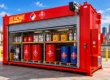
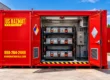
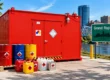
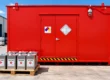
A site with outdoor chemical storage buildings that hold corrosives, oxidizers, or toxic liquids alongside flammable products needs a complete emergency response picture, not just an outdoor safety shower and eyewash San Antonio unit checked off a list.
That picture includes the safety shower and eyewash, appropriate personal protective equipment for the chemicals handled, a secondary containment plan for the storage buildings, chemical-specific first aid guidance posted near the storage location, and a communication plan for summoning medical help when a serious exposure occurs.
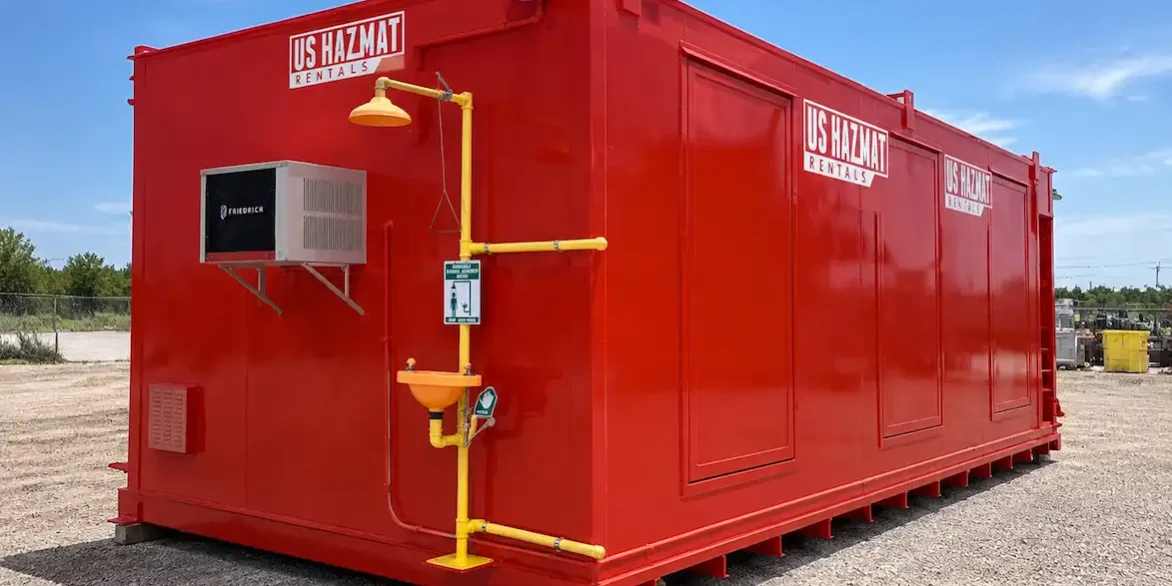
Flammable storage cabinets for sale and outdoor chemical storage buildings are the infrastructure side of the equation. The outdoor safety shower and eyewash San Antonio unit is the emergency response side. Both have to be specified for the same site, at the same time, with the same site plan.
A chemical storage building placed without considering where the nearby eyewash unit will go, or a safety shower installed without considering the flammable storage cabinet placement constraints, creates a compliance gap that surfaces during an OSHA inspection or after an exposure incident.
Getting the Complete Site Specification Right in San Antonio
Every outdoor chemical handling site in San Antonio needs an outdoor safety shower and eyewash San Antonio unit specified for the climate, sited for the 10-second travel requirement, plumbed or self-contained based on utility availability, and maintained on the schedule ANSI Z358.1 requires.
Every outdoor chemical storage building on that site needs fire-rated construction, secondary containment, and ventilation matched to the chemical profile of the inventory. Those two elements are part of the same compliance picture and have to be coordinated from the start.
US Hazmat Rentals serves the San Antonio metro with outdoor chemical storage buildings and flammable storage solutions configured for the Texas climate and the regulatory expectations of Texas sites. Get a same-day quote for your project and our team will confirm availability and lead time for San Antonio and the surrounding South Texas region. Request your quote here.
FAQ
What does OSHA require for outdoor safety shower and eyewash San Antonio installations?
OSHA 29 CFR 1910.151(c) requires suitable quick-drenching or flushing facilities wherever employees may be exposed to injurious corrosive materials. ANSI Z358.1 defines “suitable” as tepid water at 60 to 100 degrees Fahrenheit, minimum 15-minute flushing capacity, and accessibility within 10 seconds of the chemical hazard.
What is the tepid water requirement and why does it matter in San Antonio?
ANSI Z358.1 requires water temperature between 60 and 100 degrees Fahrenheit at the point of use. In San Antonio’s summer heat, water in outdoor supply lines, tanks, and unshaded units can reach temperatures well above that range. An outdoor safety shower and eyewash San Antonio unit delivering hot water in summer does not meet the standard and creates a risk of thermal injury on top of the chemical exposure.
Can a self-contained eyewash unit meet ANSI Z358.1 in an outdoor San Antonio environment?
Yes, if it is properly specified, located, and maintained. The unit must have enough tank capacity to deliver 15 minutes of flow at ANSI minimum rates. The tank water must be managed to stay within the tepid range, which in San Antonio typically requires shade, insulation, or a temperature control system. Weekly inspection and tank change schedules must be followed.
How close to a flammable storage cabinet can an outdoor eyewash unit be placed?
The eyewash unit must be within 10 seconds of travel from the chemical hazard. OSHA fire extinguisher placement requirements establish a minimum distance from flammable liquid storage areas. Those two requirements can be satisfied simultaneously with a site plan that positions the outdoor safety shower and eyewash San Antonio unit at the correct travel distance from the chemical use area without placing it within the fire extinguisher exclusion zone around the flammable storage cabinet.
What maintenance does an outdoor eyewash unit require under ANSI Z358.1?
Plumbed units require weekly activation to flush stagnant water and confirm function. Self-contained units require tank water changes on the manufacturer’s schedule with preservative treatment to control bacterial growth. Annual inspection should verify flow rates, water temperature, activation time, and site access path.
Do flammable storage cabinets for sale typically include eyewash station guidance?
Flammable storage cabinets and outdoor chemical storage buildings address the storage side of the chemical handling compliance picture. The outdoor safety shower and eyewash San Antonio requirement is an emergency response obligation that must be planned alongside the storage infrastructure, not after it.